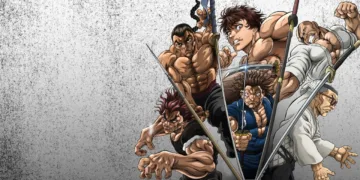
















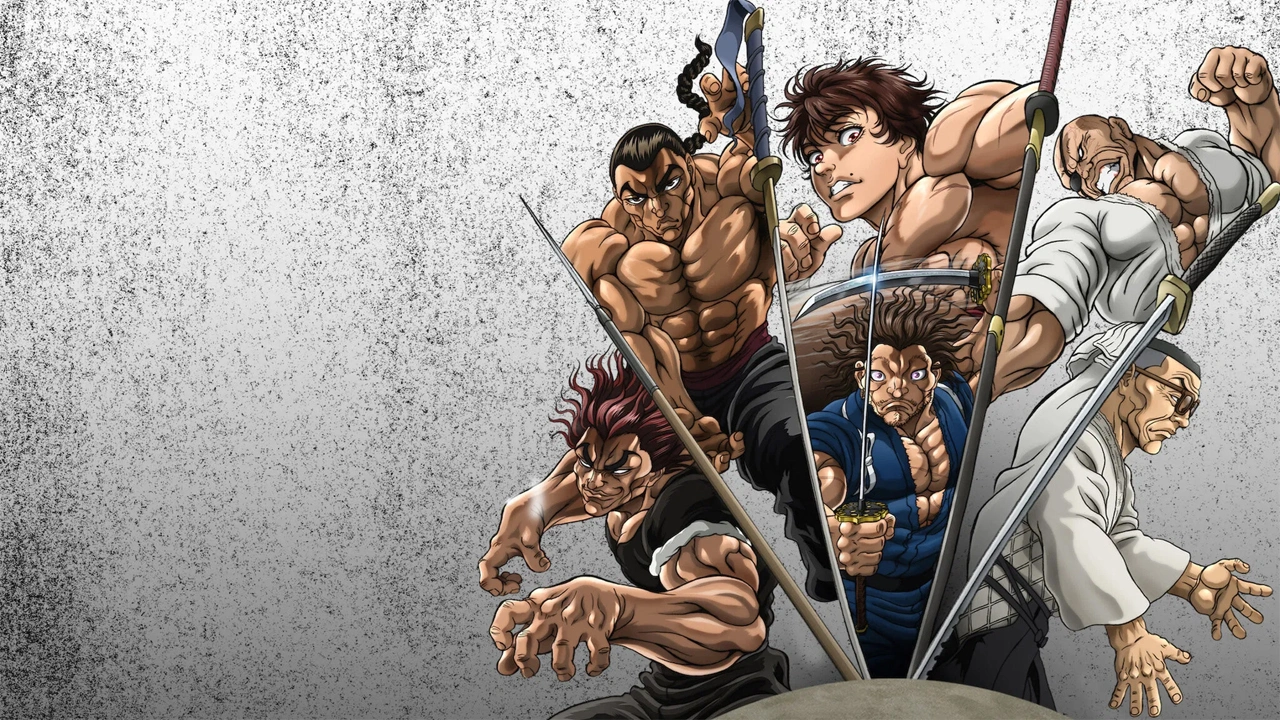

A Nobel Prize-winning scientist rushing to Japan because a prehistoric man has been spotted in the sewers is the kind of sentence streaming anime was built to say with a straight face. Baki-Dou: The Invincible Samurai Part 2 understands the absurdity of its own premise, then treats that absurdity like state business, complete with laboratories, press briefings, underground fight promoters, and men so muscular they look like national infrastructure.
The 12-episode back half of Netflix’s Musashi arc picks up after Part 1 introduced Baki Hanma’s boredom, Tokugawa’s Underground Arena, and the cloned resurrection of legendary swordsman Musashi Miyamoto. Part 2 shifts the revived samurai from spectacle to threat.
Musashi begins as a historical miracle, a dead man given flesh by modern science. By the time police bullets and electrical force fail to stop him, he has become a crisis that exposes how little this world understands the violence it resurrected for entertainment.
That is the season’s sharpest joke, and maybe its sharpest accusation. Everyone wants to study Musashi, test him, stage him, market him, or defeat him. Very few people ask what it means to drag a killer from one moral universe into another, then act surprised when he keeps killing.
The Arena Becomes a Civic Problem
Part 2’s early rhythm depends on pairing impossible bodies. Pickle, the preserved primitive man from the age of dinosaurs, is found in the sewers and pulled back toward the machinery of science. Musashi, cloned from legend, stands beside him as another specimen with a pulse. Dr. Albert Payne sees miracles. Tokugawa sees a card worth booking.
The brief lab encounter between Pickle and Musashi captures the season’s tone beautifully. Scientists panic about risk, ethics, and biological significance. The fight men hear the opening bell. The result is a no-rules Underground Arena match with weapons, a decision so irresponsible it feels almost bureaucratic in its confidence. Streaming television has trained itself to turn every extreme premise into franchise fuel; Baki-Dou turns that habit into a blood sport with better deltoids.
The escalation from arena spectacle to civic disaster gives the season its strongest shape. Musashi cuts through elite fighters, then turns toward the police, where the old romance of warrior honor curdles into public slaughter. The moonlit urge to kill is staged less as madness than as cultural displacement. He comes from a world where violence made reputation. The modern state sees murder. Musashi sees continuity.
Baki watches much of this from a distance, and that distance matters. He does not rush into the role of savior. He studies the problem. His eventual reading of Musashi as lonely gives the season a sudden emotional clarity. The samurai is terrifying, yes, yet he is also a man with no family, no era, no social language beyond cutting. The tragedy is not subtle. Subtlety has never been this franchise’s favorite muscle group.
Hanayama Lands Harder Than the Finale
The season’s best fight is Musashi versus Hanayama, partly because it gives both men something clear to represent. Hanayama’s body is endurance made flesh. Musashi’s blade is historical violence sharpened into instinct. Their clash works because the staging lets impact breathe. Hanayama’s stance, wounds, and refusal to retreat give the fight a heaviness that the more conceptual battles sometimes lack.
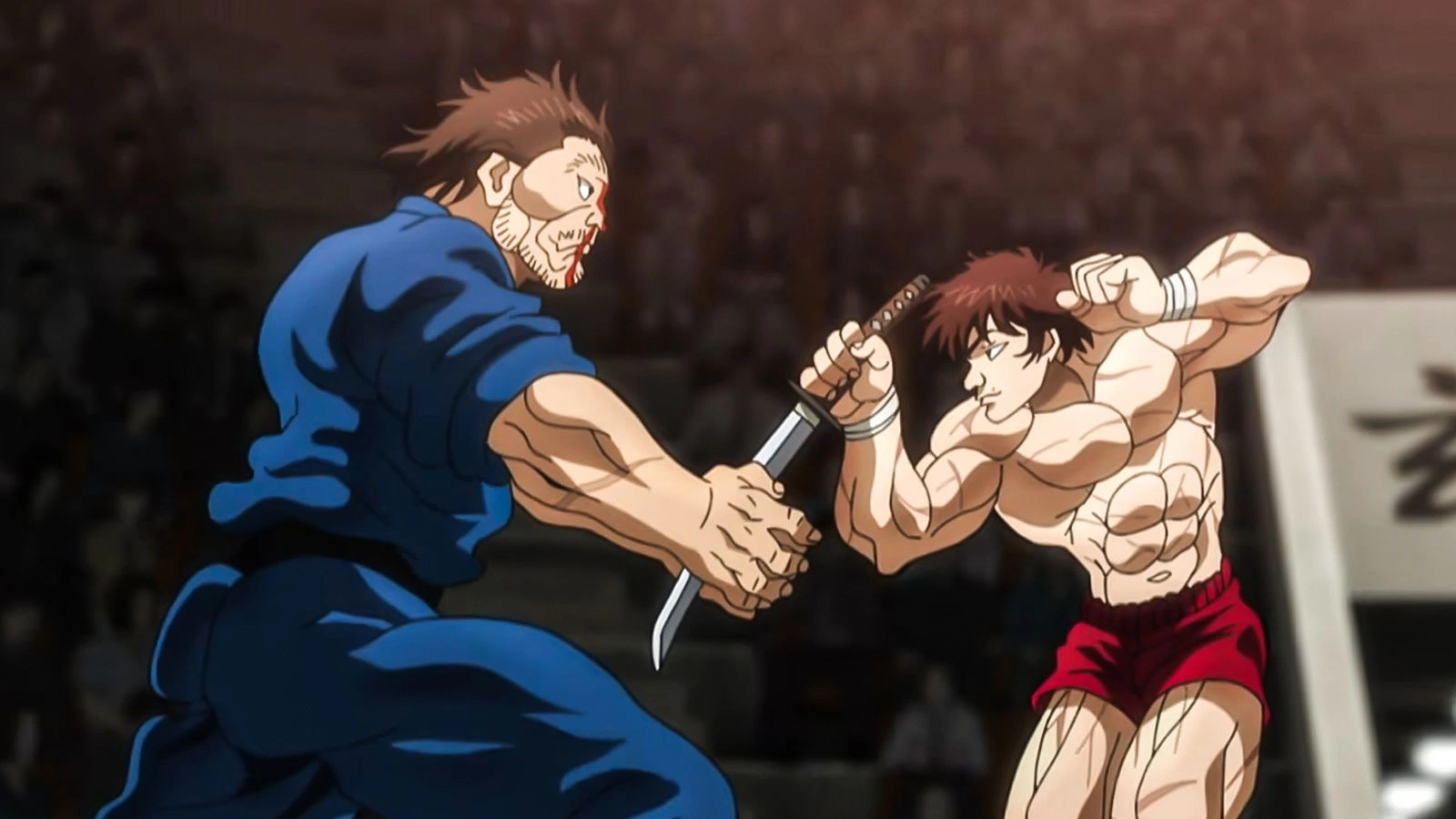
The police using Hanayama as their last resort also gives the sequence a grim social charge. He is treated as a solution because his body can absorb punishment that institutions cannot. That choice turns a beloved fighter into a civic tool, then leaves him bleeding in public while everyone waits to see if the spectacle will save them. The series may be ridiculous, but that image has teeth.
The final Baki versus Musashi confrontation is stranger and less satisfying. Baki returning Musashi’s sword, then tossing him a second blade, is a clever tactical beat. By filling both of Musashi’s hands, he creates a small opening through psychology rather than brute force. That is good Baki storytelling: ridiculous, physical, and weirdly cerebral.
The problem is the repeated use of Musashi’s “imaginary cutting.” At first, the idea fits the series’ fascination with martial aura and mental damage. After several rounds of narrated harm, the device begins to feel like a shortcut. The viewer is told bodies are being sliced by intent, yet the climax needs a cleaner physical grammar.
The soul extraction by Sabuko Tokugawa resolves the arc in a ritualistic way, and it fits the supernatural science that created Musashi. It also drains some force from Baki’s confrontation at the very moment the season has trained the audience to expect collision.
Bodies, Voices, and the Streaming Adaptation Machine
The animation is strongest when it commits to physical presence. Musashi’s posture, narrow gaze, and sudden shifts into bloodlust make him feel removed from ordinary time. Hanayama’s fight gets the clearest visual care, with heavier impact framing and enough stillness between attacks to sell the damage. The season looks better than the earlier batch in several stretches, especially when drawings hold their shape through extreme poses.
The last episodes expose the limits of the adaptation strategy. Panel-like compositions, static frames, and motion blur start to feel too visible, especially during the final fight. Manga fidelity can be a virtue, but direct panel imitation on screen risks turning animation into a guided slideshow. That matters because this arc is about bodies testing reality. When movement thins out, the bodies lose some authority.
The voice work helps restore that authority. Musashi’s performance carries the season’s descent from warrior curiosity into cold appetite, with each calm line sounding less like restraint and closer to permission. Dr. Payne’s exposition has a different function: he brings frantic scientific language into a room full of men who plainly intend to ignore every warning. His wrist getting snapped by Musashi is the season’s industry thesis in miniature. Expertise enters. Spectacle wins.
The cut manga tease involving Nomi-no-Sukune leaves the next step less certain, while Musashi’s preserved body keeps the door open in the most Baki way possible. Death, here, has paperwork.
The martial arts action anime series Baki-Dou: The Invincible Samurai Part 2 premiered all 12 of its episodes simultaneously on June 18, 2026. The story tracks the continuous chaos following the resurrection of the legendary sword saint Musashi Miyamoto via cloning technology as he squares off against underground arena fighters like Baki Hanma, Pickle, and Izo Motobe. The entirety of the explosive second part is available to watch worldwide exclusively on Netflix.
Full Credits
Title: Baki-Dou: The Invincible Samurai Part 2
Distributor: Netflix
Release date: June 18, 2026
Rating: TV-MA
Running time: 24 minutes per episode
Director: Toshiki Hirano
Writers: Tatsuhiko Urahata, Keisuke Itagaki
Producers and Executive Producers: Takayoshi Aso, Atsushi Chikaishi, Jinyu Zhang, Shinya Tsuruoka
Cast: Nobunaga Shimazaki, Akio Otsuka, Naoya Uchida, Shinpachi Tsuji, Masako Nozawa, Rikiya Koyama, Takuya Eguchi, Takayuki Sugo, Yoshihisa Kawahara
Editors: Yoshihiro Kasahara
Composer: Kenji Fujisawa
The Review
Baki-Dou: The Invincible Samurai Part 2
Baki-Dou: The Invincible Samurai Part 2 turns Musashi into the season’s best character and its sharpest indictment: a resurrected killer treated like premium content until the bodies pile up. Hanayama’s fight has the impact the finale only partly finds, while the soul-extraction ending feels fitting, strange, and a little too convenient. Still, the season’s commitment to absurd bodies, institutional foolishness, and old violence in a modern world gives it a savage charge.
PROS
- Musashi’s menace and loneliness
- Hanayama fight lands hard
- Stronger middle-episode pacing
- Sharp science-versus-spectacle tension
CONS
- Final fight feels rushed
- Imaginary cuts lose force
- Static-panel adaptation choices
- Soul ending softens impact