








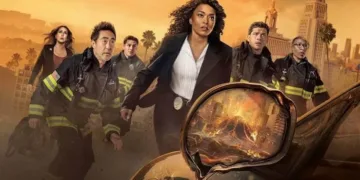











The twilight years of the Sui Dynasty provide a fertile ground for the kind of political instability that fuels great wuxia epics. In Blades of the Guardians, this historical backdrop of 581 to 618 AD serves as more than mere window dressing. It establishes a world where the law is a fading memory and power resides in the hands of whoever holds the sharpest steel.
At the center of this chaos is Dao Ma, a formidable swordsman who navigates the desert as the empire’s second most wanted fugitive. He is a bounty hunter by trade, yet his latest mission transcends simple coin. Tasked by the Mo clan leader to escort the rebel orator Zhi Shi Lang across the Taklamakan Desert, Dao Ma finds himself protecting the spark of a rising rebellion.
His traveling party includes Xiao Qi, a young orphan who acts as his constant shadow, and Ayuya, the fierce daughter of Chief Mo. Their trek toward the capital of Chang’an is a grueling race against time and tide. They are pursued by imperial forces and rival blades, making every mile a desperate struggle for survival.
Faces of the Frontier
Wu Jing carries the weight of the film with a visceral performance that anchors the narrative. He manages to balance a charming, megawatt smile with a lethal proficiency that reminds viewers why Dao Ma is so feared. His character is a master haunted by his previous life in the Left Valiant Cavalry, and Wu Jing conveys that internal burden through silence rather than long monologues.
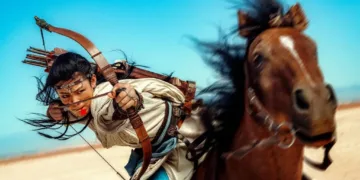
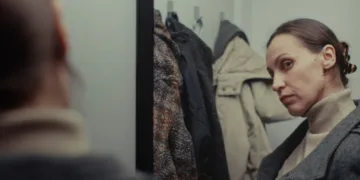
Chen Lijun provides a standout presence as Ayuya. She avoids the tropes of the damsel in distress, instead appearing as a highly capable warrior whose skills with a bow and horse are essential to the group’s survival. Her flight from a power hungry suitor adds a layer of personal stakes to the broader political mission. Nicholas Tse plays Di Ting with a stoic intensity that makes him a persistent shadow over the story.
As a mercenary leader with deep ties to the protagonist, his presence ensures that the threat feels intimate. Ju Qianlang provides the emotional grounding the story needs through the role of Xiao Qi. The presence of the orphan softens the cynical edges of the desert wanderers. The film also feels like a celebration of the genre through its use of wuxia royalty.
Jet Li appears as Governor Chang Guiren, lending his legendary status to the opening movements. Tony Leung Ka-fai brings a specific dramatic gravity to Chief Mo, ensuring the Western region segments feel substantial. Even the brief appearances of Kara Wai and Yu Rongguang reinforce the sense of scale, reminding us that this is a world populated by titans.
The Choreography of Conflict
Yuen Woo-ping has long been the gold standard for martial arts choreography, but his transition to the director’s chair here allows for a more unified vision. His experience with wire-fu is evident, yet the movement feels grittier and more grounded than his more ethereal past works. The variety of weaponry on display is staggering. Combatants reach for knives, spears, and flails, sometimes even turning common pots into deadly instruments.

The horse stunts are particularly impressive, featuring high risk sequences where riders leap between moving animals and stagecoaches with a regularity that is almost distressing to watch. One of the clear highlights is the three-way opening duel involving Wu Jing, Jet Li, and Max Zhang. It sets a high bar for everything that follows.
The climactic sword fight within a blinding sandstorm is another achievement, using the environment to heighten the tension. These sequences function as a form of character driven ballet. Each duel reveals the motivations and skill levels of those involved. The tone remains unapologetically visceral. The violence is often gruesome, which separates this film from the more sanitized fantasy entries often seen in modern Chinese cinema.
Adapting the Manhua Pulse
The film draws its energy from the popular manhua Biao Ren by Xu Xianzhe, and it successfully retains that run and fight momentum. The narrative is sprawling, populated by five different families and various factions that hunt the protagonists. While the sheer volume of names and titles flashing on screen can be daunting, it creates the feeling of a living, dangerous world.
The story explores the tension between cynical fatalism and romantic uplift. We see a world of for-profit sellouts, yet the selfless actions of cocky loners suggest that honor still has a place in the dirt. There is a subtle subtext regarding the passing of the torch as well. Seeing legendary actors share the frame with rising stars mirrors the shifting power dynamics within the story itself.
The emotional stakes undergo a significant shift in the final act. Following a surprise death, the violence stops being a simple display of skill and takes on a heavy, personal dimension. This transition ensures that the finale carries more weight than a standard action climax.
The Aesthetic of the Eastern Western
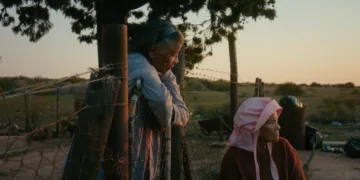
The Taklamakan Desert is far more than a setting. It is a primary character in its own right. Wide shots of the dunes and plains provide a stunning backdrop for the frequent bloodshed, emphasizing the isolation of the travelers. The film leans into an “Eastern Western” aesthetic, using lone wanderers and frontier outposts to blend traditional wuxia with cinematic tropes from the American West.
You can see the significant budget in the luxe feel of the production. The sets are expansive, and the stunts feel genuinely dangerous. The pacing manages a difficult balance between the ferocity of the action and moments of peaceful village life.
This rhythm allows the audience to catch their breath before the next escalation. Over its 126 minute runtime, the film maintains a constant sense of forward motion. It avoids the meandering nature of many historical epics, focusing instead on the kinetic energy of the journey. The result is a muscular piece of filmmaking that feels both timeless and fiercely modern.
Blades of the Guardians premiered worldwide on February 17, 2026, marking a significant cinematic event as it brought martial arts legend Jet Li out of a long hiatus. Directed by the visionary Yuen Woo-ping, the film is a live-action adaptation of the acclaimed manhua Biao Ren by Xu Xianzhe. Set against the harsh landscapes of the Taklamakan Desert during the Sui Dynasty, it follows the journey of a skilled bounty hunter protecting a high-stakes fugitive. Following its theatrical run, the film is expected to be available for streaming on major platforms like Well Go USA’s digital services and potentially Tencent Video internationally.
Where to Watch Blades of the Guardians (2026) Online
Full Credits
Title: Blades of the Guardians (Chinese: 镖人:风起大漠)
Distributor: Beijing Dengfeng International Culture Communications Company, Beijing Super Lion Culture Group, Well Go USA Entertainment (North America)
Release date: February 17, 2026
Running time: 126 minutes
Director: Yuen Woo-ping
Writers: Chao-bin Su, Larry Yang, Yu Baimei, Chan Tai-lee
Producers and Executive Producers: Wu Jing, Yu Baimei, Nigel Gostelow, Chantal Nong Vo, Lars P. Winther, Yuen Woo-ping
Cast: Wu Jing, Nicholas Tse, Chen Lijun, Yu Shi, Sun Yizhou, Cisha, Li Yunxiao, Jet Li, Tony Leung Ka-fai, Max Zhang, Kara Wai, Yu Rongguang
Director of Photography (Cinematographer): Tony Cheung Tung-Leung
Editors: Tatiana S. Riegel
Composer: William Wu, Ramin Djawadi
The Review
Blades of the Guardians
Blades of the Guardians is a muscular, high-octane revival of the wuxia genre that prioritizes visceral energy over narrative clarity. While the sprawling cast and convoluted political subplots occasionally threaten to stall the journey, Yuen Woo-ping’s masterful choreography and the charismatic lead performances keep the momentum firm. It is a gritty, soul-stirring spectacle that feels like a bridge between the legends of the past and the stars of the future. For those seeking the raw, kinetic thrill of a desert epic, this is a triumphant return to form.
PROS
- Yuen Woo-ping delivers some of the most creative and gritty choreography in recent years.
- The ensemble cast, featuring legends like Jet Li and Tony Leung Ka-fai, adds immense weight and prestige.
- The use of the Taklamakan Desert provides a stunning, cinematic backdrop for the "Eastern Western" aesthetic.
CONS
- The sheer number of factions and historical names can be difficult to track without prior knowledge.
- Certain transitions feel rushed, while some flashbacks disrupt the forward narrative flow.
- Some character dynamics, particularly between the leads and secondary villains, need more development.