


















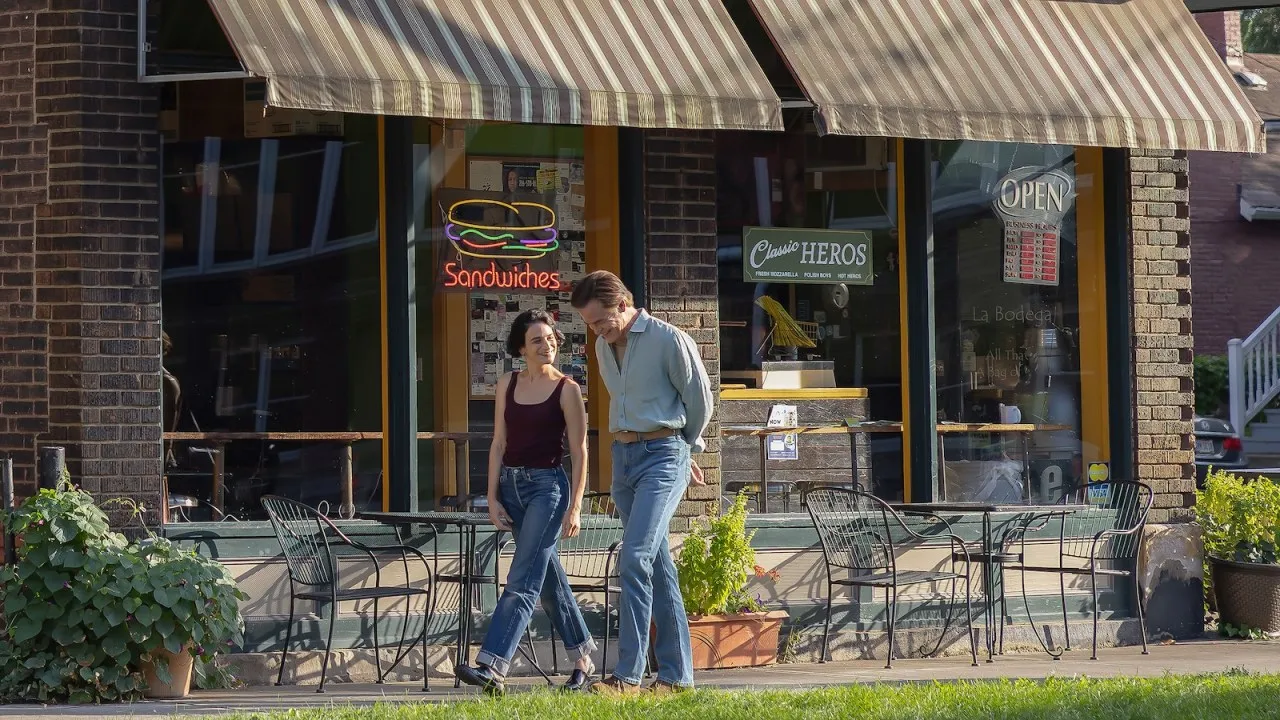

Chris Pine’s work here lands with the force of discovery. His Noah reads as a man trained to keep sorrow under control, sealed behind the habits of a professional life. The years sit on his face, and his body carries a careful, guarded softness that makes every pause feel earned. Jenny Slate’s Rebecca enters with a bright, cutting intelligence and an anxiety she cannot fully hide. Their history presses into every exchange.
They were high school sweethearts who broke apart after she left for a career in Washington D.C., while he stayed in Cleveland. The pull between them feels physical, immediate, and tense. Their pattern is familiar: they circle toward honesty, then collide with the fact that communication has always been the sticking point.
One of the film’s best scenes understands that emotional impact can come from how a moment is staged, not from how loudly it is played. In a kitchen sequence, the camera stays in the next room. We watch through a doorway as anger, regret, and old habits take turns at the wheel. The blocking turns the scene into a pressure chamber. They try to defend the choices that shaped their lives, and they struggle to face what those choices mean now. That distance makes the dialogue feel exposed, like we are overhearing something private. The scene plays like a lived-in argument with real time inside it, where each beat lands because the film lets it land.
Anchors and Anxiety
The film’s emotional weight frequently settles on Noah’s daughter, Maya. Abby Ryder Fortson plays her with a kind of reality that hits hard. In one scene, she breaks down at school, and Noah responds with a gentle touch that aims to steady her without turning her into a problem he needs to “fix.” Their bond has the feel of a fragile system under constant stress, and the story shows how quickly that system can be shaken by forces outside the home.
Sam Waterston plays Noah’s medical partner, close to retirement, and that approaching exit adds pressure to the local practice. The effect is practical and personal at once, tightening the financial situation and adding to the quiet load Noah already carries. He is grieving his father, too, and the film chooses restraint here. It never explains how his father died.
We see the residue of that loss in Noah’s guarded posture and in the way he manages himself around other people. These characters live behind emotional safeguards they have built over time. Noah’s protection of Maya shapes his instincts so strongly that a new relationship registers as instability entering the frame. In his mind, love comes with risk, with consequences he cannot control, and that belief colors every decision he makes.
Textures of the Quiet Life
Dustin Lane shoots in a 3:2 aspect ratio on 35mm film, and the image creates a close, pressed-in feeling. The frame feels boxy and intimate, like the story has fewer places to hide. Soft light moves across the scenes, keeping the world gentle even when the emotions turn sharp. That visual approach matches a story built on small shifts and internal reactions.
Rachel Lambert filmed in her own hometown, and the settings carry a lived texture that fits the film’s attention to daily details. The camera frequently turns away from the person speaking and sits on Noah’s face, forcing us to stay with his processing as it happens. It functions like a mechanic in a narrative game that keeps the player locked on the character’s internal state, making reaction the main action.
The framing also places people in corners of the image, building a quiet sense of displacement. Dabney Morris’ score leans on merry-go-round-like melodies, echoing how life and relationships can move in cycles. At points, the sound grows intentionally loud, matching the sensation of thoughts that crowd out everything else. These choices give grief and longing a physical presence, anchoring them in light, space, and noise.
The Art of Holding Back
The storytelling moves with a measured, elliptical rhythm. It keeps certain details out of reach, and that choice changes how each reveal lands. Moments of clarity carry weight because the film has made us wait for them, step by step, scene by scene. The script steers away from standard romance signposts, and it keeps the audience from settling into an easy expectation about where the relationship “should” go.
A standout sequence takes place at an airport. Noah brings Maya to a summer program, says goodbye, and then finds himself unable to move on. He falls apart in the terminal, and the scene captures loneliness as paralysis, not as a dramatic speech. Lambert also shifts perspective so we can see through Rebecca’s eyes, giving her interior life real space on screen.
The closing stretch plays in half-light, with a mood that stays tender and breakable. The film leaves pieces of the story unexplained, and that openness fits the way recovery often looks in real life: incomplete, uneven, still in motion. Hope remains present, and it arrives without a guarantee.
Carousel is a moving romantic drama that made its world premiere at the Sundance Film Festival on January 22, 2026. The film follows a divorced doctor in Cleveland whose life is turned upside down when his past love returns to town, forcing him to confront long-buried emotions and the complexities of his current relationship with his anxious teenage daughter. Currently, the film is moving through the festival circuit, including a screening at the Berlin Film Festival in February 2026, and is actively seeking a wide theatrical or streaming distributor for a global release.
Full Credits
Title: Carousel
Distributor: Latigo Films, Seeking wide distribution (Premiered via Sundance Film Festival)
Release date: January 22, 2026
Running time: 105 minutes
Director: Rachel Lambert
Writers: Rachel Lambert
Producers and Executive Producers: Alex Saks, Bobby Daly Jr., David Lipper, Chris Pine, Ian Gotler, Nat McCormick, Brandon Burrows, Melissa West, Mariela Villa, Ryan Winterstern
Cast: Chris Pine, Jenny Slate, Abby Ryder Fortson, Sam Waterston, Katey Sagal, Heléne Yorke, Jessica Harper, Jeffrey DeMunn
Director of Photography (Cinematographer): Dustin Lane
Editors: Ryan Kendrick
Composer: Dabney Morris
The Review
Carousel
Carousel is a quiet and resonant look at the friction between past regrets and the hope for a new beginning. Rachel Lambert avoids easy answers. She relies on the profound chemistry between Chris Pine and Jenny Slate to carry the narrative through its slower moments. While the elliptical storytelling may test some viewers, the emotional honesty of the performances makes the journey worthwhile. It is a mature drama that respects the complexity of starting over.
PROS
- Pine and Slate deliver some of their best, most vulnerable work.
- The 3:2 ratio and 35mm film create a beautiful, close-up atmosphere.
- The script captures the awkward, messy way adults actually communicate.
CONS
- The slow, measured tempo might feel sluggish to some.
- Some viewers may find the lack of backstory frustrating.
- The music occasionally feels too loud or heavy-handed.