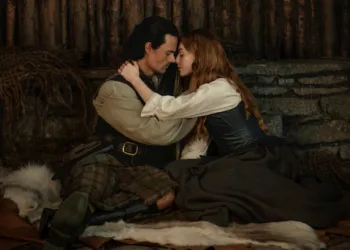




























For a nation that fought a revolution to escape hereditary power, America keeps returning to dynasties as if they are a civic hobby. The Kennedy family occupy an odd position in public imagination: treated with deference resembling royalty despite a lack of formal crowns. Love Story: John F. Kennedy Jr. & Carolyn Bessette, created by Connor Hines and adapted from a biography by Elizabeth Beller, arrives at a moment when family mythmaking and American celebrity culture feel especially obvious. The series tracks the courtship and married life of John F. Kennedy Jr. and Carolyn Bessette, played respectively by Paul Anthony Kelly and Sarah Pidgeon, from their first meeting in 1992 to the 1999 plane crash off Martha’s Vineyard, MA, US that ends their story.
The series opens on July 16, 1999 and then moves backward seven years to show how two people from different milieus tried to build a private life while the public insisted on ownership of their story. Naomi Watts appears as Jackie Onassis and Grace Gummer plays Caroline Kennedy. The series functions as a love story and as an anatomy of fame’s corrosive logic, set against 1990s New York where indoor smoking was still common and privacy had not been recast as an anachronism.
The Architecture of Inevitability
The opening scene explains the series’ argument. Carolyn sits in a Manhattan salon as photographers gather outside. She studies her freshly painted red nails and asks the technician to repaint them in a neutral tone. That small, deliberate erasure—carried out under pressure, documented by lenses, parsed by strangers—encapsulates the whole project. When she arrives at the airstrip to meet John and her sister Lauren, the sequence reads less like an end and more like an attempted withdrawal.
The show then shifts to 1992. This structural choice shapes the viewer’s posture. We observe two attractive people fall in love while the outcome is already known. Tragedy reads as fate; romance becomes dramatic irony. The form creates a modern equivalent to classical prolepsis. It places ordinary narrative tension next to our contemporary appetite for mediated spectacle.
The series resists instant gratification. John and Carolyn do not share looks until deep into the pilot and do not speak for a long stretch after that. That patience feels deliberate in an age when algorithms reward immediate hooks. Hines establishes two separate lines: John failing the bar exam and contending with inherited expectation; Carolyn working within the fashion world and moving with the private authority of someone who manages her image. Two tracks move toward the same collision.
The flashback pattern permits a focused inquiry into the paradox of celebrity marriage: how a private identity becomes unviable when a public persona produces too much value for the cultural machinery to relinquish. Carolyn shifts from an intense, autonomous presence into someone who hides in her loft with curtains drawn against the flashbulbs. John cannot grasp her contraction because he has never known life outside perpetual exposure. Their story becomes less about falling in love and more about discovering that affection cannot alter the terms by which the public claims ownership.
The series frames contemporary instances of this cycle in a way that evokes earlier examples in public life. Women enter quasi-royal spheres, hope for shelter, and then encounter constraints that hollow the person who entered. The show inspects marriage from a female perspective with surgical attention. Carolyn’s professional identity is absorbed into the Kennedy apparatus. Friends warn her explicitly that marriage will render her visible chiefly as someone’s spouse. That warning unfolds with grim predictability.
Bodies Doing the Work
Casting choices matter here. Kelly was selected shortly before production began because the role required a very particular physicality. The series demanded a presence that rearranges space when the character enters a room. Kelly delivers that presence. He often seems more composed and darker at the edges than memory of the real man, yet he inhabits the magnetism required for the narrative.
That physical charisma helps convey John’s central tragedy. He appears to move through life by rote, unable to tell performance from interior life. He voices that uncertainty in an argument with Carolyn when he says his experience feels unreliable and that he cannot parse what parts of his life are genuine. The consequence of being public property is a protagonist without interiority, a figure defined by other people’s narratives.
Pidgeon confronts a different task. Archival material offers limited access to Carolyn, who guarded her privacy. Pidgeon assembles the role through manner, through the habitual cigarette, through the small nervous gestures with her hair, through eyes that register collapse more effectively than any line of dialogue. Her early scenes glow with self-possession; she knows herself and navigates the fashion world with authority.
Then marriage intervenes. The change reads as constriction rather than growth. Pidgeon’s Carolyn becomes outwardly present but emotionally drained. Her self-knowledge persists; John’s self-understanding remains faint. That imbalance undermines their union. The chemistry between the actors sustains genuine obsession. Tender looks escalate to fights that paparazzi capture. The yearning in their scenes recalls longed-for passions usually rendered in period pieces where social barriers impeded expression. Here those obstacles are modern: media saturation and the monetization of privacy.
Supporting performances add context. Naomi Watts disappears into the role of Jackie Onassis through a precise physicality that anchors scenes where the aging matriarch attempts to steward the family narrative. Watts interprets Jackie’s vocal patterns without lapsing into caricature and leaves a strong imprint despite limited screen time. One sequence in which she dances to a tune associated with the Camelot mythology registers as both tragic and faintly camp.
Grace Gummer brings growing despair to her portrayal of Caroline Kennedy. She watches her brother court someone who seems not to belong and presses him to imagine boundaries he cannot conceive. The labor of containing a family’s legacy appears on her shoulders. She considers distancing herself from the family’s habitual openness with the press, yet inheritance offers no formal opt-out.
Alessandro Nivola portrays a fashion-industry figure who recognizes Carolyn’s talent and helps amplify it. Scenes located in that world show her competence and value beyond romantic attachment. Leaving that career becomes another form of loss.
New York as Character, Music as Memory
Cinematography by Jason McCormick and Pepe Avila del Pino renders 1990s Manhattan as something between archival record and feverish recollection. The city functions as a third presence in the relationship: witness, enabler, trap. Sequences around the city capture the glittering public surface of the couple’s image and the cramped reality beneath. Visual choices carry much of the argument. Carolyn’s sphere—fashion, creativity, chosen identity—contrasts with John’s sphere—dynastic privilege, inherited status, inescapability.

The editors use slow motion at key emotional junctures. Carolyn leaving a fashion house registers as both departure and elegy. The wedding sequence will move some viewers to tears and prompt others to recoil, depending on their relationship with the Camelot myth. These formal choices risk sentimentality yet often strike a more interesting register: the point where romantic fantasy consumes the people who live within it.
Costume design encountered early criticism. Initial photos prompted complaints about inaccuracies in Carolyn’s styling. The production brought in Rudy Mance to course-correct, sourcing period-accurate pieces that reflect both the era and the couple’s actual look. The series acknowledges Carolyn’s status as a style reference; her minimalist 1990s aesthetic continues to influence current trends. Wardrobe operates as character exposition. The nail polish change from red to a neutral tone becomes a concise statement about conformity and erasure.
Fashion functions as more than surface. Carolyn’s professional skill lies in her capacity to shape image. Watching her exchange that craft for the role of spouse registers as a concrete diminution, emphasized by costume choices that mark what she has relinquished.
The soundtrack trades in 1990s touchstones. Kate Bush’s “This Woman’s Work” accompanies the couple’s first fully charged meeting. The lyric about things left unsaid haunts those early scenes. The series also references Peter Gabriel, Sade, Mazzy Star, The Cranberries, Radiohead and Cocteau Twins. The use of Venus in Furs and other selections maps feeling onto a historical moment.
Composer Bryce Dessner supplies a recurring theme that functions as the lovers’ motif across episodes. Music signals emotional shifts, deepens verisimilitude, and anchors the viewer in a slightly different temporal logic. The soundtrack cultivates a specific kind of longing for a near past when smoking indoors still seemed ordinary and personal privacy had not been fully reframed by digital surveillance.
Atmosphere moves between unabashed romanticism and anxious scrutiny. The series attempts to stage a glamorous fairy tale while also exposing its bruising underside. Paparazzi strobes become recurring images of intrusion. The loft apartment transitions from refuge to constraint. A pile of period detail accumulates: indoor smoking, analog-era celebrity texture, pre-digital conditions that made private life feel more plausible.
The Machinery of Myth
Fame functions as the primary adversary. Constant media pressure erodes privacy, autonomy, and mental stability. The paparazzi appear vulturous and relentless. Carolyn’s arc tracks a shift from incandescent presence to concealment. Her contraction has force behind it.
John’s relation to fame manifests differently. He appears to take pride in managing the media, to find a kind of identity in its attention because it is the only framework he has known. That framework traces back into public memory—into formative images that attached spectacle to personal life. Carolyn fears the loss of control over her image. John simply has no precedent for losing control.
That incompatibility reads as the series’ sharpest observation. Two people can love each other and still prove disastrously mismatched. Context matters. The surrounding machinery matters.
The treatment of gender dynamics remains persistent. Marriage experienced from a woman’s vantage involves sacrifice and absorption. Carolyn’s disappearance into the Kennedy mechanism operates at systemic and personal scales. Friends deliver a simple warning—marriage will recast her identity into single terms—and that forecast plays out with depressing clarity. Professional personhood diminishes. Personal agency becomes negotiable.
The Kennedy family holds an odd mythic place in U.S. imagination. The public treats the family like royalty while insisting the nation has no royals. That manufactured intimacy yields a parasocial relation on a national scale. Jackie’s line about the public holding both a stone and a flower captures that double capacity to celebrate and to destroy.
As the show presents them, the couple become consumable figures: real people, fictionalized versions of themselves, avatars for collective fantasies about power, tragedy, and love. The burden of being an heir to a myth sits on John in ways that he cannot render into speech. The two attempt to define themselves outside inherited narratives but the culture refuses the separation because the myth carries enormous emotional and economic value.
The series maintains a careful distance rather than indulging easy catharsis. Many aspects stay intentionally unresolved. The program does not claim exhaustive knowledge of its subjects. That restraint registers as a kind of humility. Jackie’s remark that the public cannot imagine famous families except as extensions of themselves captures one side of the relationship. The reverse is true too: public appetite constructs much of what the Kennedys are in cultural memory.
The show holds an unresolved paradox: it interrogates the Kennedy mystique while simultaneously intensifying that fascination. Frames that critique public obsession still present the family as a spectacle. Scenes that analyze the toxic co-dependence between famous households and public consumption also participate in consuming them. The work implicates its audience.
What Works, What Wobbles, What Remains
Kelly and Pidgeon create chemistry that transcends surface magnetism. Their scenes generate a yearning that makes viewers anticipate the next exchange, the glance that recalls earlier attachment before the reasons for impossibility return. Early curiosity builds into ardor, ardor curdles into fights the press photographs, and reconciliations feel authentic yet fragile. That quality usually appears in dramas that hinge on social impediments; here it emerges from the impossibility of shielding private life.

The series negotiates documentary replication and imaginative reconstruction. Documented incidents appear recreated and staged, and the project performs best when it stages moments that existed beyond tabloid frames. An episode heavy on dialogue allows actors to excavate dimensions that newspapers could not. The show treats its material with care and with finely tuned writing. It avoids mere tabloid retelling and attempts to regard these people as complicated figures who, given different conditions, might have sustained one another.
Still, nine episodes can test patience. The length feels excessive to some viewers because the ending is foreknown. The relationship sometimes elongates into a long arc of similar exchanges. Repetition sets in when scenes revolve around the same dynamic across different settings. Whether the narrative sustains that scope depends on individual tolerance for recurring patterns and for immersion in the central romance.
An ethical question persists. Turning a recent public tragedy into serialized drama invites scrutiny. The addition of a further recent death in the family complicates the matter for some viewers and raises moral unease. Even a careful treatment cannot fully resolve the tension between critique and perpetuation. The series both examines and benefits from public fascination.
Emotional manipulation forms part of the structural device. Foreknowledge of the ending fosters a kind of tragic voyeurism. The pull to continue watching may stem from acting, visuals, music, or editing. It may also reveal a darker collective appetite: to observe attractive people consumed by misfortune and to feel confirmed that privilege does not immunize against ruin.
The wedding sequence functions as a test. Viewers will find themselves either overcome with nostalgia for the Camelot image or repulsed by its sentimentality. How one reacts says less about the show’s technical merit and more about personal relations to national myth and taste for sentiment. Both responses remain legitimate within the episode’s design.
What endures after most of the run is a portrait of two people who loved one another and could not protect each other because the surrounding apparatus proved too strong and too invested to allow an alternate outcome. The series concludes without tidy answers. It leaves open a question that lingers: did we ever truly know them? The follow-up question presses: did we have the right to know them in that way?
Love Story (originally titled American Love Story) is a biographical romance anthology series created by Connor Hines and executive produced by Ryan Murphy. The first season, titled John F. Kennedy Jr. & Carolyn Bessette, premiered on February 12, 2026. The series explores the intense, whirlwind courtship and marriage of JFK Jr. and Carolyn Bessette, tracking their lives from their initial meeting to their tragic deaths. It is currently available for streaming on FX and Hulu.
Where to Watch Love Story: John F. Kennedy Jr. and Carolyn Bessette










Full Credits
Title: Love Story
Distributor: FX, FX on Hulu
Release date: February 12, 2026
Rating: TV-MA
Running time: 43–58 minutes
Director: Jesse Peretz, Max Winkler, Crystle Roberson Dorsey
Writers: Connor Hines, Kim Rosenstock, D.V. DeVincentis
Producers and Executive Producers: Ryan Murphy, Nina Jacobson, Brad Simpson, Connor Hines, Eric Kovtun, Nissa Diederich, Scott Robertson, Monica Levinson, Kim Rosenstock, D.V. DeVincentis, Tanase Popa
Cast: Sarah Pidgeon, Paul Kelly, Naomi Watts, Grace Gummer, Leila George, Noah Fearnley, Sydney Lemmon, Alessandro Nivola, Omari K. Chancellor, Constance Zimmer, Dree Hemingway, Erich Bergen, Michael Nathanson, Ben Shenkman
The Review
Love Story
"Love Story" succeeds as both romantic tragedy and cultural autopsy, dissecting America's parasocol relationship with the Kennedys while delivering genuinely affecting performances from Pidgeon and Kelly. The nine-episode length tests patience, and the series can't escape its own complicity in the mythology it critiques. Yet Hines' script treats these doomed figures with unexpected restraint, leaving much unsaid in ways that feel purposeful rather than incomplete. It's a beautiful, occasionally exhausting examination of what we sacrifice to our need for American royalty.
PROS
- Exceptional chemistry between lead actors
- Thoughtful examination of fame's destructive effects
- Gorgeous 1990s production design and soundtrack
- Naomi Watts' powerful supporting performance
- Respectful handling of tragic subject matter
CONS
- Nine episodes feels overextended for the story
- Participates in the Kennedy mythology it critiques
- Pacing drags in middle episodes
- Risks emotional manipulation through foregone tragedy