



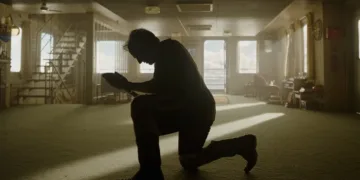







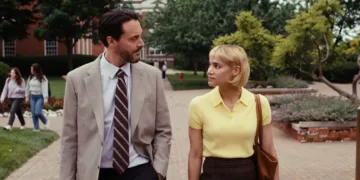


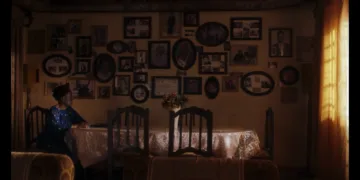



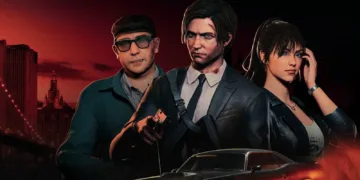






Romeo begins as a small-town deputy in Deadford, Pennsylvania, a setting defined by two local oddities: a rumored alien landing site and oddly lifeless tomatoes. His routine collapses the night he finds Juliet, an amnesiac woman lying in the road. He disregards his grandfather’s warnings about falling for someone discovered unconscious and forms a brief romance that ends when a monster kills him.
Benjamin, the grandfather and inventor, brings Romeo back using experimental helmet technology and then dies himself. Sustained by that device and renamed Deadman, Romeo is recruited by the FBI’s Space-Time Police to chase dimensional criminals through a splintered multiverse while searching for Juliet, who may tie into the cataclysm that fractured reality. Benjamin later manifests as an animated patch on Romeo’s jacket after inventing time travel, a literal grandfather paradox.
This marks Suda51’s first original title in a decade and it leans fully into the director’s trademark weirdness. The narrative hops between 3D action, 2D sprite-based hub exploration, comic panels, and cutscenes, and it frames its multiverse conceit with the idea that time behaves like a sphere: events shift but destinations repeat.
The Mechanics of Hunting Space-Time Fugitives
Missions begin aboard The Last Night inside a 2D sprite hub where Romeo’s eccentric crew congregate. His mother and sister live on the ship beside color-coded FBI agents such as BlueMountain, TheBlack, and RedBrown. One agent criticizes the name “Deadman.” From this hub you scan for dimensional anomalies, pilot the ship — its exterior marked with bold “FBI” lettering — and blast through dimensional blockages with a weapon labeled Eternal Sleep. Romeo then rides a motorcycle across a bridge of light to enter each mission. That sequence repeats for every assignment, underscoring the game’s structural emphasis on recurrence.
Combat offers eight weapons split evenly between melee and ranged tools. You begin with a chainsaw-sword and a pistol and unlock the rest rapidly, often within the opening mission. Melee follows the modern trinity of light attacks, heavy attacks, and dodging, with a system that lets you chain strikes in any order for fluid mixing of heavy and light hits.
That freedom feels liberating at first, though the moveset lacks deeper, named techniques or extended combos reminiscent of classic action systems such as Devil May Cry’s advanced methods. The basic sword works well for quick swipes. Arcadia separates and recombines in mid-combat, and the Juggernaut gauntlets turn Romeo into a heavy-hitting brawler.
Ranged options become crucial against larger foes with flower-shaped weak points. The pistol, machine gun, shotgun, and the Yggdrasil rocket launcher all use infinite ammunition, which removes reload management from the equation. The Yggdrasil excels at eliminating priority targets with single rockets, though each shot requires a cooldown. That weak-point focus tilts encounters toward firearms: melee handles crowd control while guns punish glowing targets, producing an imbalance during major fights.
A single blood meter ties combat and recovery together. Kills fill this gauge and let you trigger Bloody Summer, a weapon-specific finisher that also restores health. Bloody Summer can be activated while dodging or jumping, adding tactical options for both offense and survival. This dual role reduces dependency on the limited healing items scattered through levels.
Enemy types appear early and the roster expands only modestly. Rotters serve as common fodder while special variants include scorpion-like shooters and ballerinas wrapped in flesh tutus. Jellies force you to peel away an exterior with melee before ranged attacks can hit their cores. The game reveals most of its enemy toolkit in the opening hours and then cycles those types repeatedly. Bosses range from memorable set-pieces, like the aggressive Death Changeling, to frustrating fights with instant-kill moves or slim windows that interrupt combos.
Life Aboard The Last Night
The ship’s hub, rendered in retro 16-bit sprite art, operates as a lived-in space beyond a mere menu. You can buy food, materials, and equip pins that adjust stats. The design favors manual interaction: systems require explicit input rather than automation.
The Bastard system exemplifies hands-on design. Seeds drop from enemies or hide in levels; back on the ship Romeo’s sister Luna appraises them and you plant each one in a garden plot by hand. Once grown, you physically pull Bastards from the soil. These organic companions act as sentries, healers, chain-lightning emitters, or suicide bombers that rush and detonate on enemies. You can fuse two Bastards to raise their stats, though fusion rarely creates surprising combined effects unless you produce specific variants. The game communicates their value poorly. I ignored Bastards for most of my run and later had to grind stronger versions when I realized how much they simplified tough fights.
Progression abandons straightforward experience points for a tactile arcade machine. The leveling interface is a Pac-Man-style maze where collected currency fuels a tiny rocket ship. You guide that ship manually through the maze, selecting stat upgrades by the path you choose. Suda51 credits the concept to his team and it stands among the title’s most inspired ideas. The hands-on method makes character growth feel active rather than menu-driven.
The curry cooking minigame with Romeo’s mother delivers stat boosts if you perform a simple task each time. The rewards feel small compared with other upgrade avenues, making the minigame a low-return time investment. Similarly, refining space debris into weapon resources via Sentrey remains opaque even after prolonged use. Early missions suffer as a result: weapons feel underpowered until you gather enough Sentrey to meaningfully enhance them.
Optional challenges exist through boss rematches and standalone dungeons, but accessing them requires physically traveling to the crew member or location involved. There is no quick menu. You walk to the person, start a conversation, and commit. That enforced traversal makes the ship feel coherent as a place Romeo inhabits rather than a set of abstract upgrade screens. Some players will find the choreography tedious. I appreciated the way it anchored upgrades to the world.
Dimensions Folding Into Each Other
Subspace is the game’s most distinctive environmental mechanic. Accessible through floating televisions that display a suited man eating steak and offering cryptic commentary, subspace overlays neon-rectangular architecture atop the normal environment. Entry is limited to specific TVs. In subspace, blocked real-space routes sometimes open, and puzzle solving depends on finding alternate TVs to re-emerge at new real-world locations, clearing obstacles via parallel navigation, and retrieving keys to unlock barriers back in reality.

The TV man provides new lines when you discover fresh entry points so you can track which set leads where. These segments offer pacing breaks, since they are usually combat-free and emphasize the spatial relationships between layered dimensions. Orb-based tasks require smoothing jagged spheres, but objectives can feel unclear until you find a correct approach through trial.
Subspace’s uniform neon styling creates navigation difficulties. Paths all look like rectangles of light, and backtracking becomes disorienting when you cannot remember which TV you used to emerge. The uniform aesthetic offers few landmarks. The concept works on paper but struggles in execution.
Mission locales include Deadford City Hall, a 1970s cult enclave where you partner with a zombie named Jenny, a 1980s shopping mall, and a haunted asylum that evokes John Carpenter’s use of insect imagery in Prince of Darkness. Time periods shift but stay within a mid-20th century envelope. Individual spaces do not present bold architectural identities; the interest comes from seeing identical sites layered across realities.
Camera placement compounds design frustrations. A tight, close-up camera sits near Romeo’s back and frequently hides incoming attackers off-screen, especially during early levels while encounter patterns remain unfamiliar. The limited field of view reduces battlefield awareness and forces guesswork about unseen threats. Romeo’s model itself occupies a large portion of the frame and contributes to visual obstruction.
Soulslike conventions appear in the Space-Time Pharmacies, which function as save points and fast travel hubs while also restoring health and items. Using one respawns all previously defeated enemies. There is no death penalty or currency loss; instead, Romeo’s mother spins a roulette to grant temporary bonuses to attack, defense, or blood gain. These mechanics align with sprawling, interconnected titles such as Dark Souls where respawns push mastery of routes. In this title’s linear mission structure, enemy respawns after saving create repetitive backtracking that feels out of place. The framing that each save spawns a parallel universe does not make the mechanic feel natural.
A Collage of Styles and Sounds
Visual language shifts constantly between 3D action, 2D pixel sprites, animated cartoons, comic pages, and PS2-era polygonal cutscenes. Each mode supports a particular narrative or tonal beat rather than functioning as a random gimmick. The frequent transitions ensure the story is continually refracted through new visual lenses. Few modern games mix so many aesthetic approaches in a single package. Romeo wears a deliberately silly helmet and his grandfather appears as an animated jacket patch. The Game Over screen shows a melting head model that plays in reverse once you continue.

Narrative structure embraces fragmentation across a 15 to 20-hour runtime. Multiverse time travel generates intentional confusion. Events recur with variation, illustrating the sphere concept where circumstances shift while endpoints remain constant. Romeo relives an identical nightmare each night, spilling his drink on waking. Players repeat similar actions to defeat Dimensional Seers that gate mission access.
Credits roll after each criminal capture, producing false endings that mirror the looped structure. Juliet reappears intermittently across dimensions before confronting Romeo as a boss. Late-game passages carry a melancholic tone that echoes themes present in Neon Genesis Evangelion, where sadness permeates scenes without overwhelming them. Despite the formal chaos, some moments feel deeply personal in a way that ties back to Suda51’s sensibility.
Cultural references sprinkle the script. The Clash receives repeated mentions. Oscar Wilde quotes introduce each level. Morrissey lyrics show up on the title screen and name a boss. Rick and Morty served as a stated influence. These citations flavor the experience rather than replace its own voice, which helps the title avoid feeling like a pastiche that trades personality for citation.
The soundtrack holds attention across tonal shifts, combining goofy energy with moments of creepiness. Sound design supports the chaotic tone without overwhelming it.
Technical problems appear in later stages as enemy waves balloon. Frame rates drop noticeably on more demanding levels, degrading performance even on high-end consoles. Weapon-draw quick-time events before certain fights feel awkward and vestigial. Picking up items requires holding a button and then confirming, which becomes tedious when you gather many objects. Bloody Summer sometimes fails to register despite correct input, leaving the player exposed when a salvaging finisher is expected. Weapon switching uses the D-pad and tends to stop movement unless you have unusually long thumbs. Gun aiming can feel loose, allowing shotgun blasts to miss clustered foes directly in front of you.
Early-game spikes make difficulty feel harsh, notably during the second mission in the 1980s mall. Underpowered starting weapons hit like spitballs against damage-soaking enemies. Later, weapon upgrades and thoughtful Bastard deployment flatten encounters, inverting the curve. The inability to change difficulty mid-playthrough forces either a full restart or perseverance through sections that would smooth out with better preparation. Lower difficulty would likely reduce mechanical frustrations, yet the lack of mid-run adjustment creates needless friction.
When Form Mirrors Function
The sphere concept treats time as cyclical with shifting conditions that still lead to identical destinations. That design philosophy permeates choices across systems. Romeo’s recurring nightmare, the repeated mission templates, and the credit sequences that reset after each capture all express the same structural idea. New Game+ suggests replaying to expose additional layers of the cyclical metaphor.

Manual interaction amplifies the sensation of inhabiting a fractured cosmos. Physically planting Bastards, steering the arcade maze for leveling, and walking to crew members for services replicate multiverse repetition through mechanical loops. The form of play echoes narrative function. Execution varies in success: the arcade leveling feels brilliant while the curry minigame feels underdeveloped.
The title intentionally fragments itself across systems and visual modes. Many elements do not cohere into a single unified whole, mirroring Romeo’s fractured universe where dimensions overlap without integrating. The design treats fragmentation as a deliberate choice. Players with low tolerance for that approach will view looseness as a defect; others will see it as an artistic decision. Personal preference will determine how forgiving a player feels.
The story resists tidy comprehension after completion, yet it lingers in the mind. Mechanical shortcomings do not erase conceptual ambition. The game favors memorability over polish and experimentation over refinement. It commits to eccentric touches seldom attempted elsewhere, such as the melting Game Over or the steak-eating TV man. Some ideas land sharply while others feel half-formed, but the sheer willingness to attempt them counts amid an industry that often avoids risk.
Romeo is a Dead Man demands acceptance of its fragmented storytelling, repeated structures, and refusal to explain itself plainly. Combat lacks layered depth. Boss design ranges from inspired to aggravating. Technical issues complicate challenging encounters. Important systems, like Bastards, hide their value until hours have passed. The camera sits too close and enemies often attack from angles outside your view.
Still, the game persists in the mind days after finishing. Its strange, uneven choices prompt repeated thought about a second playthrough and what it might reveal. That lingering curiosity suggests a reward buried under the mess. Whether that reward outweighs the frustrations depends on how much patience you have for games that privilege experimental vision over player convenience.
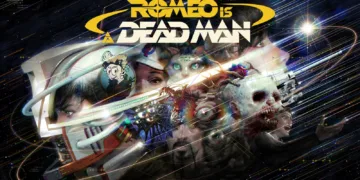
Romeo is a Dead Man is an ultra-violent science-fiction action-adventure game developed and published by Grasshopper Manufacture. Released in February 2026, the game follows Romeo Stargazer, a man caught between life and death who is recruited as a special agent for the FBI’s Space-Time Police. Players navigate a shattered space-time continuum, utilizing a stylish “Bloody Action” combat system that allows Romeo to swap between swords and guns while hunting cosmic fugitives and searching for his missing girlfriend, Juliet. The game features a distinct surrealist aesthetic that blends 90s cartoon styles with cyberpunk-pop art and is available on PlayStation 5, Xbox Series X/S, and PC via Steam and the Microsoft Store.
Full Credits
Director (Creative/Game Director): Ren Yamazaki, Goichi “Suda51” Suda (Executive Director)
Writers (Lead Writer/Narrative Designer): Goichi Suda, Ren Yamazaki
Producers/Studio Leadership (Producers, Executive Producers, and Key Studio Heads): Goichi Suda (CEO/Executive Producer)
Lead Voice Cast: Information regarding specific voice actors for Romeo and Juliet has not been widely publicized in primary promotional materials, though Romeo Stargazer and Juliet Dendrobium are the central characters.
Key Engineering/Technical Leads: Hironaka (Main Programmer)
Developer, Publisher: Grasshopper Manufacture, Grasshopper Manufacture (Self-published, with NetEase Games as parent company)
Release Date: February 11, 2026
The Review
Romeo is a Dead Man
Romeo is a Dead Man frustrates as often as it fascinates. Combat lacks depth, technical issues plague later sections, and crucial systems hide their importance until too late. The camera sits claustrophobically close, enemies attack from blind spots, and difficulty spikes punish unprepared players. Yet Suda51's vision persists in memory long after credits roll. The tactile hub world, inventive leveling system, and bold commitment to fragmentation create something genuinely distinctive. This sphere of repeating events won't satisfy everyone, but those willing to embrace its chaotic philosophy will find an experience that lingers.
PROS
- Inventive arcade-style leveling system feels fresh and engaging
- Visual diversity across multiple art styles keeps presentation interesting
- Bastard companions provide valuable tactical options when properly utilized
- Subspace dimension-hopping creates clever environmental puzzles
- Thematic cohesion between mechanical repetition and narrative concepts
CONS
- Combat lacks depth with limited movesets and no advanced techniques
- Severe technical issues including frame rate drops on high-end hardware
- Claustrophobic camera causes frequent off-screen deaths
- Early game difficulty spike from underpowered weapons
- Poor communication about crucial systems like Bastards