













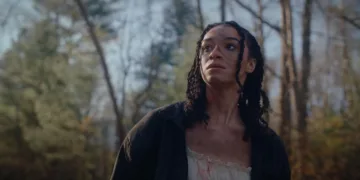

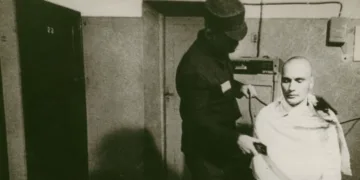











Malik reenters Chicago with the air thick and charged, and he carries one sharp intention. He has just come out of prison, and the city he left reads colder now. Sayeed, his friend, is gone, killed by a rival crew led by Straw. Malik’s homecoming becomes a straight line toward payback. He lives by street rules that rarely need to be spoken aloud.
Then Nana, his grandmother, hands him a small prayer card of Saint Moses the Black. The gesture lands softly and still manages to rearrange the room.
Moses comes with a biography that reads like a warning label. In fourth-century Ethiopia, he lived in blood and plunder, then turned toward a monastic life shaped by radical peace. Malik gears up for war with Straw, and the saint’s old story starts seeping into the present tense. The film sets up a pressure point between the gang cycle’s gravity and the quiet idea of a different road. Malik ends up living between two hauntings: Sayeed’s murder and Moses’ redemption.
Chrono-Syncing Redemption
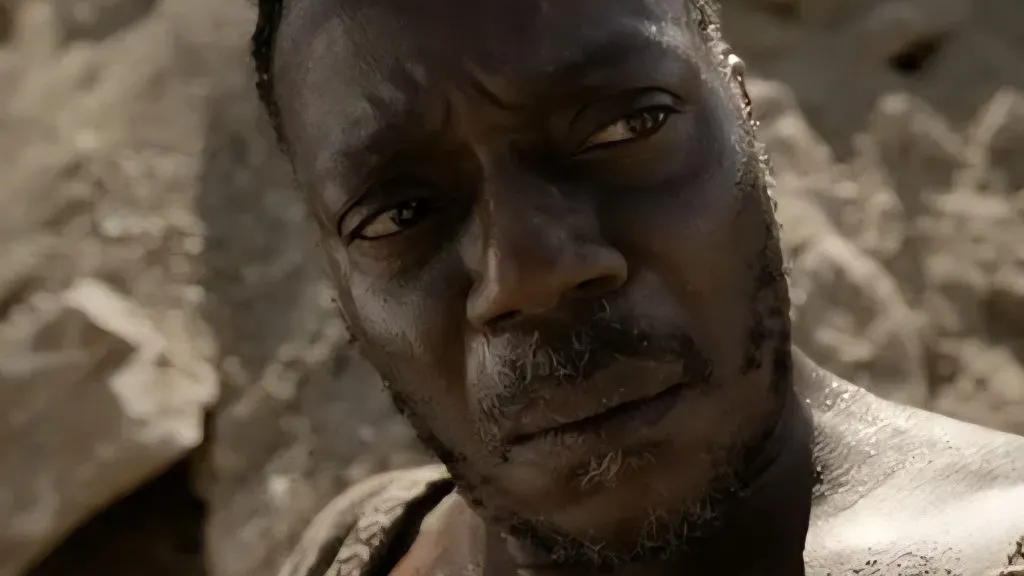
Director Yelena Popovic runs a dual-timeline design that I’ll tag as “theological parallelism.” The film cuts from the Chicago underworld to the scorching sands of 405 A.D., as if time itself has decided to argue with Malik. Chukwudi Iwuji plays Moses with an intensity that spans the centuries. He also arrives to Malik in visions: a weeping warrior-monk who looks less like a stained-glass emblem and more like a spiritual mirror that refuses flattering angles.
The script leans on the biblical warning about living by the sword and perishing by it. The point lands as weight, not classroom recitation. “Valley of tears” becomes a shared map for both men. In the desert, it has sand and heat. In Chicago, it shows up as fatherless homes and “booty bandit” social media beefs that turn pride into a public sport.
Malik starts dropping his fatalistic mantras in small pieces. He used to treat his fate as fixed. The prayer card wedges itself into that certainty. The change sparks a very real “hesitation-tension” inside his organization. A boss who pauses before pulling the trigger creates space for doubt, and doubt invites mutiny. The film frames personal change as dangerous inside a machine built to keep violence moving.
Stoics, Rappers, and the Law
Omar Epps carries the film with a performance that stays remarkably buttoned-up. His Malik reads as a man of constant sorrow, shaped around a “veteran-villain” archetype that suggests exhaustion with his own legend. He moves like someone already acquainted with his expiration date.
Wiz Khalifa steps in as 2wo-3ree, giving the story its needed counter-balance. He embodies the life Malik keeps trying to step away from: volatile, trigger-happy, fixated on power’s optics. Quavo plays Straw as the catalyst, the figure who keeps the coming violence hovering over each scene like a storm with good timing.
The hip-hop casting clicks because the performers hold the film’s tonal register instead of wrestling it to the ground (a temptation that has ruined many a “serious” crime drama). They show up, they occupy space, and the story keeps its shape.
Cliff Chamberlain’s Jerry is the wild card. As a corrupt officer, he brings a “loony,” near-manic energy that brushes against the surreal. His performance can feel like it wandered in from another movie, maybe a dark satire that took a wrong turn. That dissonance ends up pointing a highlighter at Malik’s inward struggle, which stays somber and grounded. Iwuji remains the anchor through it all, making Moses feel painfully human, closer to flesh and regret than to any distant icon.
The Aesthetics of the Funeral Path
Popovic’s direction carries the imprint of her background in religious cinema. She approaches the Chicago gang war with a “spiritual reverence” usually reserved for cathedrals. Wardrobe becomes a lead narrator. Black clothing wraps nearly everyone, and the film starts to resemble a 100-minute funeral for the choices these men keep making.
Recurring train shots work as a visual motif for Malik and Moses. Two lives, two tracks, forward motion that feels pre-written. They ride lines they never laid, and the destination keeps calling like it has an appointment on the calendar.
The pacing favors interior conflict over the kinetic “shoot-’em-up” rhythm many viewers expect from a gang-war setup. When violence arrives, the staging can look amateurish, and that creates a jolt next to the meditative desert close-ups. The cut can feel like switching from prayer to rehearsal.
Dialogue operates through “moral sparring.” Characters trade aphorisms about worldliness and the lack of time for paradise. Words get treated like physical objects, heavy enough to bruise. The film keeps returning to its “sacred-gritty” meeting point, chasing a specific spiritual sensation: the moment someone finds a historical figure whose scars match their own.
Moses the Black was released nationwide in the United States on January 30, 2026. The film is a gritty crime drama that parallels the life of a modern Chicago gang leader with the fourth-century repentance of Saint Moses the Black. It is currently available to watch in select theaters through Fathom Events and is expected to move to digital platforms and streaming services later this year.
Full Credits
Title: Moses the Black
Distributor: Fathom Entertainment
Release date: January 30, 2026
Running time: 110 minutes
Director: Yelena Popovic
Writers: Yelena Popovic
Producers and Executive Producers: Alexandros Potter, Yelena Popovic, Brett Hays, Curtis “50 Cent” Jackson, Wiz Khalifa, Omar Epps, Nick Mirkopoulos, Alex Pissios, Josh Schachter, William Dzombak, Reginald Ahkeem Berry Sr., John Kynigopoulos, Florence Larsonneur, Nat McCormick, Brandon Burrows
Cast: Omar Epps, Wiz Khalifa, Quavo, Chukwudi Iwuji, Corey Hendrix, Cliff Chamberlain, Ahmad Ferguson, Skilla Baby, Deontay Wilder, Kierra Bunch, Sambou Camara, Maurice Cobige
Director of Photography (Cinematographer): Panagiotis Vasilakis
Editors: Dimitris Tzetzas
Composer: Kostas Christides, Wiz Khalifa (Original Soundtrack)
The Review
Moses the Black
Moses the Black is a rare specimen: a gritty hood drama that genuiney wrestles with the weight of antiquity and faith. While the low-budget action sequences occasionally falter and the pacing leans toward the ponderous, the film succeeds as a thoughtful character study. Omar Epps provides a hauntingly quiet center to a story that avoids easy resolutions. It is an ambitious, if uneven, meditation on the possibility of a second act in a life defined by blood.
PROS
- Strong, stoic lead performance by Omar Epps.
- Unique, layered parallel storytelling.
- Meaningful use of religious symbolism and icons.
- Seamless integration of supporting cast.
CONS
- Uneven pacing and tonal shifts.
- Amateurish staging in action sequences.
- Occasional "preachy" dialogue in the final act.
- Low-budget production values are visible.