




















Takashi Miike often lives in the global film imagination as a director linked to extremity. His career includes hyper-violent spectacle and surreal genre experiments. Sham marks a sharp shift from that high-energy image. Miike works here in a calm, realistic register and builds a grounded legal drama.
The film adapts a real 2003 incident in Fukuoka that seized public attention in Japan. It is drawn from investigative journalist Masumi Fukuda’s detailed book about the case involving primary school teacher Seiichi Yabushita.
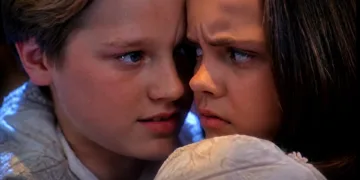
The story follows severe allegations made by a mother, Ritsuko Himuro. She says Yabushita abused her son, Takuto, by tearing his ears and pinching his nose until it bled. The accusations carry racial force. Himuro says Yabushita used discriminatory language toward the boy because of his American grandfather.
The claim of “tainted blood” transforms a local dispute into a civil lawsuit and a national media scandal. Miike captures the cold terror of a man watching his career and reputation collapse. He pays close attention to how fast public accusation can strip a person of stability.
Visual Duality and the Architecture of Doubt
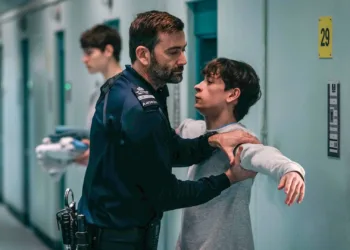
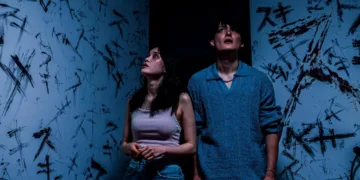
Miike uses a clear dual-perspective design to move through the unstable territory of memory and testimony. The first twenty minutes operate as a visceral dramatization of the mother’s courtroom account. This passage uses horror imagery to shape perception.
Deep shadows hide the teacher’s face or expose a menacing, psychotic grin. The violence appears sadistic and intense. Shots such as the teacher lifting the boy by his ears carry a harrowing force. This opening stretch sets a starting impression of guilt through visual shock.
A sudden title card appears after that sequence and announces a full change in visual language. The next forty minutes present Yabushita’s account of events. The cinematography turns realistic and attentive. Miike drops the genre filters and adopts a restrained, plain style. Yabushita appears as a gentle family man and a committed teacher who cares deeply for his students.
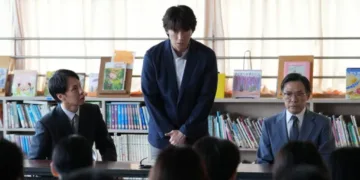
The last hour shifts into courtroom drama. Miike avoids flashy camera display and technical flourishes during the hearings. He builds tension through steady framing and deliberate pacing. The collision between the horror-tinged opening and the ordinary texture of the trial pushes the viewer to reassess first impressions. That structural friction produces sustained doubt and echoes the difficulty of locating objective truth inside a courtroom.
The Performance of Perceived Identities
Gô Ayano gives a layered performance as Seiichi Yabushita. He convincingly inhabits two versions of the same person. In the opening testimony, he plays a frightening villain with quiet menace. Later, he plays a naive, hopeful professional who slowly fractures under the pressure of the trial.

Ayano conveys the emotional cost of the accusations with intense desperation. Kô Shibasaki forms a sharp counterpoint as Ritsuko Himuro. She plays the mother as cold and emotionally opaque. Her unreadable face and monotone delivery keep her motivations hard to read. She occupies a narrow space between grieving protector and calculated liar.
Kira Miura plays Takuto, though the role functions mainly as a catalyst and not a fully developed figure. The film places him in the middle of a storm where adults battle for control of the story. Supporting performances deepen the institutional conflict.
Ken Mitsuishi plays the school headteacher who pressures Yabushita to apologize for the sake of social order. Kazuya Kamenashi plays a media figure who stands for the outside forces feeding public vilification. The central tension stays with the teacher and the mother. Their performances carry the drama through silence and facial expression. The film stresses internal psychological strain over external action.
Institutional Order and the Price of Peace
The film delivers a harsh critique of media sensationalism and public judgment. Yabushita’s forced public apology spreads widely and ignites national outrage before evidence receives formal scrutiny. The reaction points to a society ready to accept the worst claim in service of collective moral anger.
Miike also studies pressure from the school administration. The institution protects social stability and the school’s reputation ahead of the facts of the case. Officials push a man toward a false confession so the crisis can disappear quickly.
This treatment of truth exposes weaknesses in a legal system shaped by subjective memory and biased testimony. The 2003 setting still feels relevant to current debates about social accountability and public accusation. Many courtroom dramas sustain ambiguity and leave resolution in the audience’s hands.
Sham moves toward a defined truth. It takes a position. That decision leads to a somber coda focused on the shadows that remain over these lives. Miike offers a bleak portrait of flawed people trying to find justice inside a system that values appearances above reality.
Sham arrived in Japanese theaters on June 27, 2025, following a high-profile international debut at the Tribeca Film Festival earlier that month. This unflinching courtroom drama is currently touring through the United Kingdom as part of the Japan Foundation Touring Film Programme, with screenings scheduled across various cities through March 2026. For those looking to view the film at home, it is available for streaming on Netflix in select territories. The production offers a stark departure from the typical high-octane works of its director, focusing instead on a grounded and haunting legal battle based on real events.
Full Credits
Title: Sham
Distributor: Toei Company, Ltd., Netflix
Release date: June 27, 2025
Rating: PG-12, 13+
Running time: 129 minutes
Director: Takashi Miike
Writers: Hayashi Mori, Masumi Fukuda
Producers and Executive Producers: Kenichi Wasano, Keiichi Hashimoto, Misako Saka, Shigeji Maeda
Cast: Go Ayano, Ko Shibasaki, Kazuya Kamenashi, Koji Ohkura, Fumino Kimura, Kazuki Kitamura, Kaoru Kobayashi, Kira Miura, Yukiyoshi Ozawa, Masahiro Takashima
Director of Photography (Cinematographer): Hideo Yamamoto
Editors: Naoichiro Sagara
Composer: Koji Endo
The Review
Sham
Sham is a masterclass in restrained tension, marking a fascinating pivot for Takashi Miike. By utilizing a fractured narrative to mirror the instability of truth, the film forces us to confront our own biases. It brilliantly exposes the fragility of a man's life when caught between institutional cowardice and a ravenous media. While the definitive ending sacrifices some thematic mystery, the powerful performances and stark visual duality make it a profound exploration of justice. It is a sobering, essential look at the cost of social order in a world quick to condemn.
PROS
- The shift from horror-coded testimony to grounded reality effectively unbalances the viewer’s perspective.
- Gô Ayano and Kô Shibasaki deliver nuanced, haunting portrayals of characters existing in a moral gray zone.
- A biting and accurate critique of media sensationalism and institutional "peace at any price" mentalities.
- Miike proves his mastery by letting the quiet, legal proceedings provide more impact than his signature gore.
CONS
- The move toward a definitive truth undermines the earlier Rashomon-style ambiguity.
- The child at the center of the case lacks depth, serving more as a plot device than a character.