
























![Kingdom Hearts Collection [I-III] Review](https://gazettely.com/wp-content/uploads/2026/10/Kingdom-Hearts-Collection-I-III-1-360x180.webp "Kingdom Hearts Collection [I-III] Review: KHII Holds Steady as Newer Entries Fluctuate 37")





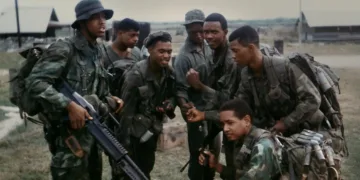
Director J.M. Harper builds this documentary from the 2003 memoir by Army veteran Ed Emanuel, keeping the story anchored in the lived record of Company F, 51st Infantry, a six-man Long Range Reconnaissance Patrol team.
Their work took them deep behind enemy lines for five days at a stretch, and the film treats that mission profile like a design constraint that shapes everything that follows: tight numbers, high stakes, little margin for error. It also opens the timeline forward, capturing a final reunion in 2024, then letting those present-day faces carry the weight of what the film is trying to recover.
Most of the men were teenagers during their 1968 to 1969 tour, and the documentary keeps returning to that detail because it changes how you read every memory. Thad Givens served at age 17. Lawton Mackey Jr. forged a signature to join. A white colonel gave them the name Soul Patrol, a label that marked them as the first all-Black special operations team in the conflict.
Harper stays attentive to what that label meant inside the unit and outside it, and the film’s larger focus sits with the history it pulls back into view. The experiences of these young men sit beside the social upheaval of the time, yet the production keeps its attention on the unit’s specific military identity and the personal cost of service, presented with plainspoken directness.
Visual Language and Artistic Interpretation
Harper uses a set of visual techniques that function like interlocking systems, each one pushing the viewer between 1968 and the present day. Super 8 footage shot by the soldiers themselves supplies the most intimate material, catching their off-hours and daily lives with a closeness that polished retrospectives rarely reach.
The 2024 reunion scenes shift into black and white, a decision that puts emphasis on expression, posture, and the aging faces of the survivors. It is a stark presentation choice, and it turns the reunion into its own kind of playable space, where the smallest reaction can feel like an event.
The film also introduces scripted adaptations as surreal sequences, giving memory a more unstable texture. One scene places young versions of the soldiers in a modern supermarket, patrolling fluorescent aisles in combat gear while reciting the philosophy of Friedrich Nietzsche and pushing shopping carts.
It is an intentionally disorienting construction, and it changes the pacing of the documentary in a way that feels deliberate: the movie toggles from firsthand archive, to present-day reflection, to staged imagery that behaves like a dream you cannot fully parse. That rhythm creates a push and pull between clarity and distortion, which mirrors the way traumatic memory can fracture.
Archival news footage from 1968 adds another layer of grounding, tying private experience to public catastrophe through coverage of the assassinations of Martin Luther King Jr. and Robert F. Kennedy. The wives and partners of the veterans appear as well, giving their perspectives on the long-term impact of the war and widening the emotional field beyond the men who served.
Put together, these choices create a layered view of memory, with grainy personal film colliding against crisp modern cinematography. That collision produces a sense of temporal displacement that matches the subject, and it makes the distance between jungle life and the domestic years after service feel tangible rather than abstract.
Racial Demographics and Social Friction
The documentary studies the friction between the soldiers’ service and the societal terrain of the late 1960s, with attention to the racial dynamics Black men faced inside the military and across the American public. The film includes statistics that place the imbalance in stark terms: Black men made up 11 percent of the population and accounted for 27 percent of the deaths in the war. Those numbers do important narrative work here, because they explain why erasure lands as a repeated wound rather than a single insult.
Media coverage often removed Black soldiers from the story of the war, and journalist Jesse Lewis notes that special operations teams were often ignored in favor of their white peers. The nickname Soul Patrol becomes a pressure point inside the film’s structure. Some of the men found it endearing. Ed Emanuel saw it as a patronizing label that put race ahead of their status as professional soldiers. That tension gives the documentary a strong internal conflict that plays out through recollection and reflection, rather than through spectacle.
Harper also positions their military work against the fight for rights back home, describing an internal struggle as they fought for a country that failed to protect their rights on American soil. Audio of Martin Luther King Jr. and footage of Stokely Carmichael track anti-war sentiment rising in Black communities, and that material helps explain the isolation the men carried.
The film frames their experience as two wars operating at the same time: a war in the jungle against an armed enemy, and a war inside their ranks and back on American soil. The pacing here matters. Harper gives space to the contradictions without rushing past them, letting the historical record and the men’s own voices create the tension.
Processing Silence and Finding Solidarity
This section turns to the emotional aftermath and to what the 2024 reunion means after decades of silence. The men carried shadows they did not discuss for fifty years, and the documentary treats that silence like a long-running mechanic that shaped their lives, a rule they lived under until the reunion finally changed the conditions. One veteran recalls Bangkok, trying to wash Vietnam off his body in a hotel pool. The image lands with painful clarity, capturing the desperation to scrub away combat memory through a physical act that can never fully work.
Ed Emanuel describes a shift from seeking revenge to recognizing shared humanity. He remembers meeting working-class people in Thailand who reminded him of himself, and that recognition made the cycle of violence feel hollow. The film ties that emotional movement to the 2003 book, which acted as the catalyst that brought the team back together. The reunion plays as communal therapy, built from conversation, listening, and the kind of familiarity that only comes from shared danger.
The documentary keeps returning to the bond between the team members, presenting it as their primary reason for survival. Their devotion to one another replaced their doubts about the purpose of the war, and that focus allows the film to stay close to how people manage long-term trauma.
Harper suggests healing comes from breaking the silence, and the brotherhood formed in combat functions as a safety net in the present day. The veterans find peace in the shared recognition of their history, and their collective memory becomes a defense against the erasure they faced when they returned home.
Soul Patrol premiered on January 25, 2026, at the Sundance Film Festival, where it garnered significant acclaim and won the U.S. Documentary Directing Award. The film is a powerful documentary that explores the lives of the first all-Black special operations unit during the Vietnam War, blending modern reunions with archival Super 8 footage. As of early February 2026, the film is completing its festival circuit and was briefly available for online public screening through the Sundance platform; a wide streaming or theatrical release date has not yet been announced but is highly anticipated for later this year.
Full Credits
Title: Soul Patrol
Distributor: Park Pictures, Submarine Entertainment, CAA
Release date: January 25, 2026
Running time: 100 minutes
Director: J.M. Harper
Writers: J.M. Harper
Producers and Executive Producers: Sam Bisbee, Danielle Massie, J.M. Harper, Nasir Jones, Peter Bittenbender, Ed Emanuel, Joe Plummer, Jenifer Westphal, Stacey Reiss, Lance Acord, Jackie Kelman Bisbee, Cody Ryder, Lauren Driscoll, John Driscoll, Jenny Raskin, Kelsey Koenig, Davis Guggenheim, Rahdi Taylor, Andrew Gertler, Max Allman
Cast: Ed Emanuel, Thad Givens, Lawton Mackey Jr., John Willis, Norman Reid, Emerson Branch Jr., Myles Simms-Aur, Deion Smith, Elijah Richardson, Okea Eme-Akwari, Michael Oloyede, Danielle Lyn
Director of Photography (Cinematographer): Logan Triplett
Editors: Byron Leon, Niles Howard, Gabriela Tessitore
Composer: Christopher Lyo, Mike Theis
The Review
Soul Patrol
Soul Patrol is a searing recovery of lost history that prioritizes raw, first-person testimony over polished military tropes. By weaving together the intimate reflections of the first all-Black special operations unit with the turbulent civil rights era, J.M. Harper creates a powerful study of brotherhood under pressure. While some of the stylized reenactments feel slightly disconnected from the gravity of the veterans’ own voices, the emotional weight of their final reunion is undeniable. It is a necessary, poignant look at the cost of being a soldier when your own country is at war with your identity.
PROS
- The use of personal Super 8 footage adds an authentic, heartbreaking layer of humanity.
- Sheds light on the specific, often erased contributions of Black special operations teams.
- The focus on the men’s wives and the lifelong impact of trauma provides a holistic view of war.
CONS
- The scripted segments occasionally lack the visceral tension found in the interviews.
- Certain artistic choices, like the heavy score or abrupt visual shifts, can feel over-engineered.







