
























Still Hope opens as a grave drama shaped by the brutal realities of contemporary exploitation. The story follows Hope Creighton, a sixteen-year-old living within the quiet discipline of a middle-class household in Missouri. Her parents, Garrett and Valerie, keep a home ordered by religious tradition, and Hope meets that structure with the restless skepticism of adolescence. That strain inside the family sets the stage for the mistake that changes everything, as Hope slips away from her grandmother’s house to meet Trevor, a young man she met online.
Their first meeting at a local bowling alley arrives with the polished look of an ordinary teenage date. Trevor presents himself with easy charm and gives Hope a gold necklace, using affection as cover for predation. The mood turns with shocking speed after he gives her a spiked drink, and the betrayal lands with cold efficiency.
Hope is drugged and transferred to a trafficking ring, disappearing into a hidden world of violence. Her abduction throws her parents into panic, and the film frames that panic against a suburban sense of safety broken open by a crime that feeds on lapses in supervision and exposure through digital contact.
The Mechanics of Captivity and Justice
The film then shifts into a severe account of organized cruelty and the procedural labor aimed at stopping it. Hope falls under the control of Bishop, a scruffy and threatening pimp, along with his associate, Queen. The script lays out the calculated stripping away of personhood through details such as a branding tattoo and the forced use of the name Blaze. Hope survives a relentless pattern of physical abuse and psychological damage, intensified by a forced narcotics dependency used to secure obedience.
The criminal network is presented through gritty realism that stresses the market logic imposed on human bodies. Running alongside Hope’s ordeal, the story follows the patient work of law enforcement. FBI Agent Romero leads the case with measured professionalism, searching for the minor mistakes that can crack the operation open.
The breakthrough comes with recovered security footage from the bowling alley, a digital trace that gives investigators the leverage needed to break the syndicate apart. That procedural line reaches its peak in a rescue operation, ending Hope’s eighteen-month captivity and redirecting the film from crime mechanics toward the unstable terrain of survival.
The Secular Void and Spiritual Recovery
The second act turns to rehabilitation, moving Hope from captivity into the “Restore” recovery center. When she returns, she appears emptied out, carrying deep cynicism and the heavy imprint of post-traumatic stress. She challenges the idea of a benevolent God who permits such suffering, and that conflict creates sharp tension between her inner condition and her family’s expectations. Restore operates through a strict religious structure under the guidance of a counselor named Jennifer.

The program places spiritual reconciliation ahead of standard psychiatric treatment. Its curriculum centers on forgiveness, pressing Hope toward peace through divine grace and the release of resentment. Major moments of spiritual transformation arrive through the recitation of The Lord’s Prayer and a climactic baptism, each presented as a cleansing of past trauma.
This direction makes faith the main route to restoration and ties healing to a return to the religious values Hope once resisted. The film treats that movement as a spiritual victory, while sidestepping the legal and clinical complexities attached to long-term trauma care.
Performance Integrity and Educational Intent
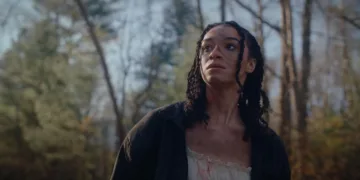
Luna Rivera carries the film’s emotional burden with a performance that registers the volatile range of trauma. Her work tracks Hope’s movement from teenage innocence to damaged survival through silent fear, eruptions of rage, and a slowly earned calm. Alex Veadov gives Bishop a chilling presence, shaping the character without slipping into caricature, and James Liddell brings steadiness and compassion to the lead investigator.
Director Richie Johns, working from experience on faith-based productions such as The Chosen, applies a disciplined visual approach to the Missouri setting. The cinematography uses local locations to anchor the story in recognizable spaces, avoiding graphic images of sexual violence while preserving a heavy and mournful atmosphere.
That restraint supports the film’s dual identity as drama and educational material. The end credits include specific safety resources and guidance for parents, fixing the production in place as a work built to raise awareness and help prevent future harm. The film presses for vigilance and uses its form to expose a crisis that remains hidden in plain sight.
Still Hope is a poignant drama released in the United States on February 5, 2026. Inspired by true events, the film explores the harrowing journey of a 16-year-old girl named Hope who is abducted for sex trafficking and her subsequent path to spiritual and emotional recovery. Viewers can currently watch the film in theaters nationwide through Fathom Entertainment, with potential streaming availability on faith-based platforms expected later in the year.
Where to Watch Still Hope (2026) Online

Full Credits
Title: Still Hope
Distributor: Fathom Entertainment, Studio 523
Release date: February 5, 2026
Rating: PG-13
Running time: 113 minutes
Director: Richie Johns
Writers: Mitch Hudson, Randy McWilson
Producers and Executive Producers: Richie Johns, Bethany Johns, Randy McWilson, Natalie Miller, Enoch Joshua, Brent McMinn
Cast: Luna Rivera, Alex Veadov, John D. Michaels, Michelle Haro, Andrea Mitchell, Kionta Banks, Kylie Kay, James Liddell, Daniel Ferrell, Wilma Rivera, Roslyn Gentle, Averi Curtis, Wesley Ridings, McCartney Ogle
Director of Photography (Cinematographer): Julius Damenz
Composer: Kenji Standlee
The Review
Still Hope
Still Hope navigates the harrowing reality of exploitation through a lens of profound spiritual conviction. While the first half effectively captures the cold, procedural terror of abduction and the clinical precision of law enforcement, the second half trades psychological complexity for a narrow religious curriculum. Luna Rivera’s performance remains the production’s strongest asset, providing a necessary human anchor in a narrative that occasionally feels more like a promotional tool than a traditional drama. It is a work of clear, singular intent that prioritizes moral instruction over cinematic nuance.
PROS
- Luna Rivera’s emotionally resonant and range-heavy lead performance.
- Avoids graphic exploitation while maintaining a somber, serious tone.
- Provides practical, real-world resources for parental awareness.
- Grounded, realistic depiction of the FBI's investigative process.
CONS
- The second half feels like a didactic shift toward religious marketing.
- Narrative momentum drags during the extended recovery sequences.
- Prioritizes faith-based resolution over clinical psychiatric depth.
- Secondary characters often lack development beyond their archetypal roles.