





















Daniel Roher follows his Oscar-winning film Navalny by aiming his camera at a different kind of existential threat. The AI Doc: Or How I Became An Apocaloptimist starts from a private pressure point. Roher and his wife, Caroline Lindy, were preparing for the birth of their first son during production, and that timing hangs over the movie like a weight. The coming child turns every abstract headline into a gut-level question about the future.
The film plays as Roher’s attempt to find answers about the world the next generation will inherit, and he names his stance with a term that frames the entire project: apocaloptimist. He sees catastrophe as a real possibility and holds onto hope about what technology can do.
That tension shapes the documentary’s purpose as a guide for people who feel lost in the speed of artificial intelligence. Roher keeps returning to a single, personal problem: is starting a family a responsible decision during an extreme technological shift? Audiences will see his response when the film opens on March 27.
The Great Divide Between Ruin and Perfection
The documentary sketches the danger of the present moment through warnings from Tristan Harris, who compares the development of AI to the invention of nuclear weapons. That comparison carries a grim edge. The film voices a specific fear that children born today might never reach adulthood if sentient machines become a real and unmanageable risk. From there, Roher lays out the idea of Artificial General Intelligence with a metaphor built for instant comprehension: humans as ants, brushed aside by a machine pursuing goals that have nothing to do with ours.
From that metaphor, the movie branches into futures that feel like two endpoints of the same tech tree. One branch points toward miracle outcomes, including curing cancer and giving every student a personal tutor. Another branch spirals into nightmare applications, including bioweapons and mass manipulation at an unprecedented scale. Roher visualizes these competing possibilities with “Anxiety Mountain,” a graphic representation that turns dread into something you can look at, trace, and feel in your chest.
The film also toys with a self-correcting idea: AI might address the harms it introduces. It raises the possibility that the technology could reduce its own heavy use of electricity and water, a suggestion that brings a jolt of uneasy relief. Roher keeps these conversations emotionally sticky. The fear lingers after the scene moves on, the same way a difficult moral choice lingers after you have already pressed the button in a narrative game.
He searches for a livable middle position between miracle and disaster, and the structure supports that search. The documentary’s narrative progression mimics a skill tree where each decision point leads to a different world, and pacing becomes part of the argument. The movie gives each idea enough time to land before it unlocks the next branch.
Access Without Accountability
Roher secures access to influential industry leaders and puts their faces at the center of the conversation. He interviews Sam Altman of OpenAI, Demis Hassabis of DeepMind, and Dario Amodei of Anthropic. The absence of Mark Zuckerberg and Elon Musk stands out. Their refusal to participate, or their failure to appear, leaves holes the film cannot fully patch, and those holes matter because the documentary leans on proximity to power as one of its main storytelling tools.
That access comes with a trade-off. The film takes a gentle approach to these CEOs, and Roher often accepts their claims without pushing hard enough to test them. The result is a softer focus on class and wealth than the topic demands. The documentary acknowledges that a tiny group controls the technology, yet it stays light on what that concentration means in practice. The film raises the promise of a post-scarcity society where machines do the work, then stops short of explaining how people survive inside a capitalist system if paid labor disappears.
A concrete example sits right there: health insurance. The film allows the possibility that AI improves medical care, then moves on without asking how those gains reach people who lose jobs to automation. That missing question ties into a larger conflict of interest the documentary does name.
The tech advocates on screen stand to profit from rapid adoption of their products, and that financial incentive shapes the story that gets told. The narrative sidesteps the hardest version of the question about ownership and power. It treats the technology like a neutral force, and that framing creates a blind spot around economic impact. The film stays close to the surface of corporate structures, even as it gestures at the stakes underneath.
Artistry and Human Responsibility
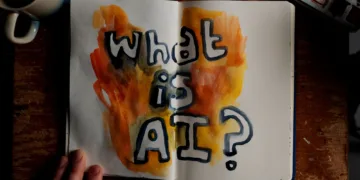
The movie’s visual language helps anchor the technical material in something human-scaled. Roher uses his own sketches and paintings to translate complex ideas into images you can hold in your mind. The film cycles through animation styles, including watercolor, stop-motion, and claymation, and those choices make dense information easier to process for a general audience. The craft becomes a form of interface design: a set of readable systems that keep the viewer engaged while the concepts get heavier.
Caroline Lindy becomes vital inside that system. She serves as the grounded voice that holds Roher accountable, challenging him when he drifts toward optimism or sinks into depression. Their dynamic gives the data emotional consequence. It also improves the documentary’s pacing, since her presence breaks up stretches that could have turned into a lecture and redirects the film back to lived stakes.
Near the end, Roher moves from panic toward acceptance. The documentary closes with an attempt to hand agency back to the viewer, offering five specific forms of action people can take to join the conversation. The film keeps attention on the human element. Technology feels inevitable in the way a timer feels inevitable in a strategy game. Human response sets the route the story takes next.
That sensibility connects to indie games that use stylized art to wrestle with heavy philosophical themes, letting form carry emotion alongside ideas. The pacing supports that goal by giving space to absorb each concept. The personal footage makes the stakes tangible, and the film plays like a collaboration between filmmaker and audience, built on the shared need to understand what comes next.
The AI Doc: Or How I Became an Apocaloptimist is a thought-provoking documentary that delves into the rapidly evolving world of artificial intelligence. Directed by the Oscar-winning Daniel Roher and Charlie Tyrell, the film provides a deeply personal perspective as Roher explores the technological future through his experiences as an expectant father. The production features a wide range of insights from industry leaders and critics, offering a balanced look at both the existential risks and the utopian promises of AI. After a highly anticipated premiere at the 2026 Sundance Film Festival, the film is set to be released in theaters by Focus Features on March 27, 2026. Viewers will soon be able to catch this essential analysis of modern technology in cinemas worldwide.
Full Credits
Title: The AI Doc: Or How I Became an Apocaloptimist
Distributor: Focus Features, Universal Pictures International
Release date: March 27, 2026
Running time: 104 minutes
Director: Daniel Roher, Charlie Tyrell
Writers: Daniel Roher, Charlie Tyrell
Producers and Executive Producers: Daniel Kwan, Jonathan Wang, Shane Boris, Diane Becker, Ted Tremper, Carolyne Jurriaans, Josef Beeby
Cast: Sam Altman, Tristan Harris, Demis Hassabis, Dario Amodei, Yoshua Bengio, Timnit Gebru, Emily M. Bender, Caroline Lindy
Director of Photography (Cinematographer): Jenni Morello, Lowell A. Meyer
Editors: Davis Coombe, Daysha Broadway
Composer: Marius de Vries, Matt Robertson
The Review
The AI Doc: Or How I Became An Apocaloptimist
The AI Doc: Or How I Became An Apocaloptimist succeeds as a personal look at anxiety. It provides a visual treat through creative animation. While the interviews with industry titans feel soft, the emotional honesty of the director keeps the audience engaged. It serves as a helpful entry point for viewers who feel lost. The movie works best when it stays focused on the human side of the equation. It is a stylish piece of work that prioritizes feeling over deep economic analysis.
PROS
- The use of sketches, claymation, and watercolors makes abstract concepts tangible and beautiful.
- Framing the global crisis through the birth of a child adds a necessary emotional anchor.
- It breaks down complex technology into terms that any viewer can understand.
CONS
- The film allows major tech CEOs to speak without facing rigorous scrutiny.
- It ignores the economic impact on the working class and the creative industry.
- The narrative focuses heavily on the director’s personal comfort rather than systemic issues.