



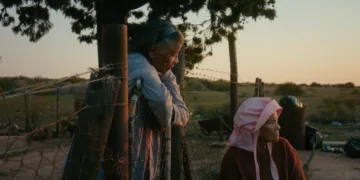







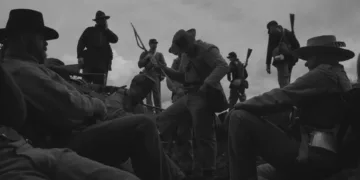


















The year 1846 functions as a hinge in global history. Public attention could drift toward Neptune’s discovery or the saxophone patent, yet the Caribbean was living through the slow, violent collapse of a maritime order. On the emancipated colony of Cayman Brac, Ercell Bodden lives inside a fragile pocket of domestic routine.
She is marked by family roles, mother to Isaac and sister-in-law to Elizabeth. Her husband, T.H. Bodden, works as a merchant captain and often disappears beyond the horizon, leaving Ercell to hold together a quiet household in a tropical refuge.
That calm carries the texture of performance. The Golden Age of Piracy has, in theory, ended, yet its residue has hardened into something leaner and meaner. Ercell hides an earlier life as Bloody Mary, a former pirate who betrayed her partner, the sociopathic Captain Francisco Connor, and vanished with a fortune in gold.
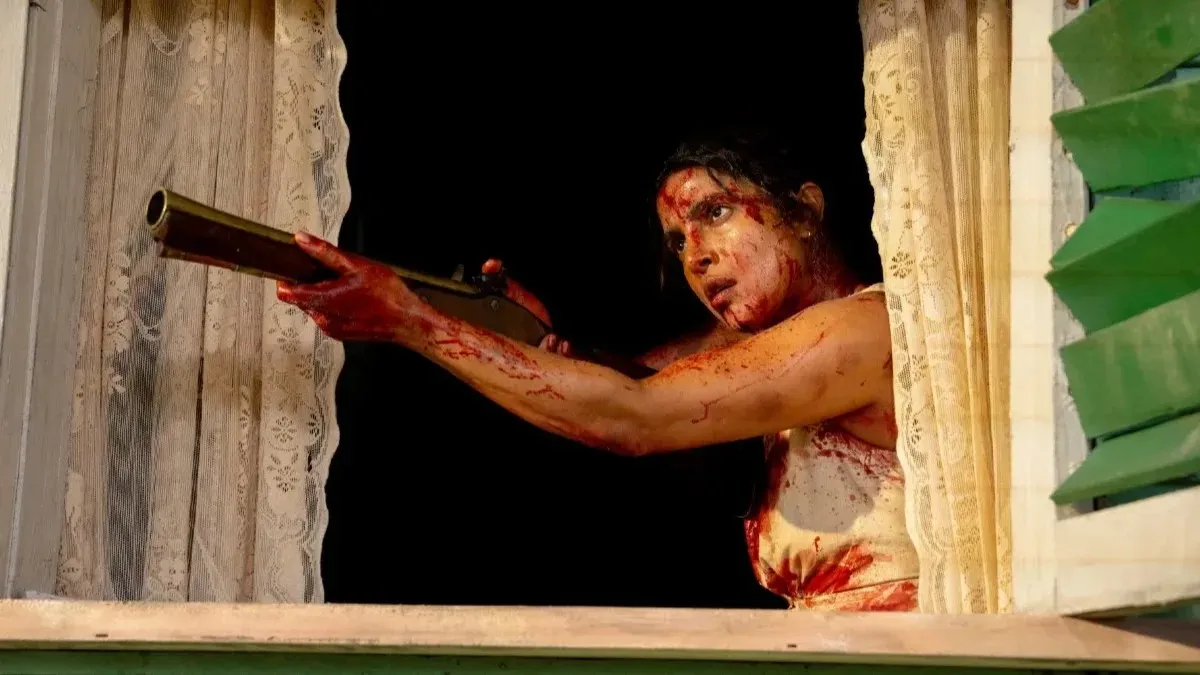
Once Connor’s fleet appears offshore, the film pivots from period drama into siege narrative. Ercell protects her family by stripping away the peaceful identity she built. She retrieves the lethal skills she buried and converts her home into a fortress against a mercenary force.
The Mother, The Monster, and the Scenery-Chewer
Priyanka Chopra Jonas works across what could be called a maternality-lethality spectrum, and she does it with a physical seriousness that steadies the film. Her Ercell becomes a case study in what I would call Domestic Duality, a forced merger of a caregiver’s instincts and a killer’s methods. In scenes with Isaac, she carries visible softness. Once the first blade comes out, her body language changes.
She uses flintlocks and rapiers with tired, practiced precision, the kind of muscle memory that suggests repetition and cost. The flashbacks point to a woman who left piracy and attempted to bury the substance of her old self. Her central drive is clear: she wants Isaac outside that cycle of bloodshed, even as she reaches for violence to keep him alive.
Karl Urban plays Captain Connor as the embodiment of a dying brutal order. He delivers lines with calm sadism and a relish that lands as archaic and frightening at once. He reads as a figure of Toxic Nostalgia, fixated on betrayal and a chest of gold that no longer holds real meaning. His command style stays quiet and steely, which gives him force as Ercell’s opposite pressure point. He does not need frenzy to dominate a room. He carries menace like habit.
The supporting cast supplies emotional weight and structural balance. Temuera Morrison, playing Quartermaster Lee, gives the film a sharply drawn Pirate Pragmatist. He follows a strict buccaneer code that restrains Connor’s erratic impulses and gives the crew hierarchy a sense of internal logic. Isaac, meanwhile, serves as the moral compass.
His innocence is fed by romantic pirate stories, and that reading habit creates a painful irony because he has no idea his mother is the terrible reality behind those legends. The friction between Ercell and Connor draws power from years of unspoken history, so their confrontations feel like the collision of two people who have already haunted each other for a long time.
Decolonizing the Jolly Roger
The film rejects Disneyafication and goes after a grittier realism that cuts against the familiar swashbuckler template. Forget the flamboyant swordplay and choreographed elegance associated with Errol Flynn. Combat here runs on Casual Brutality. A blade entering a body reads as labor, not spectacle. That choice reframes piracy as desperate criminal violence and places the film closer to the historical atmosphere of 1846, a period shaped by post-colonial shifts and blurred lines between legal trade and illegal plunder.

The choice to place a female lead of Indian descent in a 19th-century Caribbean setting carries a historical correction that many films ignore. Real buccaneers such as Anne Bonny and Grace O’Malley already dismantle the fantasy of the sea as an exclusively male sphere.
The film also gestures toward colonial violence as a recurring social engine. Ercell tries to build peace on an emancipated colony, and that effort becomes a compact image of life after inherited trauma. Connor arrives at her doorstep as a literal return of buried history. The past in this film behaves like a creditor. It collects.
Cayman Brac operates as a character in its own right. Its multicultural population and rough geography give the action a tactile grounding. The 1840s setting creates a very specific pressure system: communication moves slowly, and help never appears on time. That condition produces a feeling I would call Island Isolationism, and it gives the conflict a larger historical charge even inside a story confined to a single bluff. The geography shrinks the map and expands the stakes.
Volumetric Shadows and Visceral Sounds
Director Frank E. Flowers uses his knowledge of the Cayman landscape to convert natural beauty into tactical menace. The Die Hard on an island premise works through clear spatial logic. The film tracks Ercell’s position against her hunters with enough precision that the action remains legible.
Certain exterior shots that rely on the Volume set carry an occasional digital sludge effect, which clashes with the tactile production design. The interior material holds up much better. The kitchen fight, for example, uses tight framing and a oner-style approach that builds claustrophobia and keeps the violence uncomfortably close.
The cave sequences stand out through lighting design. Greg Baldi’s cinematography leans on brief, blinding gunfire flashes to expose the fighters in fragments. The result is a staccato visual rhythm that sharpens tension and turns visibility into an event. In those passages, the film edges away from standard period-piece texture and brushes against modern thriller aesthetics. It still belongs to the same story world, yet the visual grammar starts speaking a newer dialect.
Sound design carries major weight in places where the camera pulls back. The wet thud of a blade and the crack of a bone arrive with startling clarity, almost to the point of intrusion. Environmental sound fills out the world with care: splintering ship wood, weathered surfaces, jungle undergrowth shifting underfoot.
Some wider coastal shots reveal thin CGI, and that weakness shows. The smaller production details keep the film grounded anyway, especially the colorful shacks and the grit on the pirates’ skin. Those textures preserve physical credibility at the human scale, which is where this movie earns most of its force.
The Architect of The Bluff
The action choreography from Tara Macken and Kyle Gardiner feels strikingly modernist even with period weapons in play. I would label it Pistol-Period-Fu, a system that combines brawler force with martial-arts precision. Each kill is efficient. Ercell spends no motion on flourish and targets the fastest route to neutralizing a threat. That savage economy makes her return to Bloody Mary feel earned. The film treats expertise as ugly knowledge, not heroic pageantry.
The Bluff itself functions as a designed battlefield, not a scenic marker. It becomes a vertical maze that Ercell has rigged with MacGyver-esque traps and improvised mechanisms. Makeshift bombs and barrel shotguns give the final stretch a Rube Goldberg quality, though the damage remains brutal and practical. The environment turns into an extension of her thinking, which puts her intelligence on the same level as her physical ability. She survives through planning, memory, and terrain fluency.
Several set-pieces land through tonal distinction. The kitchen fight plays as a frantic and dirty scramble. The jungle chase follows a Predator-style hunting logic, with dense foliage masking Ercell as she removes Connor’s crew one at a time. The beach invasion shifts into war-film scale through cannon fire and mass landings.
Man-eating crocodiles bring in a strain of Ecological Horror that expands the threat field and reminds the audience that the island has no moral investment in human survival. Pirates kill for profit. Nature kills because it can. That cold symmetry gives the action a harsh philosophical edge, and it keeps the film tied to Ercell’s stubborn effort to protect the next generation from the world she helped build.
The action-adventure film The Bluff premiered globally on February 25, 2026. Set in the 19th-century Caribbean, the story follows a former female pirate whose past catch up with her, forcing her to protect her family from her former crew. You can watch this high-stakes swashbuckler exclusively on the Amazon Prime Video streaming platform.
Where to Watch The Bluff (2026) Online


Full Credits
Title: The Bluff
Distributor: Amazon MGM Studios, Prime Video
Release date: February 25, 2026
Rating: R
Running time: 101 minutes
Director: Frank E. Flowers
Writers: Frank E. Flowers, Joe Ballarini
Producers and Executive Producers: Priyanka Chopra Jonas, Anthony Russo, Joe Russo, Angela Russo-Otstot, Michael Disco, Cisely Saldaña, Mariel Saldaña, Zoe Saldaña, Frank E. Flowers, Joe Ballarini, Chris Castaldi, Ari Costa, Kassee Whiting, Thorsten Schumacher, Sarah Halley Finn, Nick Van Dyk
Cast: Priyanka Chopra Jonas, Karl Urban, Ismael Cruz Córdova, Safia Oakley-Green, Vedanten Naidoo, Temuera Morrison, Zack Morris, David Field, Pacharo Mzembe, Gideon Mzembe
Director of Photography (Cinematographer): Greg Baldi
Editors: Lisa Lassek
Composer: Henry Jackman
The Review
The Bluff
The Bluff is a visceral, "Pistol-Period-Fu" survivalist drama that succeeds primarily as a showcase for Priyanka Chopra Jonas’s physical and emotional range. While the script occasionally navigates the shallow waters of generic revenge tropes and uneven CGI, the film’s refusal to romanticize pirate brutality provides a refreshing, gritty perspective. It is a muscular, if structurally predictable, exploration of how the past inevitably demands a blood sacrifice from the present. It functions effectively as a "Die Hard" on a 19th-century island, offering enough kinetic energy to satisfy genre enthusiasts.
PROS
- A powerful, committed lead performance that anchors the film's emotional stakes.
- Visceral, efficient, and inventive combat sequences that modernize the period setting.
- A refreshing subversion of the "goofy" pirate trope, focusing on casual brutality and grit.
CONS
- The script stays on the surface, failing to fully explore the complex history between Ercell and Connor.
- Some CGI exterior shots look muddy and artificial compared to the tactile production design.
- The film occasionally slows down for exposition that explains more than it reveals.