



























The surveillance screen at Sheremetyevo Airport offers a grainy, desaturated reality, the kind that makes people look like evidence. A figure closing in on seven feet crosses the frame, reduced to Panopticon-pixels (my term for the way state surveillance shaves off a subject’s humanity until only “data” remains). Alexandria Stapleton refuses the saintly treatment.
She keeps her lens on the cold, sterile footage: bags opened, routines interrupted, a life quietly taken apart. From there, the film tracks a ten-month stretch of state-sponsored kidnapping. Stapleton gains access to Brittney Griner and her inner circle, shaping a story that plays like an intimate autopsy of a crisis, not a headline recap. We meet the athlete before the world labeled her a political asset.
The airport’s ceiling cameras establish a sense of doom that feels preloaded into the architecture. Their view suggests inevitability: you enter, you are watched, and the machinery keeps turning. The film leans on that footage to underline a blunt point about power. Fame offers no protection from a foreign state’s systems. The result stays direct and unvarnished, tracking how a person gets converted into high-stakes currency. The interviews land with a raw edge. The pacing moves with intention.
Height-Alienation and the Economic Exile
Griner’s Houston history carries the shadow of her father, a police officer who supplied a strict moral compass. Her childhood sits inside a specific kind of physical alienation. Her height and deep voice turned her into a target in middle school corridors, where cruelty functions like a local economy.
(Parenthetical aside: the traits that made her a bullying magnet later made her rich, which says something bleak about how American culture prices bodies.) A shift arrives one afternoon when she dunks a basketball, an act that marks the end of anonymity. She climbs through Baylor University and dominates the WNBA.
Also Read






The film spotlights the “Economic-expatriation” that haunts female athletes. WNBA salaries come in at a fraction of what male counterparts earn, so she heads to Russia in the off-season for work. That need sets the stage for her arrest. She registers as a world-class talent who plays for a foreign oligarch to get paid what she deserves.
The documentary looks at the pay gap without leaning into sermonizing, laying out a practical chain of cause and effect: financial inequality can funnel a person toward physical danger. Her on-court dominance reads as unquestioned; her status as an American star fails to translate into a living wage at home. The film frames her life as constant motion, chasing a ball and a paycheck across hemispheres.
Statist-Hostaging and the Sudoku Cell
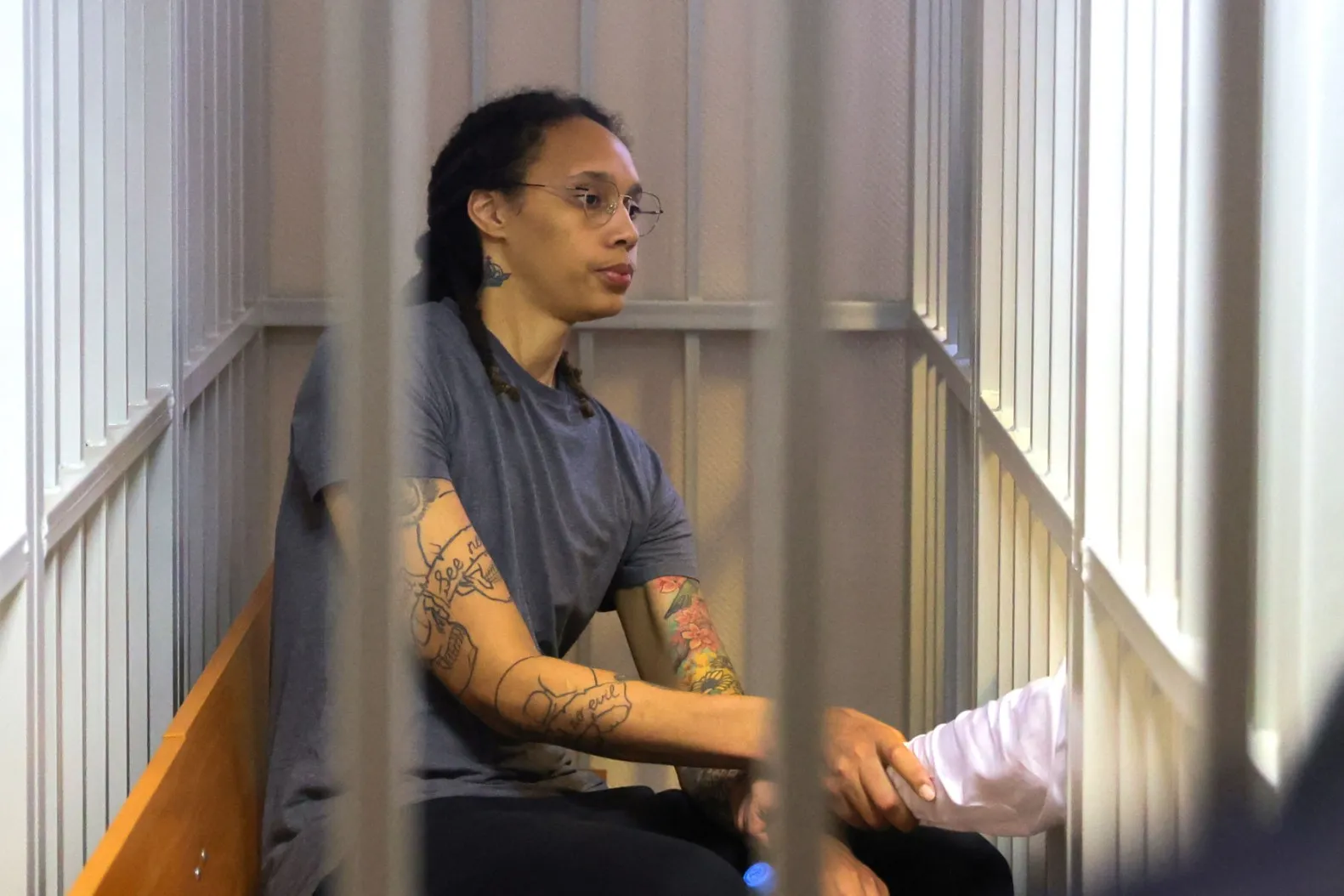
The 2022 arrest plays as a masterclass in Statist-hostaging. Russian authorities locate nearly empty THC cartridges, a small detail inflated into a nine-year sentence. The timing lines up with the invasion of Ukraine, and a legal error becomes geopolitical equipment.
Griner speaks about the penal colony conditions with dry, near-detached clarity, as if distance is the only available insulation. She describes cold, isolation, and a cell built for smaller bodies. (Parenthetical aside: the image of a world-class athlete folded into a bed that cannot hold her feels like the film’s thesis rendered in furniture.)
Sudoku books and journals become tools for a mental-fortress, something sturdy enough to withstand the Russian legal system’s weight. The trial arrives as theater: a stage where the script existed long before she walked into the courtroom.
She requests hard labor to keep a thread of agency intact, even inside a structure designed to erase it. She remains cut off from family, and she still keeps a record of her thoughts. The film shows the Russian state turning her body into a proxy for its frustrations with the West. It becomes a legal maze with no exit, law functioning like a ghost that can haunt you without protecting you.
Intersectional-Friction and the Architecture of Hope
Cherelle Griner steps forward as the architect of the advocacy-engine that brings Brittney home. She moves from private grief into public strategy, holding the White House to account and keeping the push alive. The period carries intense Intersectional-friction.
As a queer Black woman, Griner becomes a lightning rod in domestic cultural debate, a person onto whom the country projects its arguments. Some frame her as heroic. Others treat her situation as ammunition against social justice movements. The film tracks the cost to the family with a steadiness that refuses cheap catharsis.
Her return in late 2022 lands as profound relief and later leads into her participation in the 2024 Olympics. (Parenthetical aside: her tears during the national anthem get dissected with the same forensic attention people gave her trial, which feels like a national pastime with a darker subtext.) The experience reshapes her public identity into advocacy for others wrongfully detained abroad.
She uses her platform to keep other names from disappearing. The film ends with her facing a future where her identity stops functioning as a liability. She turns trauma into active resistance, and her arc rests on resilience and a sharper understanding of her own power. She remains a basketball player, and she speaks for people the system prefers to misplace.
The Brittney Griner Story premiered at the Sundance Film Festival on January 27, 2026, as a cornerstone of ESPN’s renowned 30 for 30 documentary series. The film offers a deeply personal look at the WNBA star’s 2022 arrest in Russia and the harrowing ten months that followed, featuring exclusive interviews and never-before-seen footage. It is currently available for streaming on Disney+ and ESPN+, and it continues to air periodically on ESPN’s cable networks.
Where to Watch The Brittney Griner Story (2026) Online
Full Credits
Title: The Brittney Griner Story
Distributor: ESPN Films, Disney Entertainment Television
Release date: January 27, 2026
Running time: 107 minutes
Director: Alexandria Stapleton
Writers: Alexandria Stapleton
Producers and Executive Producers: Alexandria Stapleton, Stacy Scripter, Funmi Akinyode, Megan Goedewaagen, Carolyn Hepburn, Lindsay Kagawa Colas, Jon Liebman, Cherelle Griner, Brian Lockhart, Burke Magnus, Marsha Cooke, Heather Anderson
Cast: Brittney Griner, Cherelle Griner, Lindsay Kagawa Colas, Roger Carstens, Maria Blagovolina, Alexander Boykov
Director of Photography (Cinematographer): Eve Cohen
Editors: Rosella Tursi, Benjamin Kast
The Review
The Brittney Griner Story
The documentary avoids the typical trappings of a sports film to present a somber study of a human life used as a political bargaining chip. It succeeds by grounding a massive international incident in the quiet, domestic reality of a marriage under siege. While the pacing occasionally stumbles during biographical detours, the raw access to the subjects creates a powerful sense of intimacy. It is a necessary record of a modern-day "statist-hostaging" event.
PROS
- Unfiltered access to personal journals and private reflections.
- Strong focus on the economic disparities driving female athletes abroad.
- Compelling depiction of Cherelle Griner as a central protagonist.
CONS
- Standard biographical segments occasionally slow the narrative momentum.
- A slightly narrow focus that misses broader global context.