

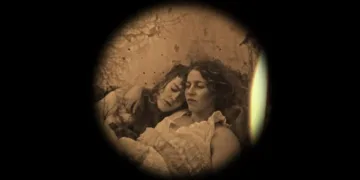







The garage sale in 1997 opens like a seam between two lives that move toward a terminal collision. In Pacific Grove, twenty-four-year-old Anna Fitch meets Yolanda Shea, a Swiss immigrant already seventy-three years deep into her own claimed territory. The meeting sparks a record that later feels like an autopsy performed on memory while it is still warm.
Co-directed by Banker White, the film stays close for a decade, and that closeness outlasts its subject. The work turns toward the making of a physical ghost: a scale model of Yo’s cottage and neighborhood. The miniature world becomes a stage for a woman who treated reality as something negotiable. A project that began with the familiar posture of filming a living artist becomes an intense labor of reconstruction.
The Habanera from Bizet’s Carmen returns again and again, a refrain for a spirit that keeps its distance. The relationship here lives in the gap between youth and the slow slide toward silence. Biographical tribute gives way to a mapped terrain of friendship that endures until Yo’s physical cessation in 2013.
The Anatomy of a Rebel
Yolanda Shea wears rebellion like a second skin, formed in the cramped rooms of Italian-speaking Switzerland. Her past carries friction with the pull of conservative heritage. She recalls an argument with a Catholic priest during confession, an argument that ends with her exclusion from the church. The rejection of the divine arrives early, and it shadows the life that follows.

In California, she abandons the expected roles of mother and wife. Highway One becomes a kind of cold clarity for her, with years spent hitchhiking, and homelessness accepted as part of the bargain. In her later kitchen, cannabis sits on the table with the casual frequency of tea. She speaks of one specific LSD experience as an absolute fracture from the mundane world, as if a seam in the everyday finally tore open.
Also Read




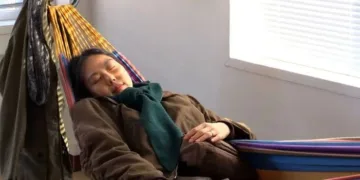
Her final days carry an unapologetic decay. She gives weathered skin and silver hair to the camera without performing beauty, and the camera receives it without flinching. The portrait holds contradictions that never settle into a neat moral. She remains affectionate toward her four children, and the choice to leave them behind still casts a long shape across her.
A phobia of birds persists as dread carried forward from youth, and then shifts in a way that feels almost impossible to explain with certainty. She befriends a blue jay, and the friendship reads like a truce with what once held her in fear. The film presents a woman who refuses to be tamed by age or by social requirement, and it leaves room for the discomfort that refusal can bring.
Handcrafted Memory and Visual Language
The film speaks through a deliberate vocabulary of miniatures, a language built to articulate loss by giving it edges and surfaces. Fitch constructs a replica of Yo’s environment at a scale that invites strange physical intimacy. The filmmaker’s hands loom in the frame, arranging furniture from a dead woman’s life.

The image carries a disquieting sensation of a world held and controlled by a grieving giant, tender and invasive at the same time. A hand-carved marionette stands in for the departed, moving through the model house with stiff, eerie mimicry that never quite becomes life. The artificial motion feels honest in its limitation. It admits the failure that sits inside every attempt to bring someone back.
Entomological imagery threads through the film as cold commentary on existence. Caterpillars shed their skins in time-lapse, and the transformation suggests the self as a temporary vessel, borrowed for a while and then discarded. In a surreal slide away from ordinary realism, greedy relatives appear as cockroaches feeding on the ruins of a mother’s apartment.
The metamorphosis turns family into scavengers and brings forward the bitterness that can follow death. Archival photos and stop-motion animation bridge the distance between what was tangible and what remains remembered. These methods create scenes the camera never witnessed in real time, and the creation carries its own uneasy beauty. Memory becomes material here, something that can be manipulated, painted, and staged. Wood, paint, and clay take precedence, heavy with texture, resisting the clean drift of the digital.
The Creative Process of Mourning
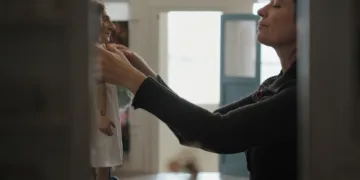
The production lasts ten years, long enough for observation to harden into preservation. The film follows the slow physical decline of a woman whose mental sharpness stays jagged. Anna Fitch appears on-screen as a surrogate daughter, watching a mentor move toward departure while her own infants enter the edges of the frame.
The infant daughter of the filmmakers shares a book with a dying Yo, a stark image of beginning and ending pressed into the same moment. Grief needs somewhere to go, and art becomes the place where hands can keep working when the heart feels overloaded. The replica cottage stands as a tomb that invites visitors to enter, linger, and feel the weight of a life arranged into rooms.
Yo’s voice continues to inhabit the space, sharp enough to cut through sentimentality. The film treats aging as an encounter with the unknowable, and that encounter resists tidy understanding. Clarity never arrives as a prize. The work accepts the presence of a ghost and holds it there, as if holding is the only honest gesture left. Her closing words carry finality in their simplicity: a French phrase meaning “that is life.”
The phrase lands as surrender to the void, and it also carries a kind of stubborn calm. She lives without a desire for monuments, without a need for a legacy polished into perfection. The film recognizes that every life ends in quiet, inevitable cessation, and it honors her rebellious spirit by leaving the rough edges visible, still raw, still unresolved.
This documentary premiered yesterday, February 20, 2026, at the 76th Berlin International Film Festival. It was featured in the main competition as the only documentary vying for the Golden Bear. First Hand Films manages the international distribution and sales. While it currently tours the festival circuit, broader streaming or theatrical availability is expected through arthouse platforms later this year.
Where to Watch Yo (Love Is A Rebellious Bird) (2026) Online
Full Credits
Title: Yo (Love Is A Rebellious Bird)
Distributor: First Hand Films
Release date: February 20, 2026
Running time: 78 minutes
Director: Anna Fitch, Banker White
Writers: Anna Fitch, Banker White
Producers and Executive Producers: Sara Dosa, Hannah Roodman, Banker White, Anna Fitch
Cast: Yolanda Shea, Anna Fitch, Dylan White
Director of Photography (Cinematographer): Banker White, Andy Mitchell
Editors: Banker White
Composer: Tyler Strickland
The Review
Yo (Love Is A Rebellious Bird)
The film serves as a somber, meticulously crafted bridge between the living and the dead. It avoids the shallow waters of sentimentality by grounding its grief in the heavy, tactile reality of miniature wood and paint. While the focus on the filmmaker's own artistic process occasionally threatens to overshadow the subject's own creative legacy, the result remains a profound meditation on the inevitability of the void. It is a haunting, irregular tribute to a woman who lived with a jagged, uncompromising autonomy.
PROS
- A striking, original visual language that utilizes high-fidelity miniatures.
- A raw, unsentimental portrait of a complex and rebellious female protagonist.
- Effective use of surreal, entomological metaphors to explore themes of transformation.
- Deeply personal and philosophically grounded exploration of the mourning process.
CONS
- The focus on the director’s handiwork occasionally minimizes the subject’s own art.
- Certain structural choices feel scattered, lacking a traditional narrative anchor.