



















The air in Italy in 1983 carried a heavy scent of transition. The country was trying to move past the leaden years of political violence, yet a different strain of tension stayed close to the skin of everyday life. Friday nights could feel ritualistic: streets quieting, millions turning their television sets to the same frequency.
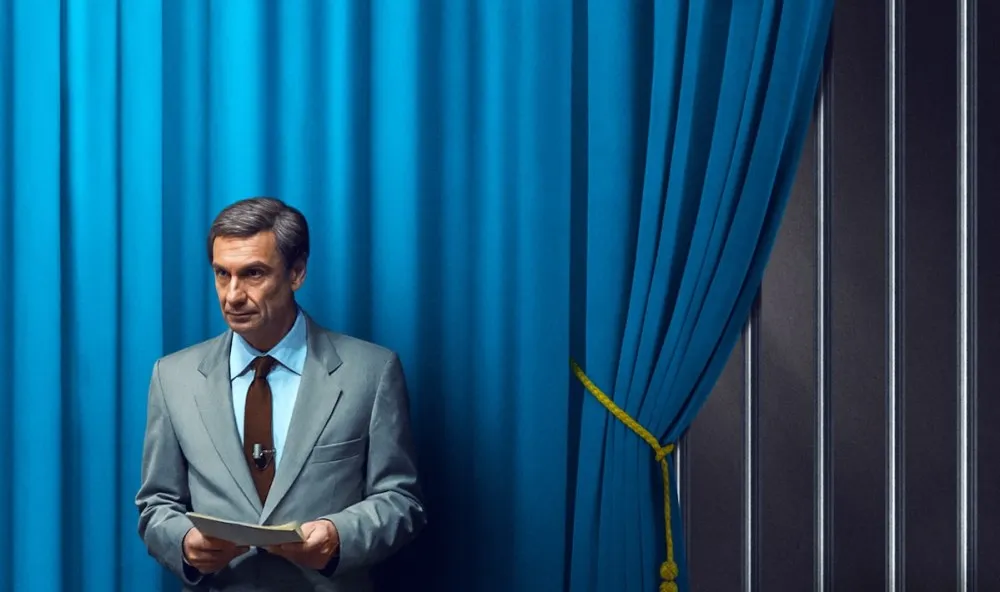
Enzo Tortora, played by Fabrizio Gifuni with sharp, ethical precision, read as a pillar of the establishment, the sort of figure a nation projects stability onto. His arrest on June 17, 1983 hit like a national jolt that outpaced any earlier scandal. Authorities accused him of high-level involvement with the Nuova Camorra Organizzata, an allegation that clashed with the logic of his public persona.
Marco Bellocchio’s six-episode HBO Max production frames the event as a point of no return for Italian civil society. The series sidesteps the expected rhythms of a biographical drama and locks onto the fast, terrifying erosion of a human life under state-sponsored suspicion.
The image of a national hero gets dismantled piece by piece until what’s left feels hollowed out. It becomes a study of how justice can run on public perception, how the machinery keeps moving once a story takes hold. Watching it, I kept thinking about how easily a familiar face turns into a screen for other people’s needs, the way a crowd can demand a plot twist even from real life.
The Fractured Reality of the Soundstage and the Cell
The storytelling hinges on constant, jarring movement between the high-gloss world of television and the brutal confinement of the penal system. Bellocchio spends real time inside the variety program that gave the series its name, treating it like a civic room with studio lights. Inventors arrive with bizarre gadgets. Ordinary citizens step forward to tell their life stories to the country. The mood carries an earnest, provincial charm, the sort of intimacy that makes a mass audience feel like a neighborhood.
Ramon, the parrot stationed at the center of the set, stands out as a silent witness to Tortora’s peak influence. The bird famously refuses to speak, and Bellocchio uses that detail as a needle of absurdity threaded through the later criminal accusations. It plays like a deadpan joke with a terrible aftertaste. I’m a sucker for that kind of visual punctuation, a small element that keeps tapping the glass while the room insists it’s hearing something else.
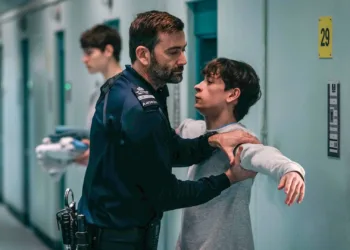
Across the country, the program draws a staggering audience and seeps through every layer of society. Nuns in secluded convents watch with the same intensity as hardened criminals inside Poggioreale prison in Naples. The series keeps a critical eye on that overlap. It shows inmates viewing the host as a distant, unattainable emblem of success while they plot his downfall from smoke-filled cells.
The visual language underlines the split: bright, flat studio lighting that begins to feel aggressively artificial when it sits next to the damp, grey reality of prison corridors. Bellocchio suggests celebrity and criminality sit closer than the public likes to admit, linked by the same medium. A television screen holds the distance, then the state closes it with handcuffs. The switch in proximity lands with a chill, like a channel change that reveals the same country in a harsher light.
The Geometric Progression of a Judicial Farce
The legal case against Tortora plays out as a descent into a particular kind of institutional madness. It begins with testimony from figures such as Giovanni Pandico. Lino Musella portrays Pandico as a man driven by a desperate need for relevance. His work as a low-level secretary for a mafia boss places him near secrets, yet his engine is personal. Pandico sends a set of knitted lace doilies to the variety show and expects public acknowledgement. It never comes. That perceived slight becomes the seed of a national tragedy.
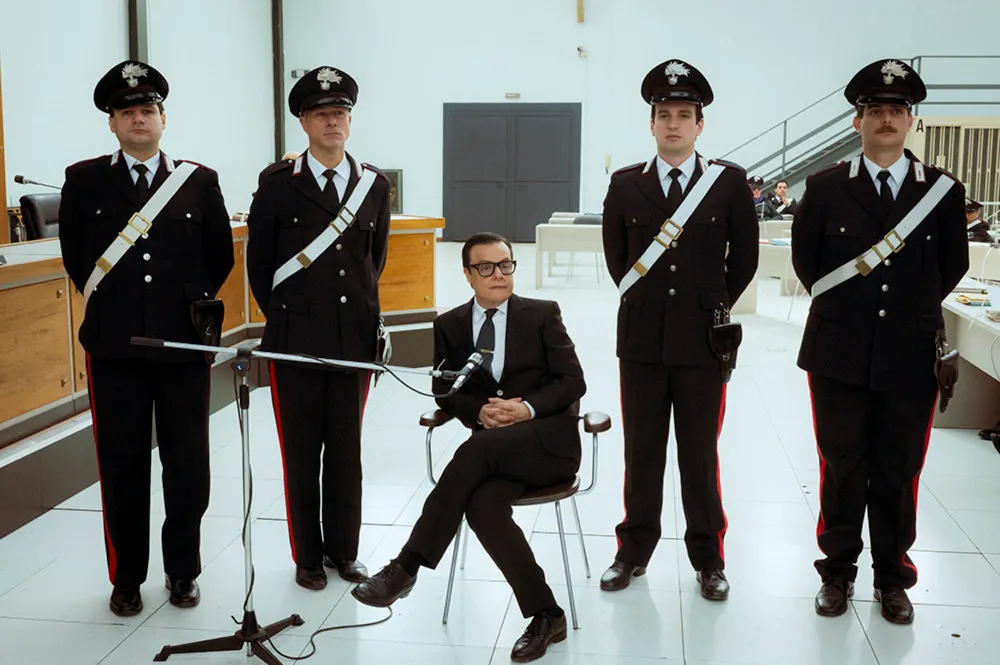
Pandico claims Tortora is a key figure in the Camorra’s drug distribution network. He tells investigators the lace doilies function as a sophisticated code for cocaine shipments. From there, the prosecution’s logic turns into a self-feeding loop.
The system begins to lose the ability to separate fact from invention, and the claims grow stranger. Pandico even suggests the silent parrot is part of the conspiracy. Physical evidence never materializes, yet the case keeps gaining momentum, powered by the word of mob informants ready to trade lies for reduced sentences.
Tortora ends up forced into an impossible posture: proving innocence against a tide of shifting testimonies. The burden of proof flips in practice. The protections of citizenship fall away, and the investigators treat his very existence as confirmation.
Bellocchio captures the helplessness of a man caught inside a machine that prizes procedure over truth. If you’ve ever watched a public narrative calcify in real time, you recognize the rhythm: an accusation becomes a headline, the headline becomes a premise, and soon the premise gets treated like evidence.
The Grotesque Vision of Institutional Failure
Bellocchio brings a distinctive aesthetic sensibility to the historical account. He steps away from the strict constraints of social realism and leans into a style that feels grounded and hallucinatory at once. Rats recur in the hallways of government buildings, a blunt image of rot that runs deeper than a single false accusation. The courtroom takes on the shape of theater, with performers fixated on spectacle.
Gifuni anchors the emotional weight of the series. He lets you see the precise instant Tortora’s professional mask begins to crack. Disbelief hardens into cold fury as he recognizes the scale of betrayal from his peers and from the network he helped build. There’s a harsh clarity in the way the performance strips away television polish. It reminded me of how a great editor can cut through surface charm and leave only the exposed nerve, the moment that tells you what a system costs a person.
Bellocchio forces the viewer to face the scandal’s lasting impact. The series studies how the press and the judiciary can work in tandem to destroy an individual in service of a clean narrative. One of the most haunting sequences shows Tortora being led away by police while former colleagues film the event for the nightly news.
The man who once controlled the cameras becomes subject to the same lens he mastered. That turn hits with a modern sting, tied to contemporary anxieties about how fast public judgment moves and how fragile reputation becomes in an age of mass communication.
The series offers no comfortable resolution. It leaves an image of a broken man alongside a justice system that looks largely unchanged by its own failures. What lingers is the warning: permanent scars carved by systemic stupidity, and the ease with which a society can turn on its icons once the story demands a fall.
Portobello is a high-profile Italian biographical drama that premiered globally on February 20, 2026. Directed by the legendary Marco Bellocchio, the six-part miniseries is the first Italian original production for the HBO Max platform. The show reconstructs the tragic and scandalous true story of Enzo Tortora, a beloved television host who was arrested in 1983 on false charges of drug trafficking and mafia involvement. You can stream the series exclusively on HBO Max, where episodes are being released weekly following its successful debut.
Where to Watch Portobello Online


Full Credits
Title: Portobello
Distributor: HBO Max
Release date: February 20, 2026
Rating: TV-MA
Running time: 60 minutes
Director: Marco Bellocchio
Writers: Marco Bellocchio, Stefano Bises, Peppe Fiore, Giordana Mari
Producers and Executive Producers: Lorenzo Mieli, Mario Gianani, Simone Gattoni
Cast: Fabrizio Gifuni, Lino Musella, Barbora Bobulová, Romana Maggiora Vergano, Alessandro Preziosi, Fausto Russo Alesi, Carlotta Gamba, Gianfranco Gallo
Director of Photography (Cinematographer): Francesco Di Giacomo
Editors: Francesca Calvelli
Composer: Teho Teardo
The Review
Portobello
This series provides a chilling examination of a judicial system governed by performance rather than proof. Through a lens that balances factual precision with the grotesque, it captures the terrifying speed of a public downfall. The portrayal of a man trapped in an institutional nightmare remains deeply unsettling. It serves as a stark reminder of the fragile boundary between celebrity and ruin.
PROS
- Fabrizio Gifuni provides a precise and emotionally resonant lead performance.
- The direction avoids standard tropes in favor of a unique, surreal aesthetic.
- It offers a sharp, relevant critique of media-driven public judgment.
- The historical reconstruction of 1980s Italy feels grounded and authentic.
CONS
- The middle episodes occasionally suffer from repetitive courtroom sequences.
- The pacing feels deliberate and may seem slow to those seeking a standard thriller.