


















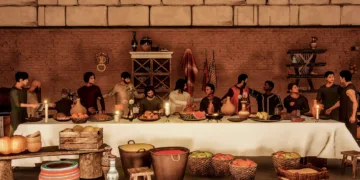


Mafia: The Old Country changes the scenery of the franchise, leaving behind the familiar American cities for a foundational story set in early 20th-century Sicily. We are introduced to Enzo Favara, a man defined not by ambition but by desperation. His life begins in the suffocating toil of the island’s sulfur mines, a world away from the tailored suits and city lights associated with the Mafia mythos.
Enzo’s flight from this life of indebted servitude leads him directly into another. He finds himself in the service of the local Torrisi crime family, trading one form of bondage for another. This exchange is framed as a choice born from necessity, setting the stage for an examination of the harsh economic realities that allowed organized crime to take root in the Sicilian soil.
The game successfully presents an authentic and atmospheric depiction of its time and place, driven by a capable narrative. This commendable presentation, however, is paired with conventional and sometimes dated gameplay mechanics.
A Sicilian Saga
The game’s plot follows a recognizable arc for anyone with a passing knowledge of gangster cinema. Across a focused 12 to 13-hour runtime, Enzo Favara enters the Torrisi crime family, slowly rises through its ranks, and inevitably faces the conflicts and moral compromises inherent in such a life. The narrative’s most interesting choice is its deliberate pacing.
The opening hours are slow, dedicated to portraying the physical labor and bleak outlook of Enzo’s pre-mob existence. This section asks for patience, but it’s a crucial investment. By grounding the player so thoroughly in the mud and dust of abject poverty, the story makes Enzo’s eventual turn to crime feel less like a choice and more like the only available path to a life with dignity. The use of historical context is the narrative’s strongest asset. The depiction of the exploitative sulfur mines is not just a backdrop; it’s a powerful motivator that informs the entire story, providing a socioeconomic foundation for the violence that follows.
This story is populated by a memorable cast. Enzo himself evolves believably from a quiet, downtrodden laborer into a capable and conflicted enforcer. His transformation feels earned. He is guided by Don Torrisi, a soft-spoken patriarch whose quiet intensity is masterfully conveyed by a standout voice performance, making him feel genuinely powerful.
The supporting roles are equally well-drawn. Luca acts as a warm and practical mentor figure, grounding Enzo in the family’s traditions. Cesare, the Don’s hot-headed nephew, serves as a constant source of internal friction and a cautionary tale about ambition without discipline. Tino, the family consigliere, is a chilling presence from his first scene, while Isabella provides the story with its central, if somewhat conventional, romantic conflict.
The script acknowledges its debt to mob story tropes but executes them with conviction. The dialogue feels authentic to the time and place, and the performances from the entire English voice cast are rock-solid. The availability of a full Sicilian language track is a welcome touch that further enhances the game’s commitment to its setting.
The Old World
Hangar 13 has poured immense effort into realizing its vision of early 20th-century Sicily, and the results are often breathtaking. The island is a world of stark contrasts, from the sun-scorched hills of the countryside to the intricate stone architecture of the fictional town of San Celeste. The attention to historical detail is meticulous, apparent in everything from the period-correct clothing to the design of storefronts and home interiors.

The game frequently slows the pace, forcing the player into “walk-and-talk” sections that move through these lavishly crafted environments. These moments function as a form of environmental storytelling, allowing the artistry of the world to take center stage. This potent visual atmosphere is reinforced by exceptional sound design.
The raw, clanking, and sputtering sounds of the era’s primitive automobiles are a constant and wonderful auditory texture. Driving one of these machines feels like operating a loud, barely-controlled piece of industrial equipment. This is complemented by a musical score that blends traditional Sicilian folk melodies with more dramatic orchestral pieces, perfectly suiting the mood of each scene.
For all its beauty, this world is ultimately a facade. The game abandons the open-world structure of Mafia 3 for a linear, chapter-based design reminiscent of the series’ earlier titles. The expansive map serves as a beautiful but static backdrop for missions, not a dynamic sandbox for player-driven action.
Outside of the main story path, the world is shockingly lifeless. An “Explore Mode” lets you roam freely, but doing so only highlights the emptiness. There is no law enforcement system, and civilian NPCs barely react to your presence, whether you are driving carefully or causing chaos. This creates a strange dissonance; the game shows you a vast, inviting world but provides almost no meaningful ways to interact with it.
Collectibles like hidden statues and photo spots exist, but they feel like a superficial checklist in a world devoid of actual side activities or emergent events. Unlike the living ecosystems of a game like Red Dead Redemption 2, Sicily here feels more like an elaborate and beautiful museum exhibit.
Tools of the Trade
The core mechanics of Mafia: The Old Country feel like a relic from a past generation of action games. The third-person combat is a standard cover-based shooter system. It is functional, but it does nothing to advance the formula. You pop in and out of cover, trading shots with enemies until one side is eliminated.

The firearms, appropriate for the era, have a satisfying weight and produce a powerful boom, which gives the gunplay a decent sense of impact. The enemy AI adds a small spark of life to these encounters; foes are aggressive, will attempt to flank your position, and can force you to reposition. This keeps the firefights from feeling completely rote, but it’s a minor point in an otherwise unremarkable system.
A minor character progression system exists in the form of equippable rosary beads, which grant small passive bonuses like a slight increase in looted money or minor damage buffs. The effects are so inconsequential that the entire system can be safely ignored without any noticeable change in difficulty or playstyle.
The game’s stealth system is similarly rudimentary. Most stealth encounters are linear paths where you simply follow a patrol route, waiting for the correct moment to perform a takedown. The game includes the basic building blocks of a stealth system, such as the ability to toss items to create a distraction and the option to hide bodies in containers. However, the implementation is clumsy and inconsistent.
Only certain bottles, for example, can be picked up and thrown, a design choice that arbitrarily limits player options and breaks immersion. The biggest issue is the inclusion of several rigid, instant-fail stealth missions. These sequences demand perfection, and a single mistake often sends you back to a checkpoint far from your point of failure. This creates tedious trial-and-error gameplay that feels punishing rather than challenging.
Driving these early-century automobiles is an atmospheric pleasure, yet the game’s design undermines this strength. The audio-visual experience of navigating the countryside in a sputtering motorcar is fantastic. However, the game’s strict mission-based structure means you are rarely given a choice of vehicle.
The ability to purchase new cars for your garage becomes an almost pointless feature, a money sink with no real gameplay payoff. The one time all these elements align perfectly is during a mission inspired by the famous Targa Florio road race. This thrilling sequence is a highlight of the entire game, a fleeting moment where the vehicle mechanics are allowed to truly shine.
An Honorable Duel
Instead of traditional boss battles, The Old Country uses a bespoke knife-fighting minigame for its most significant confrontations. These duels lock you into a one-on-one arena where you must use a simple system of dodges, parries, and attacks to defeat your opponent.

The fights are visually dramatic, filled with flashy animations and bloody clashes that are meant to feel personal and intense. Mechanically, however, they are quite shallow. The system is introduced early and never evolves; there are no new moves to learn or complex enemy patterns to master.
While these duels are meant to inject a sense of Sicilian honor and tradition into the violence, their implementation is often clumsy. The fights quickly become repetitive, feeling more like interactive cutscenes than engaging tests of skill. You often feel like a passenger, waiting for a scripted animation to play out after landing a few successful hits. The narrative logic also strains credulity, as high-ranking enemies will consistently and inexplicably discard their superior firearms to engage in a knife fight with Enzo.
For a game that works hard to ground its story in a realistic setting, this recurring trope feels jarringly out of place. This system is further burdened by a knife durability mechanic during normal gameplay. Your knife can become dull and requires a consumable whetstone to sharpen, a piece of needless resource management that discourages the use of what should be a basic combat ability.
Final Thoughts
The greatest success of Mafia: The Old Country lies in its masterful creation of a specific time and place. It is a game defined by its atmosphere. The stunningly realized Sicilian landscape, the meticulous historical detail in its art design, and the authentic soundscape work in concert to transport the player to the early 1900s. This powerful sense of place provides the foundation for a well-told, if familiar, narrative. The story is brought to life by a cast of strong characters and uniformly excellent voice performances, and it thoughtfully uses its setting to provide a deeper context for its tale of crime and survival.

Unfortunately, this narrative and atmospheric success is shackled to a suite of dated and uninspired gameplay mechanics. The core interactive loop, composed of generic cover shooting and rudimentary stealth, feels like it was designed a decade ago. It is functional but lacks any spark of innovation or mechanical depth.
The beautiful world is ultimately a static set piece with almost no interactivity, and features like the knife duels and character perks feel like underdeveloped concepts rather than fully realized systems. The game consistently builds a stunning stage but gives the player very few interesting things to do on it.
This is a game of two distinct halves, and your enjoyment will depend entirely on which half you value more. For players who prioritize storytelling, character development, and a rich, immersive atmosphere, The Old Country offers a worthwhile experience. It succeeds as an interactive period drama, a compelling journey to a rarely explored time in history.
However, players seeking a modern action game with deep mechanics and a dynamic world will find the experience to be a significant disappointment. It is a game that respects its subject matter immensely but respects the player’s time far less, a flawed relic that is admirable for its ambition but frustrating in its execution.
The Review
Mafia: The Old Country
Mafia: The Old Country is a triumph of atmosphere and storytelling, presenting a beautifully realized, historically grounded vision of early 20th-century Sicily. Its world is stunning and its characters are compelling. However, this narrative achievement is chained to a set of dated, shallow, and often frustrating gameplay mechanics. It’s a game worth experiencing for its powerful sense of place, but only if you have the patience to endure the rudimentary action that connects its excellent story beats. It succeeds as an interactive period drama, but falters as a modern video game.
PROS
- Exceptional atmosphere and an immersive sense of time and place.
- Beautifully detailed world with authentic art and sound design.
- A well-told story with strong, well-acted characters.
- Effective use of historical context to ground the narrative.
CONS
- Dated and uninspired cover-shooting and stealth gameplay.
- The world is beautiful but feels static and lacks meaningful interactivity.
- Underdeveloped features like knife duels and the perk system feel tacked-on.
- Rigid, linear mission design limits player freedom.