





























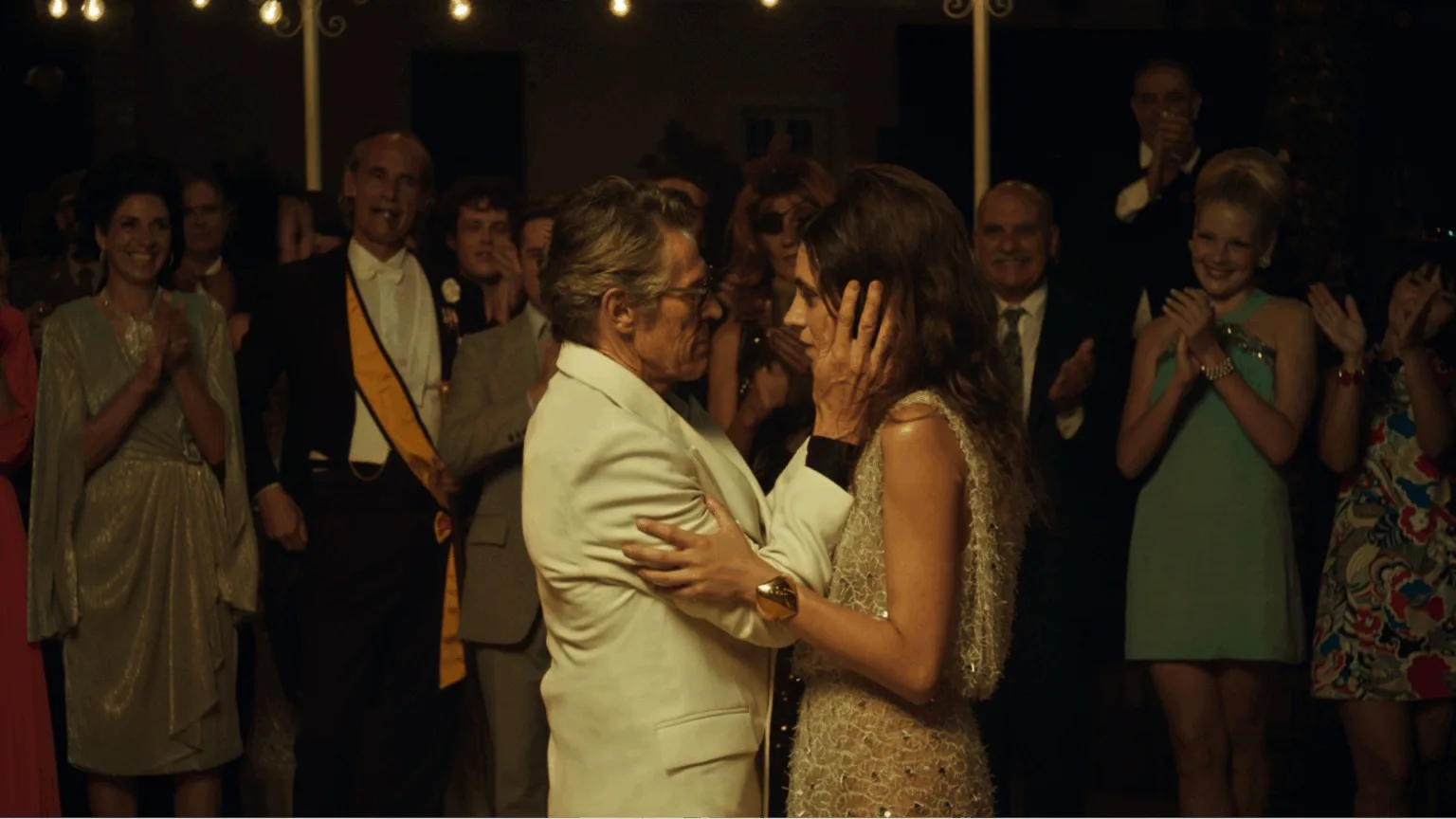

The air on the island is thick with salt and secrets. In the summer of 1975, the Mediterranean sun beats down on a private Hellenic paradise, yet the light feels hard, accusatory. It carves sharp shadows that cling to the white-washed walls of a sprawling villa.
This is the domain of Marcos Timoleon, an industrial titan of Onassis-like stature, played by Willem Dafoe with reptilian stillness. He has gathered a coterie of associates for the 25th birthday of his daughter, Sofia.
She is the celebration’s ostensible center, yet Vic Carmen Sonne plays her with a hunted awareness, a pawn in a game whose rules are being written in real time. The hedonism is a facade, the champagne-soaked pleasantries a thin veil over a meticulously engineered psychological trap. This is not a party. It is an arena.
The Minotaur in His Labyrinth
Marcos Timoleon operates from a place beyond conventional morality, a self-made deity enthroned on an island of his own creation. His power is absolute, his grief for a lost son a catalyst for a terrifying recalibration of his world. Legacy is the new currency, and Sofia is his last convertible asset. Director Miguel Ángel Jiménez builds the architecture of this control with chilling precision.
A reel-to-reel tape recorder, spinning quietly in a back room, turns every conversation into a potential exhibit and the entire island into an expressionistic panopticon. The effect is a poison that seeps into every interaction, rendering trust impossible. Marcos does not need to raise his voice; his influence is atmospheric, a pressure felt in the strained silence between words. Willem Dafoe embodies this tyranny with a frightening economy of gesture.
His performance is less a transformation than a harnessing of his own singular screen presence, that of an ascetic predator. He is always recognizably Dafoe, a choice that makes the character’s menace feel unnervingly authentic, as if this capacity for coldness is not performed but simply revealed.
During a solo dance, the camera frames him in a tight medium shot against pure blackness, his limbs moving with a strange, isolated grace. He is a man glowing against the darkness, utterly convinced of his own righteousness before the party’s light intrudes once more.
Captives of the Sun King
The film’s human heart beats within its female characters, women fighting for oxygen in the vacuum of the patriarch’s will. The narrative weight rests on Sofia, who is far more than a spoiled heiress; she is a survivor of addiction and layered family tragedy, a woman attempting to author her own existence. Her relationship with the biographer Ian is not just romance, it is a desperate bid for a normal life, an escape route from the gilded cage.
Vic Carmen Sonne’s performance is a study in precision. Her posture shifts from defiant confidence to the coiled tension of a cornered animal, her gaze flickering with a constant, weary calculus of risk. She makes Sofia’s predicament visceral, a fight for fundamental autonomy over her body and future.
Alongside her is Olivia, Marcos’s wife, portrayed by Emma Suarez as a ghost of a possible future. She arrives armed with a lawyer, a desperate gambit for freedom, yet her attempts to negotiate a divorce are systematically dismantled by Marcos’s quiet threats. Her arc is a devastating portrait of almost-liberation, a chronicle of a spirit eroded by proximity to absolute power.
The scenes between Olivia and Marcos are masterclasses in subtext, illustrating how financial control becomes a tool of profound emotional violence. Together, the two women map the bleak terrain of resistance in a world built to deny it.
A Sun-Bleached Noir
Miguel Ángel Jiménez weaponizes beauty. The cinematography by Gris Jordana drenches the screen in golden light and cerulean water, yet this postcard prettiness is a deliberate trap, creating a paradise that suffocates. This is a sun-bleached noir, a genre inversion where the oppressive brightness offers no place to hide and hard shadows function like prison bars.

The 1970s setting is not simple nostalgia; it is a canvas of decadent rot, where glistening prawns and misspelled birthday cakes become small, sickly signifiers of a deeper moral decay. By confining the narrative to a taut 48 hours, the film becomes a pressure cooker, the camera often adopting a character’s subjective viewpoint to implicate the audience in its claustrophobic voyeurism.
The sound design enhances this, layering the festive chatter with an undercurrent of abrasive quiet. The Bacchanalian revelry of the second act inevitably curdles, tipping into a grim, unsettling spiral as dawn breaks and the lighting scheme shifts to cool, clinical blues.
This story is not a simple parable of the rich getting their just desserts. It is about a species that consumes its own. Marcos remains insulated by his own delusion, a point made with bleak irony as Dafoe’s voice closes the film, reciting “Please Don’t Let Me Be Misunderstood.”
Full Credits
Director: Miguel Ángel Jiménez
Writers: Giorgos Karnavas, Miguel Ángel Jiménez, Nicos Panayotopoulos
Producer: Giorgos Karnavas
Cast: Willem Dafoe, Vic Carmen Sonne, Joe Cole, Emma Suárez, Christos Stergioglou, Carlos Cuevas, Antonis Tsiotsiopoulos, Fransesc Garrido, Maria Pau Pigem, Pelle Heikkilä, Elsa Lekkakou
Director of Photography: Gris Jordana
Editors: Nacho Ruiz Capillas
The Review
The Birthday Party
A potent and impeccably crafted psychological thriller, The Birthday Party is a masterclass in sustained dread. Miguel Ángel Jiménez’s ice-cold direction and the powerful performances, particularly from a phenomenal Vic Carmen Sonne, create a chilling study of patriarchal control. While its unrelenting bleakness may prove alienating for some, this sun-bleached noir is a beautiful, monstrous film that lingers long after the credits roll, leaving one to ponder the banality of evil in the face of absolute power. It’s a stunning piece of cinema.
PROS
- Miguel Ángel Jiménez creates a taut, claustrophobic atmosphere with meticulous control.
- The "sun-bleached noir" aesthetic is visually arresting, using Mediterranean beauty to create a sense of dread.
- Vic Carmen Sonne delivers a standout performance as Sofia, and Willem Dafoe is chillingly effective as the monstrous patriarch.
- The film offers a sharp, unsettling exploration of power, family dynamics, and moral decay.
CONS
- The film's cold, grim tone can be emotionally taxing and may not appeal to all viewers.
- While effective, Dafoe’s performance operates within his established persona rather than offering a deep transformation.
- The refusal to offer a simple condemnation of its villain may leave some viewers unsatisfied.







