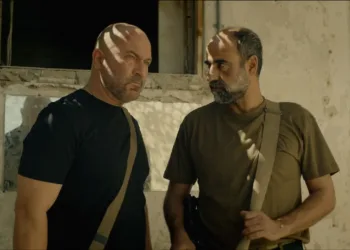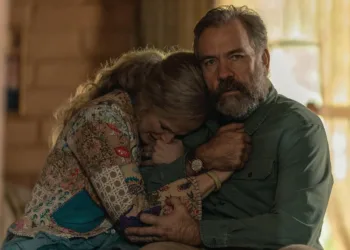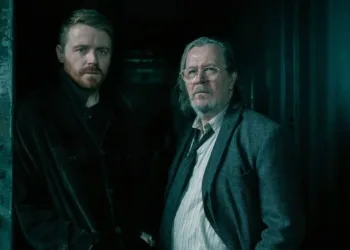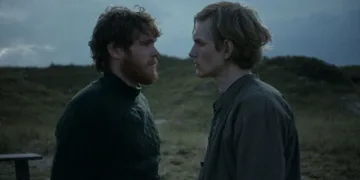

























Hein’s arrival on that North Sea island plays like a myth that got misfiled in a municipal archive. The boat cuts through mist, the figure steps onto familiar planks, and the film lets you expect the usual warmth of roots. Then it hands you paperwork.
It’s a homecoming framed as a verification process, as if belonging were an account you can have frozen for inactivity. Fourteen years away turns him into a kind of living rumor. The villagers respond with an indifference so practiced it reads like doctrine, and the story keeps tightening that screw: his mother’s progressive memory loss becomes the community’s ethics made flesh (forgetting as policy, dementia as civic infrastructure). His sister’s stare lands with the blank severity of someone told, for years, that the past is a contaminant.
The three-day trial is where the film’s satire becomes almost polite. The elders do not scream or rant. They arrange a ritual of “fairness” that already knows its verdict. It feels like Kafka with fish scales under the fingernails, bureaucratic language trying to launder a communal shunning into something that can be stamped and filed. Hein is asked to prove he is himself to people who treat recognition like a ration.
A strange thing happens, though. The setup is so nakedly cruel that it loops around into dark comedy. The village behaves like it is defending an ecosystem, and Hein is an invasive species with suspicious paperwork. I laughed once (then felt guilty, which is part of the trap).
Unroofedness and the Panoptic Shore
Kai Stänicke’s sets announce their falseness with a straight face. Houses sit like wooden shells, facades without roofs, spaces missing back walls, as if the island were built for a rehearsal that never ended. I kept thinking of a single term, “unroofedness,” because the design does more than look theatrical; it makes vulnerability architectural.

The trick is that exposure does not equal honesty. The open structures suggest a community with nothing to hide, yet the visibility becomes surveillance. Everyone can see everyone, which means everyone can correct everyone. Privacy turns into an antisocial act.
Natural light washes the frame in gray and pale blue, the kind of color palette you get when salt and wind have been sanding your world for centuries. The camera often watches from high angles, cool and clinical, turning the village into a diagram of control. It’s “panoptic” cinematography in the old sense: the gaze that makes discipline feel self-administered. The audience becomes complicit, perched above the experiment like an examiner with a clipboard. And the sea. It isn’t romantic here. It’s perimeter fencing made of water.
Still, the film refuses to be a clean concept piece. The textures are stubbornly physical: itchy wool, weathered wood, damp air that seems to cling to skin. That tactile realism fights the stage-flat artifice, and the friction matters. The island looks fake in its construction, real in its irritation, which starts to resemble Hein’s own split between memory and present demand.
The Politesse-Monster and the Hive Choreography
Paul Boche plays Hein as a man conserving oxygen. He speaks sparingly, and his face does the labor, especially the eyes, which hold a steady hunger for confirmation that never arrives. He looks almost out of time, tall and pale in a way that makes the locals seem like they’ve been carved from the island itself.
The headwoman, meanwhile, runs the proceedings with a smile that belongs in a customer service training video. It’s a weapon. Her cruelty is bureaucratically courteous, which makes her feel like a “politesse-monster,” a creature evolved for the modern age where violence prefers soft lighting and correct phrasing. She doesn’t need to raise her voice; the process raises it for her.
The supporting figures sharpen the social geometry. Friedemann, the old friend, carries a frostiness that hints at a shared secret shoved under sand dunes. Greta’s refusal stings in a way the trial cannot replicate, because intimacy is supposed to be the last refuge. Here it becomes another public institution.
The acting style goes stiff on purpose, and at first I resisted it. It can feel mannered, even alienating. Then the choice starts to click: these people aren’t behaving like individuals reacting; they’re performing roles assigned by the island’s script. Their hostility has rhythm. Their agreement has choreography. They gather to witness justice as theater, and truth becomes a disturbance that ruins the show. A very short thought: unanimity is terrifying.
Mackerel Masculinity and the “Lie” Curriculum
The film’s sharpest idea is its treatment of Heimat as a regressive utopia, a dream of home that requires constant policing. Belonging isn’t a feeling here. It’s a permission slip. The mackerel-gutting ritual sits at the center of this permission system. Hein remembers it as visceral trauma, a childhood moment where masculinity is measured in blood and performance.
The villagers remember it as pride. That mismatch is the film’s quiet thesis: memory is political, and nostalgia is a committee decision. The island rewards the version of the past that flatters its rules, then punishes any recollection that refuses to cooperate.
The recurring card game, “Lie,” becomes the social contract with cards. Bluffing, reading faces, tolerating deception, these are not side skills. They’re citizenship. Hein has spent years away from the island’s curriculum, which means he’s rusty at dishonesty, and the plot treats that rust as a threat to his survival. The irony bites: to be accepted, he must become better at lying in the way the community expects.
There’s a queer subtext running through this, and it carries weight rather than decoration. Hein’s flight reads like an escape from a heteronormative micro-cult demanding total compliance, a world where the private self is treated as contraband. Recognition becomes conditional: you can have an identity, provided it fits the village’s approved template. The film seems to argue that to be “seen” by the island is to be rewritten by it.
I caught myself wanting Hein to play along (self-preservation is persuasive). Then I wanted him to refuse on principle. The film makes room for that contradiction, because it’s honest about how communities coerce: they offer safety and erase you at the same time.
The Island as Parable, and the Cultural Bruise It Leaves
Stänicke’s island is small, yet it feels like a model for bigger systems. You can read it as a portrait of insular nationalism, of communities that mythologize purity, of societies that treat outsiders as infection. You can also read it as a study of institutional gatekeeping, the way “due process” can be staged to bless an outcome already chosen (history has plenty of examples, from show trials to quieter, administrative forms of exclusion).
The film’s cultural impact may land in the way it reframes “home” as an argument rather than a refuge. It pokes at the sentimental idea that returning is healing. Sometimes returning is an interrogation.
And maybe the most unsettling part is how believable the mechanics feel. The island’s cruelty doesn’t need grand villains. It runs on neighbors, committees, traditions, and a collective agreement to pretend the obvious is uncertain. That’s the bruise the film leaves: the sense that social annihilation can wear a polite face, speak in calm sentences, and call itself community. You walk away thinking about how many places, far from any North Sea shore, are still playing the game of “Lie,” smiling while they deal the cards.
Trial of Hein (originally titled Der Heimatlose) premiered as the opening film of the Perspectives section at the 76th Berlin International Film Festival on February 13, 2026. This psychological drama follows a man named Hein who returns to his isolated island home after fourteen years, only to be met with a “village court” trial when the community refuses to acknowledge his identity. As of its premiere this month, the film is being handled for international sales by Heretic and is a co-production with ZDF – Das kleine Fernsehspiel, where it is expected to be available for broadcast and streaming following its festival run.
Full Credits
Title: Trial of Hein
Distributor: Heretic, ZDF, SND
Release date: February 13, 2026
Running time: 122 minutes
Director: Kai Stänicke
Writers: Kai Stänicke
Producers and Executive Producers: Andrea Schütte, Dirk Decker, Dario Suter, Katrin Jochimsen, Felix von Boehm, Kai Stänicke
Cast: Paul Boche, Philip Froissant, Emilia Schüle, Stephanie Amarell, Jeanette Hain, Irene Kleinschmidt, Julika Jenkins
Director of Photography (Cinematographer): Florian Mag
Editors: Susanne Ocklitz
Composer: Damian Scholl
The Review
Trial Of Hein
Trial of Hein is a haunting, if occasionally over-deliberate, exploration of the friction between individual memory and communal myth. Stänicke’s use of "unroofed" stagecraft effectively mirrors the psychological exposure of its protagonist, though the film sometimes prioritizes its Brechtian metaphors over emotional depth. It is a rigorous, visually striking debut that reminds us that "home" is often a cage built from the stories others tell about us. While the pacing occasionally drifts, the central performance and philosophical weight make it a compelling piece of intellectual cinema.
PROS
- Striking, minimalist set design and visual aesthetic
- Intense, nuanced lead performance by Paul Boche
- Thoughtful exploration of "Heimat" and queer identity
- Effective use of natural light and atmospheric sound
CONS
- Predictable narrative beats in the final act
- Occasional over-explanation of symbolic elements
- Stilted acting style may alienate some viewers
- The 122-minute runtime feels slightly overextended