




















American Classic arrives as a comedy-drama about theater, family rupture, and the uneasy romance of going back home. Set in and around the Millersburg Festival Theater, the MGM+ series follows Richard Bean, a celebrated stage actor whose public implosion on Broadway sends him back to small-town Pennsylvania at the worst possible moment and, perhaps, the only moment that could force him to face himself. His mother has died. The family theater is struggling. The town feels worn down by financial strain and political compromise. Richard, a man who has spent years treating life as an extension of the stage, walks into that grief carrying ego, talent, shame, and a desperate need to reclaim authorship over his own story.
The setup is familiar in shape, yet the series gives it a specific texture through its devotion to theater culture and its interest in what happens when cultural prestige collides with local survival. Richard’s answer to scandal and loss is to stage Our Town, hoping that art can revive a fading institution and maybe repair a damaged self. What unfolds is warm, theatrical, and emotionally generous. The question hanging over the series is simple. Can that affection for performance turn into sharp drama about family, class, and civic identity, or does the show settle too comfortably into its own sentiment?
Richard Bean and the Performance of Collapse
Richard is introduced at a point where prestige has started to curdle. He is still famous, still decorated with the aura of serious stage greatness, yet the opening episodes strip away the glamour with unusual efficiency. He freezes, leans on help, drinks, lashes out, and turns private professional insecurity into a public spectacle. His confrontation with a critic becomes a viral humiliation, which is a sharp choice for a series invested in old theatrical traditions. The internet does not care about Richard’s legacy. It reduces him to a clip, a meme, a moment of embarrassment that travels farther than any triumphant performance ever could. In that sense, American Classic places an aging actor inside a media climate built to flatten nuance, and it finds real pathos there.
Kevin Kline gives Richard the kind of lived-in contradiction that keeps the character from collapsing into caricature. Richard is pompous, hungry for attention, absurdly self-dramatizing, and often very funny. Yet Kline keeps slipping traces of loneliness through the cracks. A line reading, a pause at a party, a flicker of hurt in the middle of arrogance, all of it suggests a man who has spent so long performing stature that he no longer knows what remains once the applause stops. Richard filters experience through theater. He reaches for Shakespeare the way other people reach for small talk, confession, or apology. That habit is comic, though it also reveals a deep incapacity. He can summon great language with ease. Plain emotional honesty is harder.
His decision to mount Our Town in Millersburg works because the series refuses to lock it into a single motive. Is he grieving? Trying to honor his mother? Chasing artistic purity? Fighting shame with grandiosity? Reasserting control in the one sphere where he still feels like himself? The answer shifts scene to scene, which gives Richard a restless complexity. He can be generous and manipulative in the same breath.
The writing gives Richard the richest inner life in the series, and there are moments when that focus narrows the world around him too much. He is the most carefully shaded figure in a town full of people who deserve that same degree of attention. Still, the show is at its best when it lets his vanity sit beside real sorrow. Richard becomes compelling there, neither redeemed by charm nor reduced to a joke about actorly narcissism.
Family as Rehearsal Space
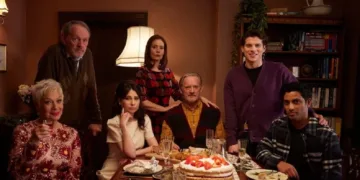
The Bean family gives American Classic its emotional engine. Richard returns as prodigal son, local legend, family irritant, and unresolved wound. Every conversation carries old history. His brother Jon has remained in Millersburg and done the unglamorous labor of keeping the theater functional. Kristen, once close to Richard and now married to Jon, has her own long memory of disappointment, desire, and compromise. Their daughter Miranda looks at acting as a path out, which makes her both Richard’s natural heir and her mother’s fresh source of anxiety. Linus, the family patriarch, moves through dementia with warmth, sadness, and flashes of comic surprise.
Jon and Kristen anchor the series in practical reality. Jon has none of Richard’s grand theatrical aura, though he understands the daily work that keeps institutions alive. Kristen is the sharper figure. As former partner, current mayor, and guardian of a fragile town, she stands where private history meets public duty. Laura Linney gives her a simmering fatigue that feels earned. Kristen knows what Richard’s brand of artistic idealism costs because she has spent years cleaning up the aftermath of dreamers who had the freedom to leave. That tension gives the series one of its strongest social threads. Richard speaks about art as spiritual necessity. Kristen deals with payroll, local resentment, political pressure, and a community that cannot eat prestige.
Miranda brings the generational layer into focus. She wants a life in performance, which connects the series to a familiar anxiety in contemporary small-town stories: the fear that ambition means departure, and that departure becomes a judgment on those who stayed. Her storyline taps into a wider cultural mood around inheritance, creative aspiration, and the shrinking promise of local futures for young people. Millersburg is full of affection, yet the series never lets that affection erase the fact that many young people are taught to see leaving as success.
Linus adds a different resonance. His repeated coming-out scenes are played for humor, though they also carry a sting. Memory is unstable. Identity repeats itself. Family members rehearse versions of care, irritation, patience, and grief every day. In a series about actors, Linus quietly becomes one of its deepest reflections on role and selfhood.
Millersburg itself is more uneven. The show presents it as a town under financial pressure, vulnerable to development schemes and institutional decline. That idea matters. At times, though, the town feels more like a soft-focus ideal of communal life than a fully textured social space. Its function is emotional before it is sociological. That choice gives the series comfort. It also limits its bite.
The Stage as Fantasy and Social Mirror
Theater is the subject of American Classic, its governing metaphor, and its comic engine. The series understands rehearsal rooms, backstage panic, performer vanity, local casting chaos, and the fragile ecstasy of making something communal out of limited means. It knows how ridiculous theater people can be. It also knows why that ridiculousness is often inseparable from devotion. That knowledge keeps the show lively.

Richard’s choice of Our Town is central. Thornton Wilder’s play has long been treated as a text about ordinary life, mortality, and the hidden value of daily rituals. Richard, true to form, responds by trying to inflate it into a spectacle with rain effects, elaborate staging, and a horse. The joke lands because it exposes a real clash between ego and material. Richard wants transcendence through excess. The play asks for humility. Their collision becomes one of the series’ smartest recurring ideas.
This is where American Classic starts touching wider cultural questions. In an entertainment environment dominated by franchise escalation, algorithmic sorting, and visual overstimulation, Our Town carries the aura of something smaller, older, and stubbornly human-scale. Richard’s instinct is to supersize it, which feels less like a personal flaw than a commentary on an industry trained to mistrust simplicity. The series keeps circling that contradiction. It wants to celebrate theater as a communal art form, yet it also understands the temptation to turn culture into event branding, local heritage into commercial rescue plan, and performance into the cure for every civic wound.
The best material comes from the way rehearsals expose feelings that ordinary conversation keeps buried. Casting choices stir jealousy, longing, old resentment, and unrealized ambition. A script gives people temporary permission to say what they cannot otherwise say. Community theater becomes a space where class, family history, and desire pass through borrowed language and come out sounding newly dangerous.
The humor is less about punchlines than collision. Richard tries to direct grief like a producer mounting an opening night. Town practicality crashes into artistic inflation. The lofty rhetoric of theater meets dinner service, municipal headaches, and amateur nerves. That dynamic is often very funny.
Yet the series strains when its faith in art turns too neat. There is a tendency to imagine theater as a civic balm capable of healing almost any fracture if enough people commit to the curtain call. That belief is moving. It can also feel a little easy. The strongest scenes resist that ease. They show performance revealing something bruised, compromised, and recognizably human.
Ensemble Grace and the Limits of Comfort Viewing
The ensemble is the series’ great strength. Kline and Linney generate the richest tension, carrying years of emotional debris into scenes that crackle with affection and annoyance. Jon Tenney gives Jon a quiet steadiness that never slips into blandness. Len Cariou brings grace to Linus, keeping him funny and fragile without turning him into a sentimental emblem. Nell Verlaque gives Miranda urgency and emotional intelligence. Tony Shalhoub, working in a smaller register, supplies dry exasperation at exactly the right moments. Elise Kibler pushes Nadia toward broad comedy, though the performance has enough energy to keep the character from feeling disposable. Even minor figures help sell the idea that the theater is a shared ecosystem.
Visually, American Classic favors interiors, rehearsal spaces, local offices, family rooms, and the theater itself. That enclosed quality fits the material. It creates intimacy and gives the show a lived-in smallness that can be appealing. At the same time, the aesthetic sometimes feels plain. The emotional ambitions are larger than the visual imagination. There are stretches where the series looks more functional than inspired, which matters in a story so invested in the transformative power of art.
The eight half-hour structure gives the show a nimble rhythm. Scenes move quickly. The season remains easy to stay with. That breeziness helps the comedy and keeps the material from hardening into prestige solemnity. It also means some relationships, civic pressures, and generational conflicts could use richer excavation. The series has plenty on its mind about local culture, artistic inheritance, and the shrinking room for institutions that exist outside pure commercial logic. It does not always dig as far as it could.
What remains is a thoughtful, appealing series that believes deeply in performance, family mess, and the fragile civic value of culture made close to home. American Classic works best as a character-driven family story shaped by theatrical language and anchored by a polished cast. Its charm is real. So are its blind spots. That tension gives the show its shape, and a fair amount of its appeal.
American Classic is a heartfelt comedy television series that premiered on MGM+ on March 1, 2026. The show follows Richard Bean, a narcissistic Broadway star played by Kevin Kline, who returns to his hometown after a very public meltdown. In an attempt to redeem himself and save his family’s struggling community theatre, he decides to direct and star in a production of a great American classic. As of today the series is available for streaming on the MGM+ platform, with new episodes releasing weekly following its two-episode series premiere yesterday.
Where to Watch American Classic Online









Full Credits
Title: American Classic
Distributor: MGM+
Release date: March 1, 2026
Rating: TV-MA
Running time: 30 minutes
Director: Michael Hoffman
Writers: Michael Hoffman, Bob Martin, Ellen Fairey
Producers and Executive Producers: Michael Hoffman, Bob Martin, Ellen Fairey, Kevin Kline, Leslie Urdang, Anthony Bregman, Miriam Mintz, David Levine, Garrett Kemble, Jon Tenney, Kevin Cotter
Cast: Kevin Kline, Jon Tenney, Laura Linney, Jane Alexander, Jessica Hecht, Len Cariou, Nell Verlaque, Billy Carter, Elise Kibler, Ajay Friese, Aaron Tveit, Stephen Spinella, Tony Shalhoub
Director of Photography (Cinematographer): Leonidas Kassapidis
Editors: David Kashevaroff
Composer: James Newton Howard
The Review
American Classic
American Classic is a warm, sharply acted series that finds real feeling in family strain, artistic vanity, and the fragile life of a hometown theater. Kevin Kline gives Richard Bean vanity, sadness, and comic flair, while the ensemble keeps the town alive around him. The writing leans on familiar beats at times, and its faith in theater can feel too tidy. Still, the show has wit, heart, and a clear affection for performance that carries it through its weaker stretches.
PROS
- Kevin Kline leads with charm, ache, and sharp comic timing
- Laura Linney and the supporting cast add depth and energy
- Strong theater-world detail and backstage humor
- Warm family dynamics with emotional texture
- Brisk half-hour pacing keeps the season lively
CONS
- Some plot turns feel familiar
- A few characters need richer development
- The town can feel idealized
- The belief in art as a civic fix can feel too neat