


























Amy is caught inside the rigid systems of corporate survival. Her work in patent acquisitions runs on dry transactions, sterile exchanges, and the constant pressure to stay available. A visit to a retirement facility to see her grandmother, Vivien, looks at first like a small break from that grind. The place has its own wild tempo. Retirees race golf carts, casino nights turn competitive, and age carries a spark of mischief.
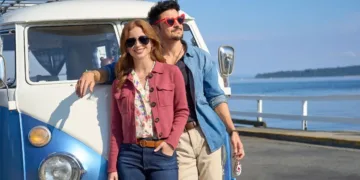
A work crisis changes the visit. Amy needs to secure a physical signature in California for a promotion, and the domestic stop becomes a cross-country trip. Vivien and her friend Sue treat the problem as an invitation. Mark, the facility’s activities director, joins as driver after Amy’s vehicle fails. His vintage Volkswagen bus works like a gameplay system built for exploration.
It values the feel of travel, the pauses, the detours, the odd landmarks, and the people sharing the ride. The four head south through a story that balances professional panic with the search for old connections. The film builds a clear tension between career pressure and spontaneous living. Its setup lets the narrative study what happens when a person finally looks away from a screen.
Archetypes and Performance Tensions
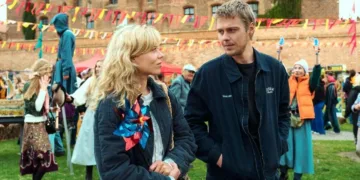
Stacey Farber plays Amy with frantic, focused energy that will feel familiar to anyone shaped by the digital workday. Amy is a portrait of modern tethering, always linked to a job that keeps pulling her attention back. Farber gives her a stiffness that loosens mile by mile, turning the road trip into a visible emotional progression.

That rigidity gives Tyler Hynes a strong counterweight as Mark. Hynes brings relaxed, fluid charm to the screen. His character calls himself a discount Jack Reacher, a self-aware joke that fits his nomadic and capable nature. Mark’s performance rhythm is built around small wonders, especially roadside oddities that Amy first treats as obstacles in her schedule.
Christine Ebersole and B.J. Harrison give the film its emotional base. As Vivien and Sue, they bring the kind of seasoned perspective the younger leads have yet to earn. Ebersole’s Vivien is driven by action, guided by a philosophy of saying yes to possibility.
That mindset becomes the story’s primary engine. The chemistry among the four actors creates a feeling of intergenerational support. Vivien and Sue act as a compass for Amy and Mark, who are both stuck in different ways. Amy is buried in work. Mark is stalled by the sheer number of possible paths ahead of him.
The pleasure comes from watching these personalities clash, adjust, and find a rhythm together. The acting keeps the characters grounded, saving them from flat archetypes. They carry histories, fears, and private hesitations. Their exchanges gain weight because each shift feels earned.
Roadside Revelations and Temporal Weight
The route from the Pacific Northwest to California mirrors the internal movement of the characters. Roadside stops, including the world’s largest ball of twine, expose the group’s competing values. For Amy, every stop burns time she believes she cannot spare. For Mark, those stops are essential beats in a meaningful life. The film draws much of its emotional design from that difference.
A large part of the narrative follows a detour to find Teddy, Vivien’s first love. That subplot brings the film’s view of love into sharper focus. Love asks for risk. Vivien’s memory of her past fling becomes a lesson for Amy and Mark, urging them to act before chances vanish. The past works here like a tutorial for the present, teaching the younger characters through lived experience.
One pivotal turn arrives when the group has to split up. Sue becomes ill, and Mark leaves Amy so he can help the older women. Amy is left to handle her work tasks alone. The separation underlines the loneliness of her career-driven existence, especially against the warmth of the group’s shared experience. The film leans into the idea of touching grass, using that modern phrase as a clean shorthand for returning to the physical world and paying attention to the present.
The script treats listening to older people’s stories as a vital act. Work deals fade. Shared adventures carry the value that lasts. The pacing of these realizations feels natural, moving at the speed of a vintage van, far from the pulse of a high-speed data connection. The characters receive room to feel the weight of their choices. That focus on presence keeps the film from slipping into routine rom-com machinery.
Aesthetic Systems and the Rhythm of Presence
The romantic movement between Amy and Mark takes a careful slow-burn shape. Their bond grows through quiet tension and gradual changes in perspective. Mark is guarded, keeping himself slightly out of reach. That distance gives Amy’s later shift in career goals real emotional force. Her choice to rejoin the group signals a readiness to let someone new into her life.
A major emotional peak comes when Christine Ebersole performs the standard song that gives the film its title. The musical choice links past and present, connecting Vivien’s history with Amy’s future. It also gives the film a moment where memory, performance, and emotional release occupy the same space.
The Volkswagen bus carries symbolic weight throughout the film. It represents a slower clock speed, directly opposed to the sterile, high-pressure world of the patent firm. Its cramped, messy interior feels alive and human beside Amy’s cold digital routine. The vehicle shapes the film’s rhythm like a game space designed to reward curiosity. Every delay, every stop, every cramped conversation becomes part of the emotional progression.
The film keeps comedy and sentiment in steady balance. Golf cart racing and casino nights add needed levity. These moments keep the themes of aging and regret from becoming heavy in a suffocating way. The technical craft supports the story’s aims.
The cinematography catches the beauty of the road without turning the film into a travel brochure. The editing leaves space for lingering glances and quiet mood shifts. By the end, the film argues for living with attention, risk, and openness. It sees memory as something built from the chances we take and the love we allow ourselves to feel.
The movie I’ll Be Seeing You premiered on the Hallmark Channel on April 25, 2026, as the final title in the network’s annual Spring Into Love programming block. Starring network favorite Tyler Hynes and Stacey Farber, the film follows Amy, a career-driven professional whose weekend plans with her grandmother take a meaningful turn into a cross-country road trip. The story highlights the value of spontaneity and intergenerational wisdom, featuring a sentimental detour to find a long-lost love. Viewers can currently watch the movie on the Hallmark Channel or stream it via Hallmark+.
Where to Watch I’ll Be Seeing You (2026) Online





Full Credits
Title: I’ll Be Seeing You
Distributor: Hallmark Channel, Hallmark Media
Release date: April 25, 2026
Rating: TV-G
Running time: 84 minutes
Director: Jessica Harmon
Writers: Joey Elkins, Blake Silver, Kathy Kloves
Producers and Executive Producers: Tyler Hynes, Charles Cooper
Cast: Tyler Hynes, Stacey Farber, Christine Ebersole, B.J. Harrison, Jana Morrison, Tom Pickett, Peter Graham-Gaudreau, Adam Fox, Fred Henderson
Director of Photography (Cinematographer): Graham Talbot, Nelson Talbot
Editors: Ellen J. Lynch
Composer: Hamish Thomson
The Review
I’ll Be Seeing You
I’ll Be Seeing You provides a grounded and moving look at the friction between career ambition and emotional presence. The film avoids typical genre traps by grounding its characters in realistic intergenerational relationships. The romantic progression moves slowly, but the emotional payoff feels earned through the wisdom of the supporting cast. The chemistry among the four leads transforms a simple road trip into a meaningful exploration of how we choose to spend our time. It is a thoughtful production that values character depth over easy plot resolutions.
PROS
- Strong intergenerational chemistry between the lead quartet.
- Christine Ebersole’s moving musical performance.
- Grounded dialogue that avoids preachy sentiment.
- The vintage van serves as an effective symbolic setting.
CONS
- The romantic lead characters occasionally exhibit frustrating stubbornness.
- The narrative pace might feel slow for viewers seeking rapid developments.
- The mid-film separation of the group creates a brief dip in energy.