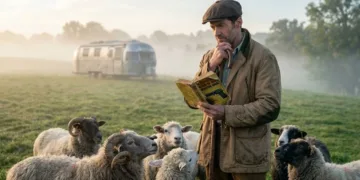















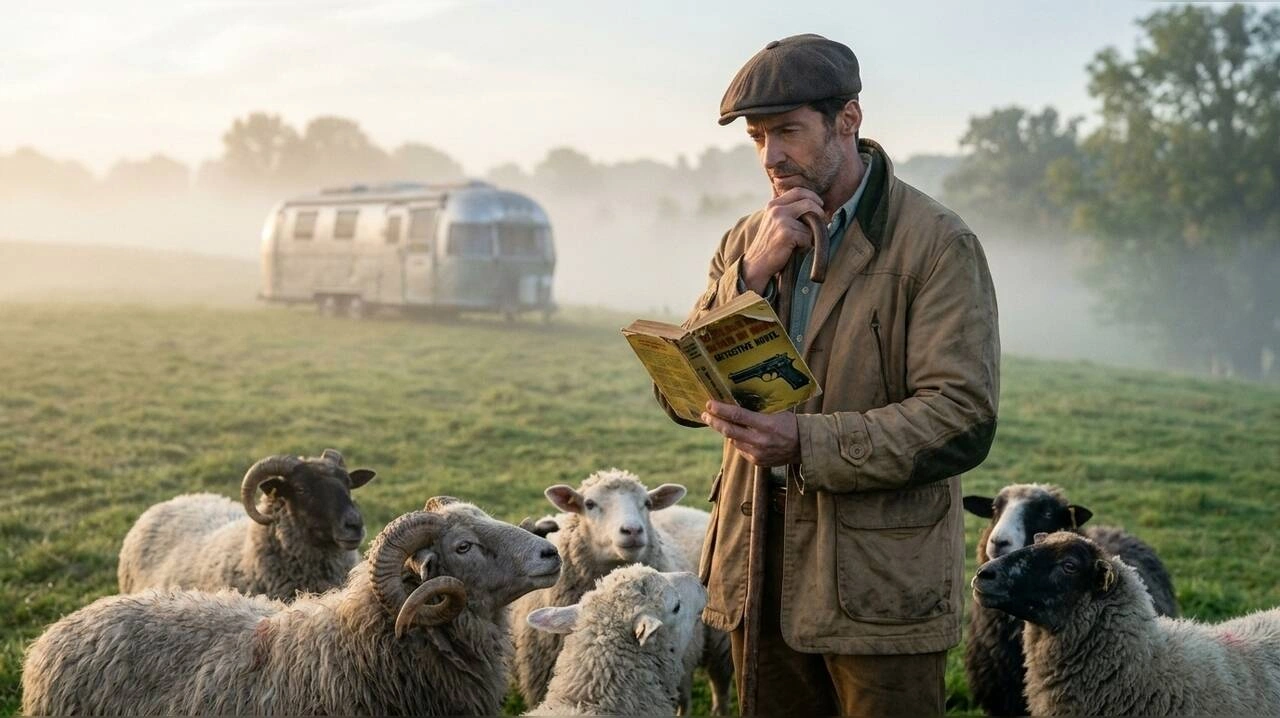

In the hushed valley of Denbrook, George Hardy lives as a lone custodian of fragile lives. Hugh Jackman gives the shepherd a weathered stillness, shaping him as a man who discovers kinship among his flock through the ritual of murder mysteries. He reads tales of blood, treachery, and hidden guilt to beings of wool and grass.
The habit forms a strange passage between animal impulse and human invention, between pasture silence and the theatrical machinery of crime. That peace breaks when the flock finds George motionless in the dew. Blue and green stains mark his hands, a cryptic farewell from a life suddenly cut away. Director Kyle Balda moves from a background in vivid animation toward a world of soil, breath, and mortal weight.
That movement echoes the sheep’s passage from untroubled grazing into grim purpose. Lily, a Shetland ewe voiced by Julia Louis-Dreyfus, becomes the designer of their search. Craig Mazin’s script balances the buoyancy of a talking animal tale with the stunned quiet of a newly opened grave. The film rejects the soft shelter of the usual fable and asks what remains after the protector disappears.
Voices from the Silent Fold
The sheep of Denbrook carry secret inner weather, a chorus of minds shaped by a cast with unusual depth. Julia Louis-Dreyfus gives Lily a sharp, anxious intelligence. Lily borrows the logic of George’s detective novels to arrange the chaos left by his absence. She becomes the consciousness that resists the apparent randomness of death, as if pattern itself could keep oblivion from entering the field.
Sebastian, voiced by Bryan Cranston, stands against her certainty with the ache of an old wound. He bears the marks of a carnival past, a life of performance that has made him guarded and tired. His skepticism lands heavily, a reminder that cruelty often finds the defenseless first. He carries the knowledge of human greed, the sour machinery behind the smiling tent.
Mopple, an Irish-accented merino voiced by Chris O’Dowd, suffers under a memory that refuses to fade. Other sheep drift toward the comfort of forgetting; Mopple preserves every jagged edge of what has happened. He is the flock’s living archive. His total recall turns awareness into a philosophical burden, a gift with a bruise inside it. Around these figures, the flock gathers into clear archetypes.
Patrick Stewart lends Sir Ritchfield a regal gravity. Regina Hall gives Cloud a polished vanity that covers shared fear. Ronnie and Reggie bring rowdy force through Brett Goldstein’s growl. Zora, voiced by Bella Ramsey, looks toward the horizon with young appetite. These voices carry feeling across the photorealistic surfaces of the animation. The actors supply the pulse missing from digital bodies. They make a grazing collective feel like a bereaved family.
The Architecture of the Mystery
The plot moves with the precise geometry of a classic whodunit. It calls up Agatha Christie’s spirit while remaining planted in farm mud. Lydia Harbottle arrives through Emma Thompson’s sharp, icy wit, bringing the chill vocabulary of human law. She discloses a fortune of thirty million dollars, a number that changes George from humble shepherd into a figure of enormous value.

From there, the film arranges its human suspects like anxious pieces on a board, each one appearing diminished and frantic through ovine eyes. Nicholas Braun plays Officer Tim Derry as a portrait of human futility. He seems trapped inside his own ineptitude, a representative of institutions unable to perceive the truth beneath the obvious. The suspects form a ring of possible malice. Rebecca, George’s daughter, carries abandonment like a shadow across her name.
The local butcher, played by Conleth Hill, regards the flock as inventory. Tosin Cole and Hong Chau help shape a village population that feels quaint and claustrophobic at once. Kyle Balda controls the tempo through movement between the village’s zesty humor and the sheep’s quiet gravity. A chicken guiding the flock across a road offers a brief flare of levity.
The script adapts Leonie Swann’s original work by relocating the setting to England and angling the tone toward a wider audience. It keeps the absurd charge of animals trying to solve a crime that humans choose to leave unseen. The story becomes a mirror, placing the smallness of human motives against the animals’ pure devotion.
The Digital Uncanny and the Eye of the Beast
Visually, the film dwells between the actual and the imagined. Framestore renders each strand of wool and each flicker of an ear with startling precision. The photorealism generates a particular unease. These animals resemble documentary subjects, yet their inner lives carry Shakespearean intensity. The choice asks the viewer to face the animal as a thinking presence, a consciousness trapped behind familiar eyes.
George Steel’s cinematography stays close to the earth. The camera rests at sheep level, making the human world loom with distorted scale and moral heaviness. Denbrook, designed by Suzie Davies, becomes an English village of charm, neon splashes, and ancient stone. Its beauty has a faintly unreal shimmer, welcoming and strange in the same breath. Puppetry used with digital effects gives the sheep a tactile presence that computer imagery can lack.
Their bodies have weight as they move through brush and touch the physical world. This craft serves the story’s existential pressure. It gives the fantasy texture, light, and mud. The landscape’s beauty collides with the ugliness of the crime. The film draws much of its force from that visual friction, from the pastoral surface trembling over violence.
The Clouds of Forgetting and the Weight of Being
The film studies the myths creatures build to survive the unbearable. The sheep speak of a cloud mythology, believing fallen companions float upward and join the sky. This belief shields them from death’s final silence. Lily’s search suggests that growth demands the breaking of such consolations. To solve George’s murder, the flock must accept his permanent absence.
Storytelling becomes their main instrument for meeting the incomprehensible. George’s books gave them a map for a place they were never meant to enter. A deep sadness gathers around the Winter Lamb, an outcast born out of season. This small creature holds the cruelty of natural cycles and the fragile beauty of persistence within the same breath. The film stresses the distance between human perception and animal reality.
Humans see mindless grazing and miss the sophisticated investigation underfoot. The irony gestures toward our blindness before the living world. The sheep prove finer detectives because ego and greed do not cloud their sight. They pursue truth because love for their shepherd compels them. The mystery’s resolution matters less than the flock’s change. They step from clouded myth into the cold, lucid light of memory.
The Sheep Detectives is a mystery comedy that brings Leonie Swann’s beloved novel to the screen with a mixture of live action and high fidelity animation. Set in the lush English countryside, the story follows a devoted flock of sheep who apply the logic of the murder mystery novels their shepherd once read to them to solve his sudden death. The film is scheduled for its theatrical premiere on May 8, 2026, in the United States and the United Kingdom. Following its exclusive run in cinemas, the production will be available for streaming on Amazon Prime Video for subscribers globally.
Where to Watch The Sheep Detectives (2026) Online







Full Credits
Title: The Sheep Detectives
Distributor: Amazon MGM Studios, Sony Pictures Releasing International
Release date: May 8, 2026
Rating: PG
Running time: 109 minutes
Director: Kyle Balda
Writers: Craig Mazin, Leonie Swann
Producers: Lindsay Doran, Tim Bevan, Eric Fellner
Executive Producers: Phil Lord, Chris Miller, Sarah Jane Wright, Amelia Granger
Cast: Hugh Jackman, Emma Thompson, Nicholas Braun, Nicholas Galitzine, Molly Gordon, Hong Chau, Tosin Cole, Mandeep Dhillon, Kobna Holdbrook-Smith, Conleth Hill, Julia Louis-Dreyfus, Bryan Cranston, Chris O’Dowd, Regina Hall, Patrick Stewart, Bella Ramsey, Brett Goldstein, Rhys Darby
Director of Photography (Cinematographer): George Steel
Editors: Martin Walsh, Paul Machliss, Al LeVine
Composer: Christophe Beck
The Review
The Sheep Detectives
The film functions as a quiet meditation on the weight of existence hidden beneath a woolly exterior. It confronts the silent void of loss with a startling sincerity. While the human elements occasionally stumble into caricature, the inner lives of the flock provide a profound look at memory and mourning. It is a rare piece of cinema that treats the animal perspective with the gravity of a Greek tragedy. This hauntingly beautiful exploration examines the stories we tell to survive the dark.
PROS
- Profound philosophical depth
- Nuanced vocal performances
- Exquisite digital textures
CONS
- Uneven human comedy
- Potential for the uncanny valley