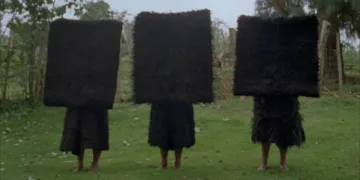














Ways to Traverse a Territory moves with the hush of fog settling over a hillside. Gabriela Domínguez Ruvalcaba’s documentary observes Tsotsil women in the highlands of Chiapas, Mexico, where sheep, wool, plants, hands, and mountain paths form the grammar of daily life. The film watches Doña Sebastiana and her daughters, shepherdesses living near San Cristóbal de las Casas, and finds a whole philosophy in their repeated gestures.
The documentary’s calm should not be mistaken for emptiness. Beneath its stillness sits a persistent ache: how does a way of life endure beside a world that keeps asking it to change shape? The women shear sheep by hand, prepare wool, dye fibers, weave, cook, sew, and walk across land that carries memory like damp soil carries footprints. Ruvalcaba does not rush toward explanation. She stays close to rhythm, texture, and silence, allowing the viewer to feel time less as a line than as a material being worked, twisted, and pulled through the fingers.
Hands That Remember What History Forgets
The film’s strongest passages are built from labor. Sheep are herded through green hills, held still, shorn with large hand shears, then the wool is boiled, dried, spun, dyed, and turned into fabric. Each action looks simple until the camera lingers long enough for its difficulty to surface. The body knows what language may fail to preserve. A hand pulls fiber. A hand braids rope. A hand touches plants, dough, photographs, fabric. These gestures become an archive.
Ruvalcaba’s attention to hands gives the film its deepest emotional force. The women are never reduced to picturesque figures against a rural backdrop. They are workers, mothers, daughters, artisans, and custodians of knowledge shaped by necessity. Their craft carries beauty, yet the film understands that beauty can be heavy. Wool may drift through the frame like snow, but someone has held the animal, washed the fiber, dyed it, and turned it into something usable.
There is a darker question here, one the film raises without spelling it out: what happens to forms of knowledge that cannot be easily priced? Modern life often sees the finished textile and forgets the body that made it. Ruvalcaba pushes against that forgetting through duration. She makes the viewer sit with process, effort, repetition, fatigue, and care. The result is a film where labor becomes a kind of metaphysics. To make something by hand is to insist on presence.
The documentary also avoids trapping the women inside an image of untouched tradition. Some daughters work in hotels. A change of clothing, the application of eyeliner, the movement toward town, all suggest a life divided between inherited practice and economic pressure. The double life is quiet, but it cuts deep.
The Territory Between Worlds
The title carries the film’s central idea. A territory is crossed by foot, by memory, by language, by money, by camera. The women move through hills and trails, yet the film is equally concerned with less visible crossings: between Tsotsil and Spanish, rural life and urban work, inherited craft and wage labor, being seen and being ignored.

San Cristóbal de las Casas hovers near the film like a promise and a threat. Its proximity creates social distance rather than closeness. Construction, commerce, schooling, hotel work, and Spanish-language fluency mark a nearby world with different rules. Younger generations may move through that world with greater ease, yet entry has a cost. Language opens doors while thinning the bond with elders who speak Tsotsil. Money offers survival while reshaping desire. Education becomes both wound and possibility.
The women’s reflections on discrimination and gender inequality give the film a sharper edge. One speaks of Indigenous people receiving greater respect than before, yet the sentence carries the fatigue of someone who knows improvement is fragile. Another recalls being denied schooling by her father. Her grief is not staged. It arrives like a crack in the earth.
Ruvalcaba also links territory to environmental danger. The land is not a postcard. It is a living system under pressure from development, extraction, water scarcity, and deforestation. The hills provide plants for dye, space for sheep, and continuity for memory. Damage to that land would be damage to culture itself. The film understands this without turning into a lecture. It lets the landscape breathe, then lets the viewer sense what may be lost if that breathing is interrupted.
The Camera as Visitor, Witness, and Question
Ruvalcaba’s form is observational, patient, and tactile. Wide shots place the women inside the vastness of Chiapas, where mist, trees, sheep, and paths seem to exist in a slower contract with time. Close shots draw attention to wool, leaves, tools, photographs, and skin. Natali Montell’s cinematography is often striking in its restraint. Wool falls through the frame. Trees move so slowly they appear fixed. Hills fade into pale weather. The film sees beauty, but it also risks aestheticizing hardship. That tension is part of its uneasy power.

The pacing will test some viewers. Long passages of walking, grazing, and waiting sometimes stretch past their immediate force. A tighter edit might have sharpened the film’s movement. Still, the slowness has a logic. Shepherding cannot be rushed. Weaving cannot be rushed. Listening cannot be rushed either, at least not without losing the thing one came to hear.
Sound plays a quiet role in this immersion. Arcadio Martínez-Lanz Durán’s minimalist electronic score appears sparingly, leaving room for wind, sheep, tools, fabric, and voices. The soundtrack does not press emotion onto the image. It lets the world remain slightly distant, as if the viewer has been allowed near but never granted ownership.
The most revealing moments arrive when the film admits the camera is there. The women acknowledge Ruvalcaba’s presence, comment on the apparatus, and share space with her rather than vanish into the old illusion of pure observation. Ruvalcaba grew up near this world, yet the film suggests that proximity is not the same as knowledge. To look ethically, one must first recognize the blindness built into one’s own position.
That idea gives Ways to Traverse a Territory its philosophical weight. The film is about paths, yes, but also about the limits of seeing. It asks how one person may approach another life without taking it, decorating it, or simplifying it. Its answer is imperfect, searching, and often beautiful: move slowly, touch the ground, listen to the hands.
Ways to Traverse a Territory, originally titled Formas de atravesar un territorio, is a 2024 Mexican documentary from filmmaker Gabriela Domínguez Ruvalcaba. The film follows Indigenous Tsotsil women in Chiapas as they herd sheep, shear wool, dye fibers, weave, and preserve a deep relationship with land, memory, and inherited craft. It had its world premiere at FICUNAM on June 17, 2024, followed by an international premiere at the Locarno Film Festival on August 14, 2024. As of May 31, 2026, the film is available to stream in the United States on True Story and Hoopla, while EPF Media handles distribution for educational and institutional release.
Where to Watch Ways to Traverse a Territory (2024) Online


Full Credits
- Title: Ways to Traverse a Territory, Formas de atravesar un territorio
- Distributor: EPF Media
- Release date: June 17, 2024, world premiere at FICUNAM, February 18, 2025, EPF Media release
- Rating: 13+
- Running time: 73 minutes
- Director: Gabriela Domínguez Ruvalcaba
- Writers: Gabriela Domínguez Ruvalcaba
- Producers and Executive Producers: Pía Quintana Enciso, executive producers not publicly listed
- Cast: Sebastiana Hernández, Maribel Pérez Hernández, Margarita Pérez Hernández, Rosalinda Pérez Hernández, Angelina Pérez Hernández, Canelo Pérez, Manuel Hernández Gómez
- Director of Photography: Natali Montell
- Editors: Dalia Huerta Cano, Gabriela Domínguez Ruvalcaba
- Composer: Arcadio M. Lanz
The Review
Ways to Traverse a Territory
Ways to Traverse a Territory is a hushed, tactile documentary that finds great weight in simple gestures. Gabriela Domínguez Ruvalcaba observes Tsotsil women with patience, respect, and visual grace, turning wool, hands, hills, and silence into a meditation on labor, memory, and survival. Its slow rhythm may test some viewers, but its quiet force lingers.
PROS
- Beautiful, restrained cinematography
- Deep respect for Tsotsil women and their labor
- Rich attention to craft, land, and tradition
- Thoughtful use of silence, texture, and natural sound
- Strong philosophical sense of place and memory
CONS
- Some passages feel overextended
- Limited context may leave some viewers wanting clearer framing
- Its meditative pace will not suit every viewer