
























![Kingdom Hearts Collection [I-III] Review](https://gazettely.com/wp-content/uploads/2026/10/Kingdom-Hearts-Collection-I-III-1-360x180.webp "Kingdom Hearts Collection [I-III] Review: KHII Holds Steady as Newer Entries Fluctuate 37")




She Was Here is a tender, aching documentary about Heather O’Rourke, the child actress whose face became inseparable from Poltergeist and whose death at 12 turned her life into a public object lesson in rumor, grief, and pop-cultural possession.
Director Nick Bailey approaches her story with a quiet corrective impulse. The film wants to pull Heather out of the haunted-house machinery that claimed her image for decades and place her back among the living: daughter, sister, classmate, performer, kid.
That sounds simple. It is not.
The documentary understands that celebrity memory is often a kind of theft. A performer becomes one line, one image, one headline, then everyone pretends that shorthand equals truth. Heather’s famous “They’re here” line still echoes through horror history, yet Bailey’s film treats that echo as the beginning of a problem, not the full shape of a legacy. The movie is gentle, nostalgic, and heavy with loss, built from affection rather than morbidity. It knows the tragedy is unavoidable, then wisely makes room for the child before the wound.
The Child Before the Icon
The film’s strongest early passages trace Heather’s life before fame hardened into myth. She grew up in Anaheim with her mother, Kathleen, and older sister, Tammy, in modest circumstances. The entertainment world entered the family through Tammy first, through dance, auditions, and small roles. Heather’s discovery has the unlikely neatness of Old Hollywood folklore: a young Steven Spielberg notices her at MGM while she is with her mother and sister, then the path toward Poltergeist begins.
Bailey presents this without turning it into a glossy destiny fable. Heather’s rise feels accidental, strange, almost absurd in the way childhood fame often does. One minute a child is eating lunch near a studio lot; soon after, she is installed in the nervous system of American horror. That is Hollywood’s preferred magic trick, complete with invisible trapdoor.
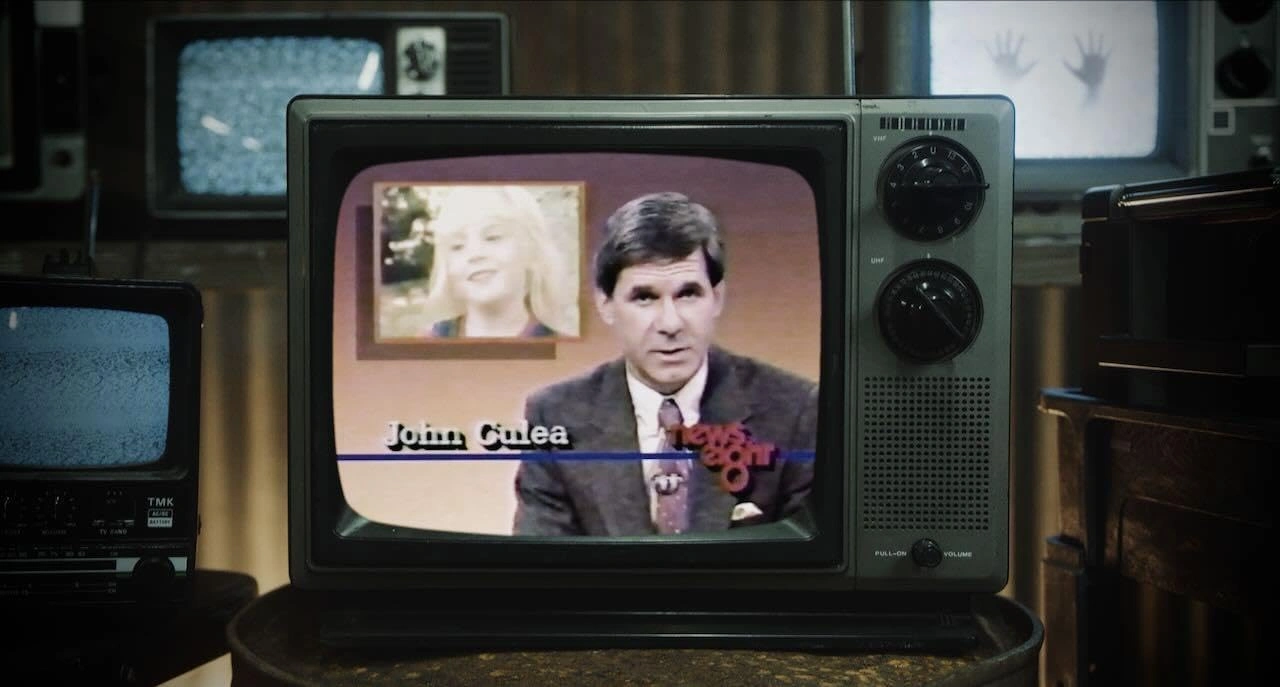
Archival material gives the film its emotional texture. Home videos, commercials, photographs, school images, interviews, and personal writings create what might be called memory-evidence: fragments that cannot explain a life fully, yet insist that a life existed beyond public consumption. Heather appears bright, composed, and unusually self-possessed, with the kind of camera presence that makes adults say “natural” when they really mean “mysteriously comfortable under pressure.”
The film also widens her career beyond Poltergeist. Her TV appearances, commercials, Happy Days, and other projects show a working child actor who remained grounded. Fame gave her visibility, but the documentary keeps returning to ordinary rituals: school, friendship, family routines, the private architecture of a childhood running parallel to the machinery of show business.
Memory, Testimony, and the Family Album Effect
Bailey builds She Was Here through testimony, and that choice gives the film both intimacy and fragility. Kathleen, Tammy, Heather’s father, childhood friends, classmates, co-stars JoBeth Williams and Craig T. Nelson, Zach Galligan, Linda Purl, and Poltergeist III director Gary Sherman all help assemble a portrait that feels communal. Nobody gets the final word. That feels right. A child’s life should resist ownership.

The interviews repeatedly return to Heather’s professionalism, kindness, lack of ego, and striking maturity. Williams and Nelson speak of her with the warmth of adults still startled by the memory of a child who could hold a set together without losing her sweetness. Galligan’s presence is valuable because it pulls the film away from the gravitational field of Poltergeist and reminds us that Heather’s career had other rooms.
Gary Sherman’s recollections are among the most affecting. Heather watched him direct, asked questions, and studied the process even on days when she was not needed on set. The detail lands with quiet force. It suggests a possible future, one where Heather might have moved behind the camera and shaped images rather than being trapped inside one.
The documentary’s archive has a family-album quality, with all the warmth and danger that phrase implies. Family albums preserve love, but they also flatten time. Here, the footage can feel almost unbearably alive. A smile, a classroom image, an old commercial, a scrap of handwriting: each becomes a small rebellion against the lurid public myths that formed around her death. Bailey avoids feeding the curse machine, which is wise. The internet has already had enough snacks.
Grief, Medical Failure, and the Uneasy Ethics of Looking
The final movement turns toward Heather’s illness and death, and the film becomes harder to watch. Her misdiagnosis, missed symptoms, legal aftermath, and preventable loss give the documentary its moral weight. This is where She Was Here connects most sharply to a larger civic anxiety: the terrifying gap between parental vigilance and medical authority. Kathleen’s testimony carries that fear in plain human terms. She was judged by the press, failed by doctors, and left to live inside a question no parent should have to ask: what else could I have done?
The film handles this material with sincere care. Its refusal to center conspiracy theories feels like an ethical stance. Heather’s death is painful enough without the gothic carnival that gathered around it. Bailey’s film pushes back against that carnival by restoring factual clarity and emotional dignity.
Still, the documentary is not free of discomfort. Some moments of private grief feel too exposed, and certain images risk crossing from remembrance into emotional overreach. A few production choices carry the sheen of a television biography special rather than a fully cinematic memorial. The pacing can lean toward sensation, then correct itself, as if the film is wrestling with the very culture it critiques.
That contradiction matters. She Was Here is a tribute shaped by love, occasional roughness, and a deep desire to repair a public memory. It gives Heather O’Rourke back her humanity: her talent, curiosity, sweetness, ambition, and everyday childhood. The cultural impact may be modest, yet meaningful. It asks viewers to stop treating lost child stars as folklore and start seeing them as people first.
A small request, somehow still radical.
She Was Here is a 2026 documentary about Heather O’Rourke, the young actress best known for playing Carol Anne Freeling in the Poltergeist films. Directed by Nick Bailey, the film looks back at her childhood, career, family life, public image, and the painful circumstances surrounding her death at age 12. The documentary was released on VOD and digital platforms on February 24, 2026, with DVD distribution handled by Kino Lorber. As of May 31, 2026, the movie is available to rent or buy through Apple TV, Amazon Video, and Fandango At Home, with no free streaming option currently listed.
Where to Watch She Was Here (2026) Online





Full Credits
- Title: She Was Here
- Distributor: Virgil Films, IndieCan Entertainment, Kino Lorber
- Release date: February 24, 2026
- Running time: 83 minutes
- Director: Nick Bailey
- Writers: Nick Bailey
- Producers and Executive Producers: Brian Pocrass, Nick Bailey, Reese Eveneshen, Avi Federgreen
- Cast: Heather O’Rourke, Kathleen O’Rourke, Tammy O’Rourke-Walker, Craig T. Nelson, JoBeth Williams, Zach Galligan, Linda Purl, Gary Sherman
- Editors: Reese Eveneshen, Isaac Elliott-Fisher
The Review
She Was Here
She Was Here is a loving, painful, and sometimes formally uneven documentary that restores Heather O’Rourke’s humanity with care. Its archival footage and interviews create a warm portrait of a gifted child whose life was too often reduced to a horror catchphrase and tabloid myth. A few choices feel too exposed, yet the film’s sincerity carries it.
PROS
- Deeply sensitive tribute to Heather O’Rourke
- Strong archival footage and personal interviews
- Avoids cheap curse mythology
- Powerful focus on family, memory, and medical failure
CONS
- Some grief-heavy moments feel too private
- Occasional TV-biography polish
- Certain images may feel unnecessary







