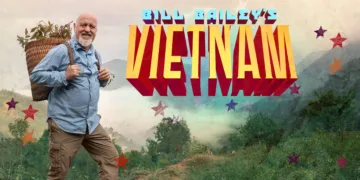
























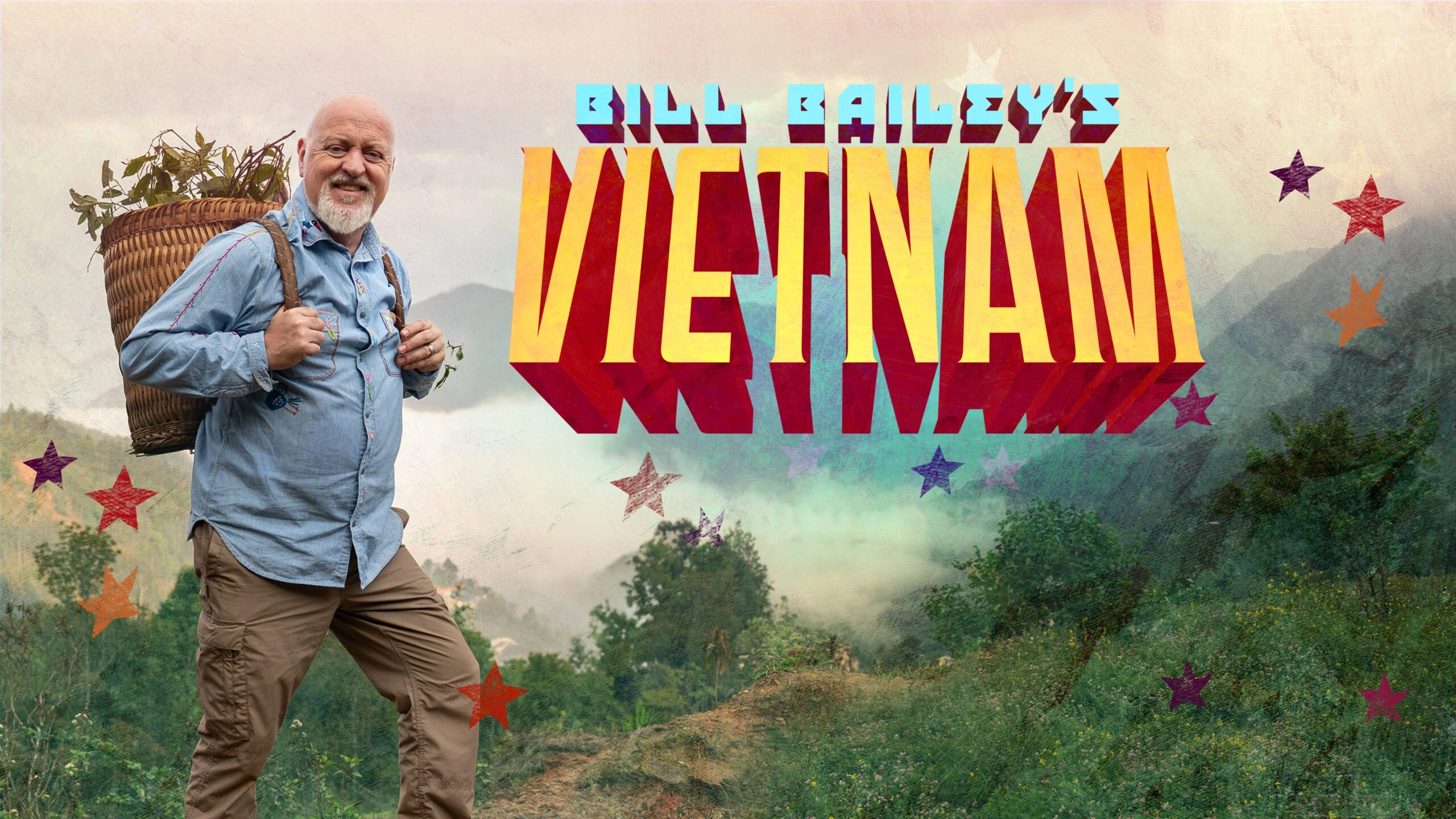

Bill Bailey’s Vietnam sends comedian, musician, and Strictly Come Dancing winner Bill Bailey across a country still shaped by memory, renewal, and restless change. The six-part travel documentary moves through Hội An, Ho Chi Minh City, Dalat, Hanoi, Sapa, and Ha Long Bay, building a portrait of Vietnam roughly 50 years after the end of the war. It is a country shown in motion: cities thick with traffic and enterprise, rural communities protecting inherited customs, coastlines tied to labor and ritual, temples carrying centuries of spiritual history.
Bailey’s presence gives the series its easy charm. He is calm, observant, mildly sardonic, and visibly unsuited to artificial travel-show glamour, which turns out to be a gift. The show has little appetite for polished spectacle. Its best stretches come from craft, food, faith, memory, and the daily intelligence of people who have built lives amid historical pressure. Bailey often looks like a man who would quite like a chair, a coffee, and five quiet minutes, yet his curiosity keeps pulling him forward.
A Host Who Makes Awkwardness Useful
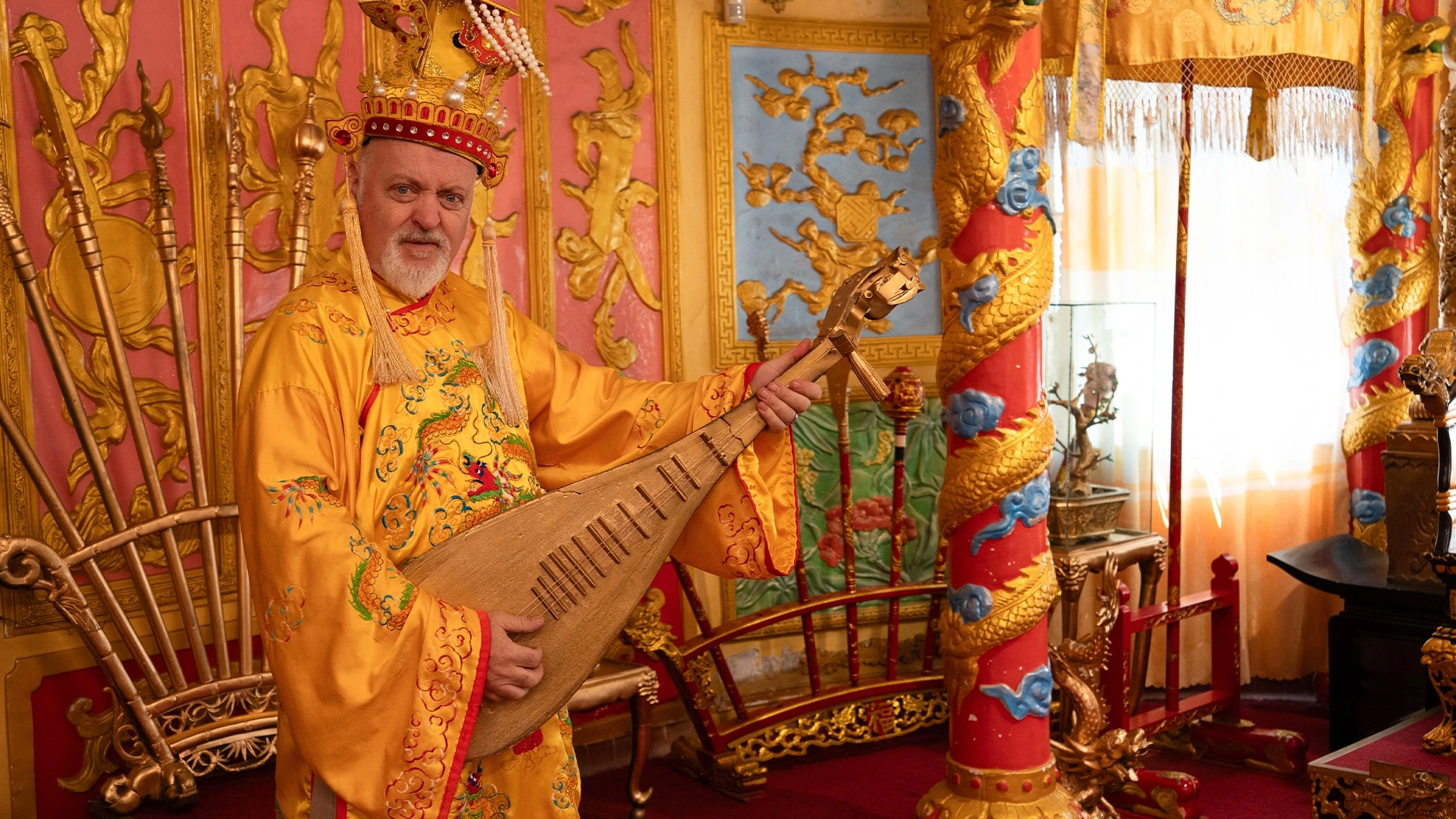
Bailey’s hosting style lands far from the hyperactive celebrity travel template. He is affable, clever, and self-effacing, with jokes that usually come from discomfort instead of performance. Struggling inside a traditional basket boat, reacting to cheese ice cream, facing the tourist crush of Hội An’s lantern ritual, or trying to process the madness of Train Street, he finds humor in ordinary confusion. The effect is refreshing. This feels like travel by a curious human being, not a sponsored fantasy in khaki.
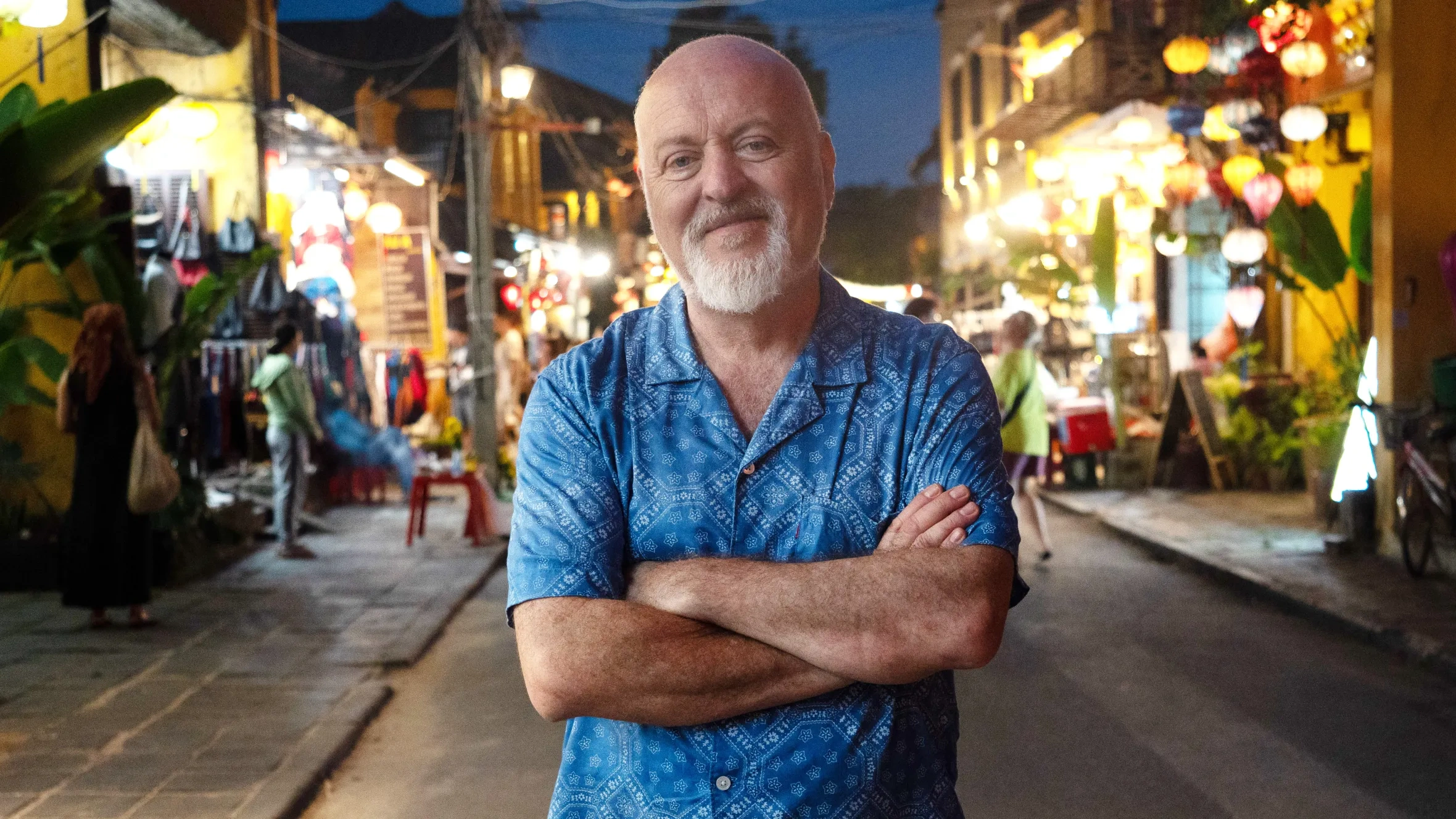
That ordinariness matters culturally. Travel television often sells access, ease, and a soft-focus version of other people’s lives. Bill Bailey’s Vietnam resists some of that polish by letting Bailey appear hesitant, tired, amused, and occasionally overwhelmed. His reactions do not flatten Vietnam into a backdrop for comic self-display. The country remains the subject.
There are limits to this approach. Bailey is warm with locals, yet his interviews can sometimes lack the sharp follow-up needed to uncover deeper personal stories. A pause lingers, a possible revelation slips past, and one senses the show choosing politeness over pressure. Still, his respect for people and customs gives the series a valuable restraint. He listens carefully, even when he does not always know where to steer the conversation next.
Vietnam Through Craft, Faith, Food, and Change
The series uses location as a way into social history. Hội An is especially rich terrain: lantern-lit streets, skilled tailors, market vendors, basket boats, fishing practices, and Thanh Ha Pottery Village all reveal a city where heritage and tourism sit in close contact. The basket boats give Bailey a comic set piece, yet their origin in colonial-era boat taxation adds a pointed historical charge. A funny wobble on the water opens into a reminder that local ingenuity often grows from unequal power.
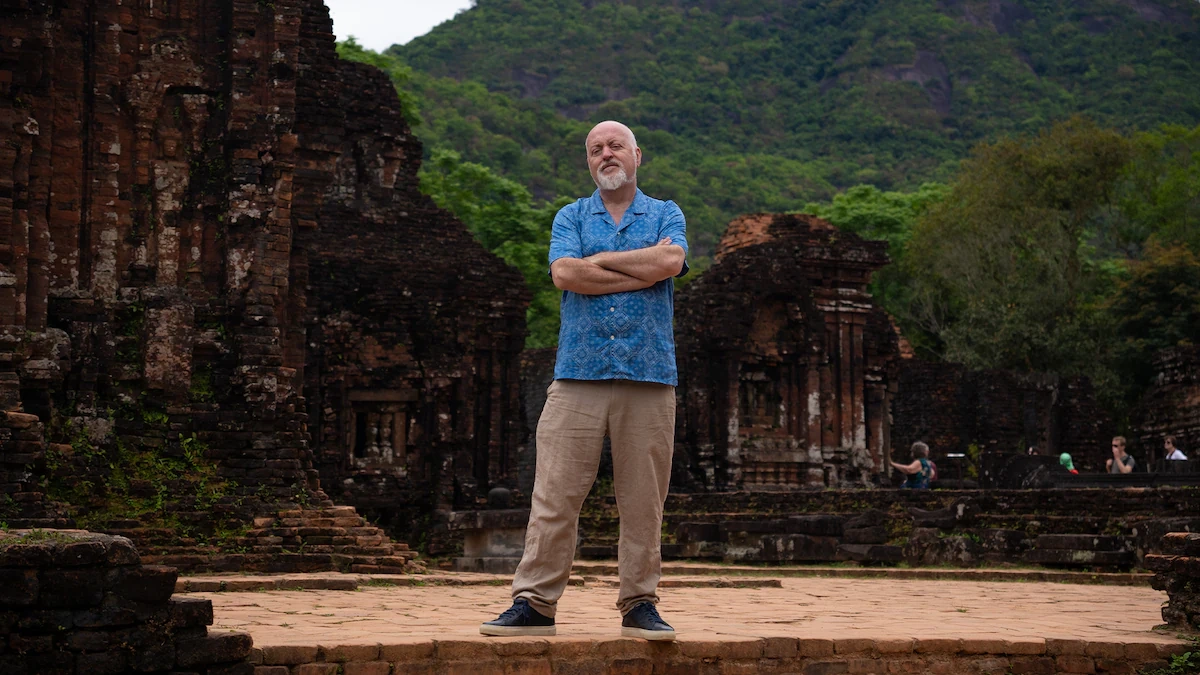
The craft sequences carry similar weight. Pottery-making in Thanh Ha becomes a portrait of work, age, and usefulness. An elderly potter who has spent decades at the wheel represents a social rhythm rarely honored by modern screen culture, where age is too often treated as disappearance. Here, longevity is linked to skill and belonging.
Faith receives the same careful attention. Buddhist monks buying live fish and releasing them back into the water give the series one of its quietest, strangest, most thoughtful moments. Commerce, compassion, ritual, and survival meet in a single act. Bailey does not force a grand explanation onto it. He lets the contradiction breathe.
The larger route expands that view. Ho Chi Minh City brings wartime tunnels, traffic, and music. Dalat carries traces of French influence in architecture and climate. Hanoi blends political memory with everyday public life. Sapa turns attention to mountain communities and cultural preservation. Ha Long Bay supplies majestic natural imagery, yet the show is at its strongest when landscape leads back to people.
The Human Stories Keep the Scenery Honest
For all its handsome images, Bill Bailey’s Vietnam gains power from encounters rather than scenery alone. Rice fields, lantern streets, mountain temples, busy markets, coastal waters, and limestone islands are beautifully presented, yet the photography rarely feels like empty tourism advertising. The camera works best when a place is tied to a person, a craft, a meal, or a memory.
Chef Trần Thanh Đức gives the Hội An episode its emotional anchor. Sent to the United States by his parents during the war as a teenager, he later returned and built a life through food. His market visit with Bailey has warmth and comic rhythm, with familiar vendors identified by what they sell rather than by name. It is funny, affectionate, and revealing. His story turns the familiar travel-show market scene into a reflection on displacement, return, and self-invention.
The series can drift. Bailey sketching a butterfly feels pleasant yet thin, and the old-meets-new framing is repeated with a little too much confidence. Some scenes appear designed to satisfy the expected travelogue checklist: try the food, attempt the craft, admire the view, meet the monkey mafia. Still, the modesty of the production helps. There is little sense of a star being worshipped by the format.
In an era when streaming platforms and broadcasters keep searching for comfort television with cultural value, Bill Bailey’s Vietnam offers a persuasive model. It slows down, gives local voices space, and treats history as something present in markets, temples, boats, recipes, and jokes. Bailey’s humility allows Vietnam’s complexity to stay visible.
Bill Bailey’s Vietnam is a British-Australian travel documentary television series that premiered on the UK network Channel 4 on March 1, 2026, with global syndication handled by DCD Rights. The six-part factual miniseries chronicles the eccentric English comedian, musician, and presenter as he travels the entire length of modern Vietnam on the 50th anniversary of the withdrawal of United States forces from Saigon. Audiences can watch the immersive historical and cultural travelogue broadcast live on Channel 4 or stream the complete first season online via the network’s digital on-demand platform, while international viewers can find it on regional networks such as BBC Earth, TVNZ, and Warner Bros. Discovery channels.
Full Credits
Title: Bill Bailey’s Vietnam
Distributor: Channel 4, DCD Rights, Perpetual Entertainment
Release date: March 1, 2026
Rating: TV-PG / PG
Running time: 60 minutes per episode
Director: Paul Bell
Writers: Bill Bailey
Producers and Executive Producers: David Alrich, Brendan Dahill, Nia Pericles, Chris Bailey
Cast: Bill Bailey, Tran Thanh Duc
Director of Photography (Cinematographer): Rhys Jones
Composer: Amara Primero
The Review
Bill Bailey's Vietnam
Bill Bailey’s Vietnam is thoughtful, warm, and unusually modest for a celebrity travel series. Bill Bailey’s dry humor and visible awkwardness give the show a human texture, while Vietnam’s people, crafts, food, faith, and landscapes provide its emotional force. The series can feel hesitant in interviews and occasionally leans too hard on familiar travelogue beats, yet its respect for place and history keeps it absorbing.
PROS
- Bill Bailey is warm, witty, and sincere
- Strong sense of place and cultural detail
- Beautiful landscapes without empty gloss
- Moving human stories, especially Chef Trần Thanh Đức
- Respectful treatment of history, faith, craft, and daily life
CONS
- Some interviews lack deeper follow-up
- A few lighter segments feel thin
- The old-meets-new framing is repeated too often
- Familiar travel-show beats appear in places