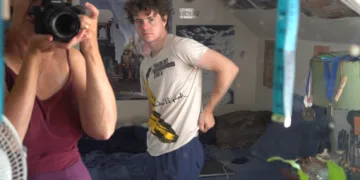

















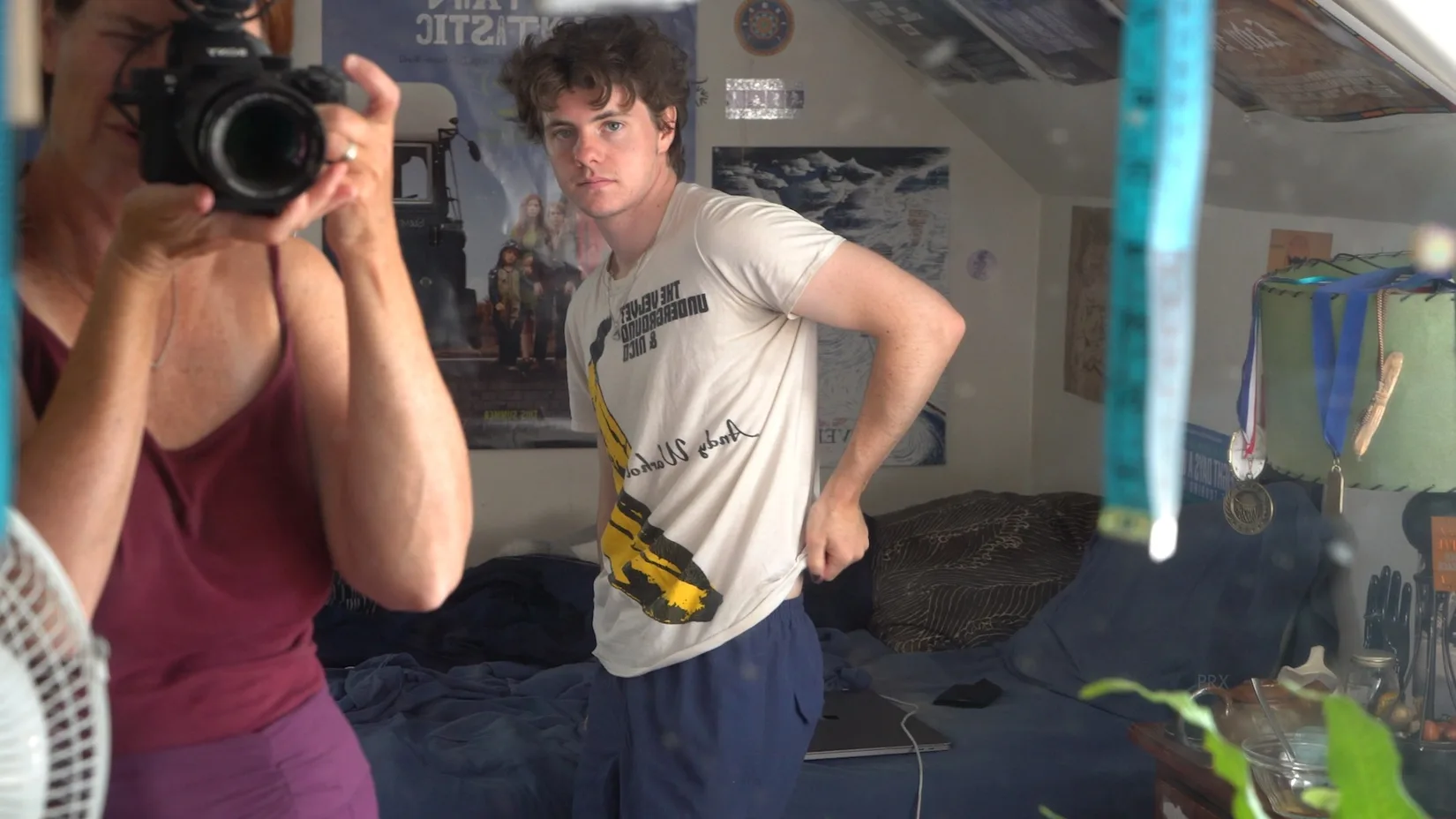

Adam’s Apple is an intimate documentary from Amy K. Jenkins about her son, Adam Sieswerda, growing from childhood into young adulthood as a trans man. Built from home videos, iPhone footage, birthdays, narration, medical milestones, music, and the everyday chaos of teenage life, the film has the texture of a family archive given narrative shape. It feels personal in the way old camcorder tapes feel personal, yet Jenkins finds a clear dramatic rhythm inside material that could easily have remained private.
The film’s strength comes from its refusal to sensationalize Adam’s life. Transition is presented through ordinary experience: school, dating, guitar practice, driving, college applications, family arguments, Covid isolation, and the urgent need to be recognized without debate. In a culture where trans youth are often discussed through fear, law, and political noise, Adam’s Apple chooses a calmer, sharper route. It treats Adam’s dignity as plain fact. That choice gives the documentary its emotional charge.
Adam’s Coming-of-Age and the Shape of Self-Knowledge
Adam is the film’s anchor: articulate, funny, creative, self-aware, and still recognizably teenage in all the messy, impatient, impulsive ways that matter. Jenkins traces his discomfort with being perceived as a girl back to childhood, from his rejection of his birth name to his desire to be called Adam by his father. His longing for an Adam’s apple and a deeper voice carries the ache of someone waiting for the outside world to catch up with the person he already knows himself to be.
The documentary handles gender dysphoria with care, never reducing Adam to suffering. There are painful passages involving depression, social anxiety, fear of judgment from male friends, and the strain of family language.
Yet the film gives equal weight to relief and joy. His first testosterone shot lands with the emotional force of a major story beat, less because Jenkins frames it grandly and more because Adam’s face says enough. The top-surgery celebration, the official name change, and his growth as a musician all become markers of a life opening up.
What makes Adam such a memorable subject is how fully the film lets him be a teenager. He asks out his first girlfriend, gets hurt by breakups, pushes rules around sleepovers, gets caught with beer, learns to drive, crashes a car, and prepares for college. In a narrative-driven game, these would be side quests that quietly define the character. Here, they do the same. Adam’s trans identity is central, yet the film never turns him into a lesson instead of a person.
Parenthood, Memory, and the Difficulty of Getting It Right
Amy Jenkins occupies several roles at once: mother, filmmaker, witness, narrator, and participant. That layered position gives Adam’s Apple much of its tension. She is close enough to catch moments no outside documentarian could reach, but that closeness also means the camera records her confusion, worry, tenderness, and mistakes. The film gains honesty from that risk. Amy’s uncertainty over discipline, coddling, fear, and protection makes her support feel lived-in rather than polished for public approval.
John, Adam’s father, brings a different kind of emotional friction. His hesitation around Adam’s transition is painful to watch, especially when he speaks about feeling that he has “lost” a daughter. Adam’s response, that he does not want to be seen as a lost daughter, cuts through the scene with rare clarity. The moment does not turn John into a villain. It shows how love can exist before understanding, and how understanding still requires work.
The family archive carries a similar charge. A stocking with Adam’s old name, childhood footage, birthday rituals, and old photographs mean different things depending on who is looking. For Adam, certain objects can recall discomfort and misrecognition. For his parents, those same objects hold Christmas mornings, childhood wonder, and years they are still learning how to remember. Jenkins allows that conflict to sit in the room. The film is stronger because it does not smooth every edge.
Editing Time into Emotion
Formally, Adam’s Apple is diaristic and collage-like, assembled from years of home footage, Adam’s own recordings, music, narration, and recurring birthday scenes. Adam is never treated as a passive subject. He contributes footage, writing, music, and perspective, which makes the film feel collaborative rather than observational. That matters. The documentary is about being seen, and its structure gives Adam real agency in how that seeing happens.
Jenkins’ editing turns time into the film’s central cinematic tool. She moves between childhood, adolescence, and young adulthood through visual echoes, match cuts, photos, birthday questions, and repeated motifs. The shifts are rarely decorative. They create the feeling of identity forming gradually, with small moments accumulating until a life looks different in hindsight.
The caterpillar and chrysalis imagery could have felt too neat, yet the film’s home-movie texture keeps it grounded. Birthday wishes change. Posters on the wall change. Adam moves from private guitar playing to public performance. The design is simple, but emotionally precise.
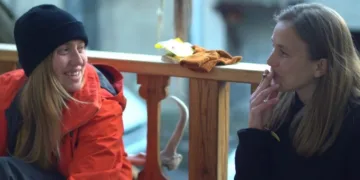
The New England landscapes, domestic interiors, handheld images, and occasional creative flashes create a sense of a life caught while it is still happening. Like Boyhood, the film draws power from watching years pass across a young face. Jenkins’ advantage is access: this is a mother’s camera, with all the intimacy and complication that implies. Adam’s Apple captures transition, adolescence, and parenthood as active processes, full of ordinary mess, grace, fear, humor, and hard-won tenderness.
Adam’s Apple is an American independent documentary feature film that made its highly anticipated world premiere at the South by Southwest (SXSW) Film Festival on March 13, 2026, followed by international screenings at festival circuits like CPH:DOX and Visions du Réel. Spanning over two decades of raw archival footage, home movies, and audio diaries, the collaborative project chronicles the childhood, adolescence, and college years of a transgender boy as he navigates his personal medical transition while his supportive parents work through their own adjustments. Film enthusiasts can watch the feature at select regional event venues, including upcoming summer presentations at the Provincetown Film Festival, Frameline, and DC/DOX, ahead of its formal commercial distribution rollout.
Where to Watch Adam’s Apple (2026) Online
Full Credits
Title: Adam’s Apple
Distributor: CPH:DOX, SXSW Film Festival
Release date: March 13, 2026
Running time: 98 minutes
Director: Amy Jenkins
Writers: Adam Sieswerda
Producers and Executive Producers: Brit Fryer, Amy Jenkins, Amy Hobby, Gerald Herman
Cast: Adam Sieswerda, Amy Jenkins, John Sieswerda, Elias Sieswerda
Director of Photography (Cinematographer): Amy Jenkins, Adam Sieswerda
Editors: Kristina Motwani
Composer: Adam Sieswerda
The Review
Adam's Apple
Adam’s Apple is a deeply affecting documentary that finds its strength in patience, honesty, and emotional precision. Amy K. Jenkins turns years of family footage into a tender portrait of Adam Sieswerda’s growth, capturing transition, adolescence, and parenthood with rare intimacy. Some moments feel shaped by the limits of family access, yet that same closeness gives the film its power. It is warm, observant, and quietly vital.
PROS
- Intimate use of home video and personal footage
- Strong emotional focus on Adam’s growth
- Thoughtful portrayal of family acceptance
- Sensitive handling of trans identity
- Effective editing across years of footage
CONS
- Some family conflicts could use deeper exploration
- The home-video style may feel modest for viewers seeking formal polish
- A few creative details about Adam’s artistic influences feel underexplored