




















![Kingdom Hearts Collection [I-III] Review](https://gazettely.com/wp-content/uploads/2026/10/Kingdom-Hearts-Collection-I-III-1-360x180.webp "Kingdom Hearts Collection [I-III] Review: KHII Holds Steady as Newer Entries Fluctuate 37")





Rockin’ Grandma’s Hot Sauce arrives as a perfect case study in small-business panic. Its future sits in the hands of a son whose formative years were spent in Jamaica chasing ska-themed electronic dance music, while retiring founder Doug watches the handoff with visible worry. Into that disorder walks Anthony Norman, a young father from Nashville who believes he has taken a temp assistant job.
The retreat in Agoura Hills, set among the trees, functions as a campground and as a carefully controlled psychological arena. Each person Anthony encounters is a paid performer. Each awkward seminar lands as a planned beat. After the courtroom setup of the previous season, the series heads into the woods and trades legal pressure for the quiet dread of workplace evaluation.
Through Anthony’s experience, it studies the modern job site as a place built on performance. He believes his livelihood depends on how well he does. He alone is living in plain reality, while everyone around him sustains a multi-day piece of theater. That change places corporate performance culture under a sharper light.
The Architecture of a Hidden World
Production shifted to an upscale campground in Agoura Hills, a site ten times larger than the office used in the first installment. That leap in scale demands an enormous logistical operation. Hidden cameras sit in trees and inside the structures scattered across the wooded retreat. A large crew stays out of view while handling makeup, stunts, and technical cues in real time. The achievement on the production side is immense, and it gives the fabricated setting enough texture to feel real.
The actors face a different assignment this time. In the earlier installment, they played strangers crossing paths for the first time. Here, they have to perform years of shared history. They are coworkers with inside jokes, stale tensions, and old rhythms already in place. That requires months of rehearsal. The cast has to make false familiarity feel fully lived in while still hitting precise marks and adjusting to Anthony’s unpredictable decisions. The blocking is exacting and closer to stagecraft than standard improv.
The crew’s stealth is part of the appeal. They pull off complicated stunts while staying invisible, creating a space where movie magic happens without a director calling out within earshot of the subject. Because the set is so large, Anthony can wander through the glamping grounds and into the surrounding hills. That freedom raises the chance of discovery, yet it also gives the setting weight and coherence.
The facade holds. The cast stays in character for days and continues performing even when Anthony is nowhere near them. That level of discipline keeps the world stable enough for the experiment to work. The production turns a campground into a digital panopticon focused on Anthony, with cameras catching each flicker of response during a manufactured professional crisis. The scale of the operation says plenty about the money and labor now flowing into reality-adjacent television.
Corporate Caricatures and Found Families
The staff of Rockin’ Grandma’s Hot Sauce is built from recognizable workplace-comedy types. PJ, the receptionist, fixates on exotic snacks like octopus-wasabi chips and dreams of life as a YouTube influencer. That detail plants him firmly in a side-hustle economy where every office worker seems to have a parallel brand strategy simmering in the background. Kevin, the head of HR, carries an earnest awkwardness that powers one of the season’s best cringe-comedy threads when he decides to propose to a coworker he has never dated.
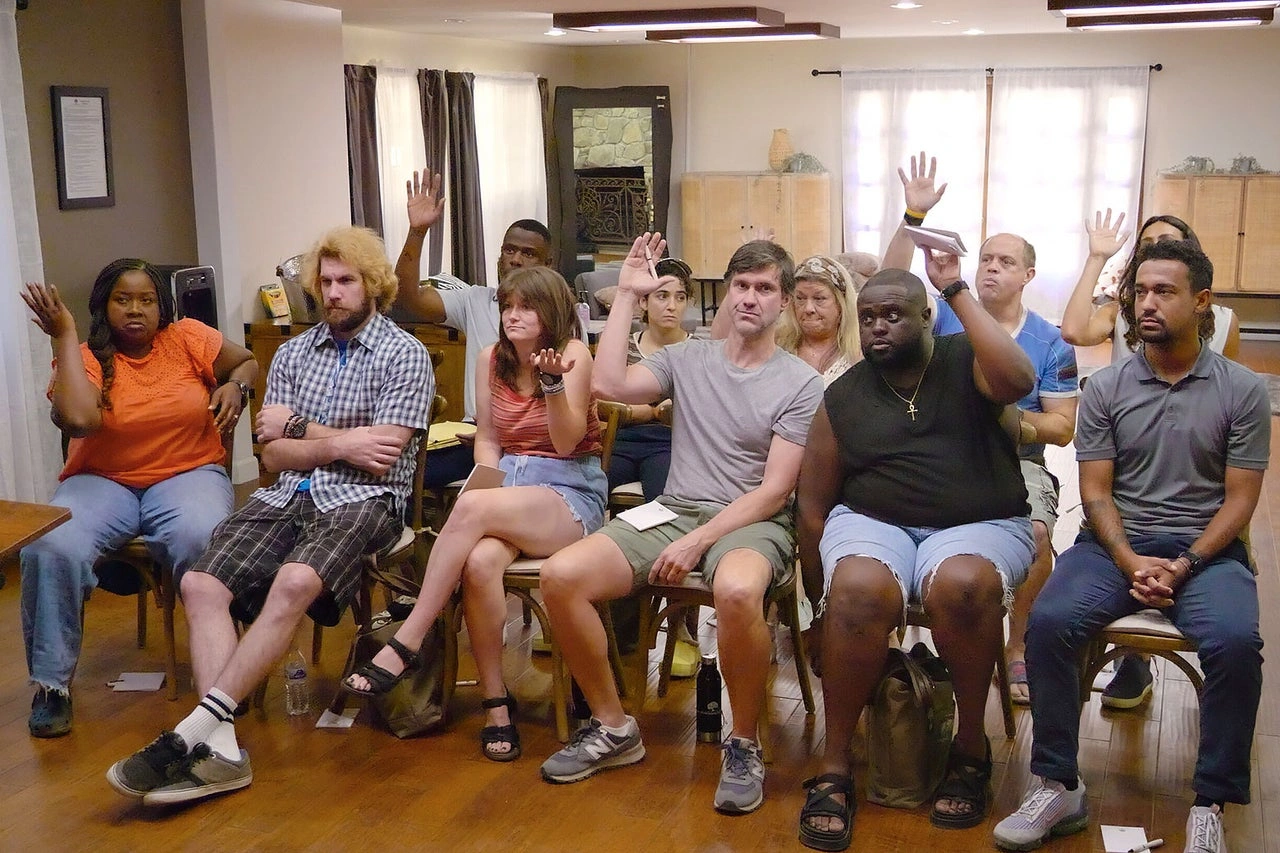
The scene pushes Anthony’s patience and his empathy into the same frame. Dougie Jr., the wandering heir, returns from Jamaica with bleached hair and a stack of ideas that leave longtime employees baffled. Characters like Helen from accounting give the ensemble a stabilizing presence that any actual office would recognize immediately.
The season also introduces the private equity firm Triukas, positioned as the predatory force circling the family business. Their arrival gets an extra comic charge from the visual gag that makes them all redheads, a detail with a slightly surreal edge. Inside the company, culture emerges through small recurring habits. Bones comes up again and again. A designated safe word exists for handling uncomfortable situations.
Those running jokes help create a shared language, and Anthony slips into it with surprising ease. He joins PJ for snack reviews. He supports Dougie Jr. in moments of uncertainty. The workplace takes on the shape of a found family, mirroring the emotional maintenance many jobs quietly demand from the people inside them.
Some characters are pitched broadly. Others feel close to people you could meet in any office hallway. That balance between satire and grounded performance is what makes the environment believable. Anthony accepts the strangeness because the personalities around him feel legible. He knows these types. He treats them seriously, even at their most eccentric.
The show captures the intimacy of a workplace that calls itself a family and the pressure placed on small businesses when outside investors start circling. In a television landscape full of stories about institutions collapsing under greed, this one filters that anxiety through prank mechanics and office banter. The method is silly. The unease underneath it is familiar.
A Study in Unwavering Decency
Anthony Norman, a 25-year-old father with an easy warmth, holds the entire production together. He beat out thousands of applicants, and the season makes clear why. His disposition is the show’s engine. He stays optimistic through escalating absurdity and remains eager to help no matter how strange the situation becomes. The season functions as a close study of that steadiness.
He meets bizarre seminars and succession drama with patience and grace. He invests in the fake colleagues around him as though their problems carry real stakes. He offers advice to the CEO. He urges leadership to protect the staff from the private equity scavengers. That instinct reveals a deep sense of integrity and a sympathy for small businesses facing pressures from larger corporate forces.
The ethics of the production remain open to debate. An innocent person is deceived on a massive scale. Still, the series presents him with affection and respect. The joke lands on the scenario, never on Anthony himself. His gullibility does not become the punchline. The reveal plays as a tribute to the care he showed the cast, and that choice matters. Cast members are moved to tears by the kindness he offered them while believing they were coworkers in distress. That approach steers clear of the cruelty that defined many older prank formats.
Anthony is lightly sketched in a few areas. We learn that he moved from Tennessee and that years of odd jobs shaped the path that brought him here. Inside the manufactured “Truman Show” setup, his responses stay remarkably generous. He misses the warning signs because he sees people in need of support. That decency gives the audience a clear emotional through line.
The real suspense lies in watching to see if kindness will hold under pressure. It does. Every time. That consistency speaks to a public appetite for stories built around decent people, especially at a moment when television can seem addicted to cynicism, rot, and prestige misery.
The series uses giant deception to expose something disarmingly plain about character. It finds joy in that discovery, and modern television rarely makes room for joy without turning it into sarcasm. Anthony stays level in one ludicrous setup after another, and the season gains emotional force from his refusal to harden.
The Architecture of the Absurd
The comedy this season runs on scripted absurdity. The talent show stands out, packed with bizarre staff performances while Anthony responds with full-throated encouragement. He cheers people on with complete sincerity. The educational seminars drift into equally surreal territory, with guest speakers delivering lectures that seem detached from recognizable logic. One of them reaches genuine Dada territory. Scenes like these push Anthony’s composure and his generosity at the same time.
The format depends on a careful balance between script and spontaneity. The writers build routes the story can follow, anticipating Anthony’s likely choices while leaving enough space for surprise. The actors then have to adjust in real time to his instincts, especially his reflexive kindness. That structure stretches familiar television grammar in interesting ways. It combines reality television with the rhythms of a scripted sitcom, and it does so without flattening either mode.
This season also points toward a durable future for the anthology. The corporate setting gives the experiment a strong frame and plenty of room for escalating scenarios. A film set could work. A summer camp could work. The idea travels easily.
The format presses against older television categories and makes a case for a hybrid form with real staying power. It carries elements of mockumentary and social experiment while keeping its attention fixed on human behavior. The series sidesteps the exploitative habits that once defined prank entertainment and offers a version shaped by care, precision, and an unusual amount of trust in its central participant.
The Agoura Hills retreat becomes an ideal setting for this kind of storytelling. It turns a company getaway into a study of community, labor, and character under pressure. The humor grows from the fine-grained details of the false world and from the way an ordinary person responds to circumstances that keep tipping into the bizarre. The season succeeds because it treats the man at its center as someone worth protecting.
It shows that the format can thrive without A-list stars, provided the casting is strong and the writing is exact. As a second outing, it gives the series real momentum and suggests a future that television executives will probably study with great seriousness, which is funny in its own right for a show built on a fake hot sauce company in the woods.
The television series Jury Duty Presents: Company Retreat premiered on Amazon Prime Video on March 20, 2026. This second installment of the franchise moves the action to a remote campground for a fake corporate event. You can watch all eight episodes on the Prime Video streaming service today. The show features a single participant who thinks he is assisting his colleagues during a hot sauce brand getaway. The production creates an environment that reflects the social behaviors of a typical office.
Where to Watch Jury Duty Presents: Company Retreat Online




Full Credits
Title: Jury Duty Presents: Company Retreat
Distributor: Amazon Prime Video
Release date: March 20, 2026
Rating: TV-14
Running time: 26 to 29 minutes
Director: Jake Szymanski
Writers: Anthony King, Andrew Weinberg, Albertina Rizzo, Asmita Paranjape, Rachel Hein, Chris Kula
Producers and Executive Producers: David Bernad, Lee Eisenberg, Gene Stupnitsky, Ruben Fleischer, Nicholas Hatton, Cody Heller, Todd Schulman, Jake Szymanski, Andrew Weinberg, Anthony King, Chris Kula, James Marsden
Cast: Anthony Norman, Alex Bonifer, Blair Beeken, Emily Pendergast, Erica Hernandez, Jerry Hauck, Jim A. Woods, LaNisa Renee Frederick, Marc-Sully Saint-Fleur, Rachel Kaly, Rob Lathan, Ryan Perez, Stephanie Hodge, Warren Burke, Wendy Braun, James Marsden
Director of Photography (Cinematographer): Chris Darnell
Editors: Diana Fishman, Steven Rosenthal, Adam Lichtenstein, Mary DeChambres
Composer: Danny Dunlap, John Nau, Andrew Feltenstein
The Review
Jury Duty Presents: Company Retreat
This installment transforms the corporate getaway into a sincere social experiment. It utilizes a massive scale to highlight human kindness. Anthony Norman acts as a moral compass within a fabricated world of hot sauce and private equity. The production avoids the cruelty of typical hidden camera shows. It prioritizes the warmth of its protagonist. The result is a funny look at community. It offers a welcome relief from the cynicism found in modern television.
PROS
- Excellent casting of Anthony Norman as a grounded protagonist.
- Ambitious production scale that creates a believable environment.
- Witty writing that captures the specific oddities of workplace culture.
- A positive tone that values character over cheap laughs.
- Strong ensemble performances that maintain the illusion for days.
CONS
- Certain secondary characters lean too heavily on broad sitcom tropes.
- The absence of a high profile celebrity presence like the first season.
- The transition from courtroom to campsite loses a bit of the surreal legal tension.