








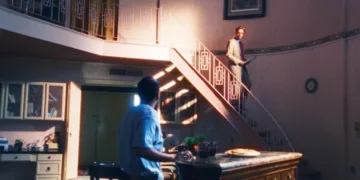
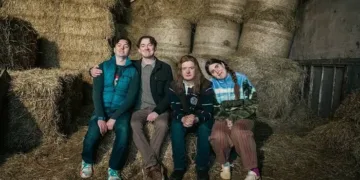













Sasha arrives in a sterile gated community for what should be an ordinary babysitting job, and the setting starts working on her almost at once. Her anxiety turns the neighborhood’s polished quiet into something suffocating. Every street, house, and smiling surface points to safety, yet the air carries a steady sense that something is off. That feeling sharpens when the child in her care vanishes at a local playground.
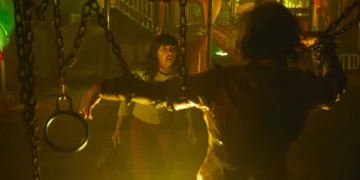
The structure itself looks strange and unfinished, yet it functions as a focal point for the area’s children. As Sasha searches, she notices the kids share an eerie bond. They track her with a single, unified stare that hints at purpose.
The suburb projects domestic success, though a predatory force sits underneath that image. Sasha moves through a space where the adults seem blind to what is happening, or willing to live with it. Her search for the missing boy turns into a confrontation with the logic of the community itself. She stands outside a world built on enforced sameness.
The Mechanics of Suburban Dread
The horror in Hive works through bodily disgust and through the corruption of spaces that should feel secure. People touched by the collective mind develop yellow sores, swollen skin, and gooey lesions that give the threat a physical presence. The supernatural menace feels sticky, infected, and immediate. Daylight becomes one of the film’s smartest tools.
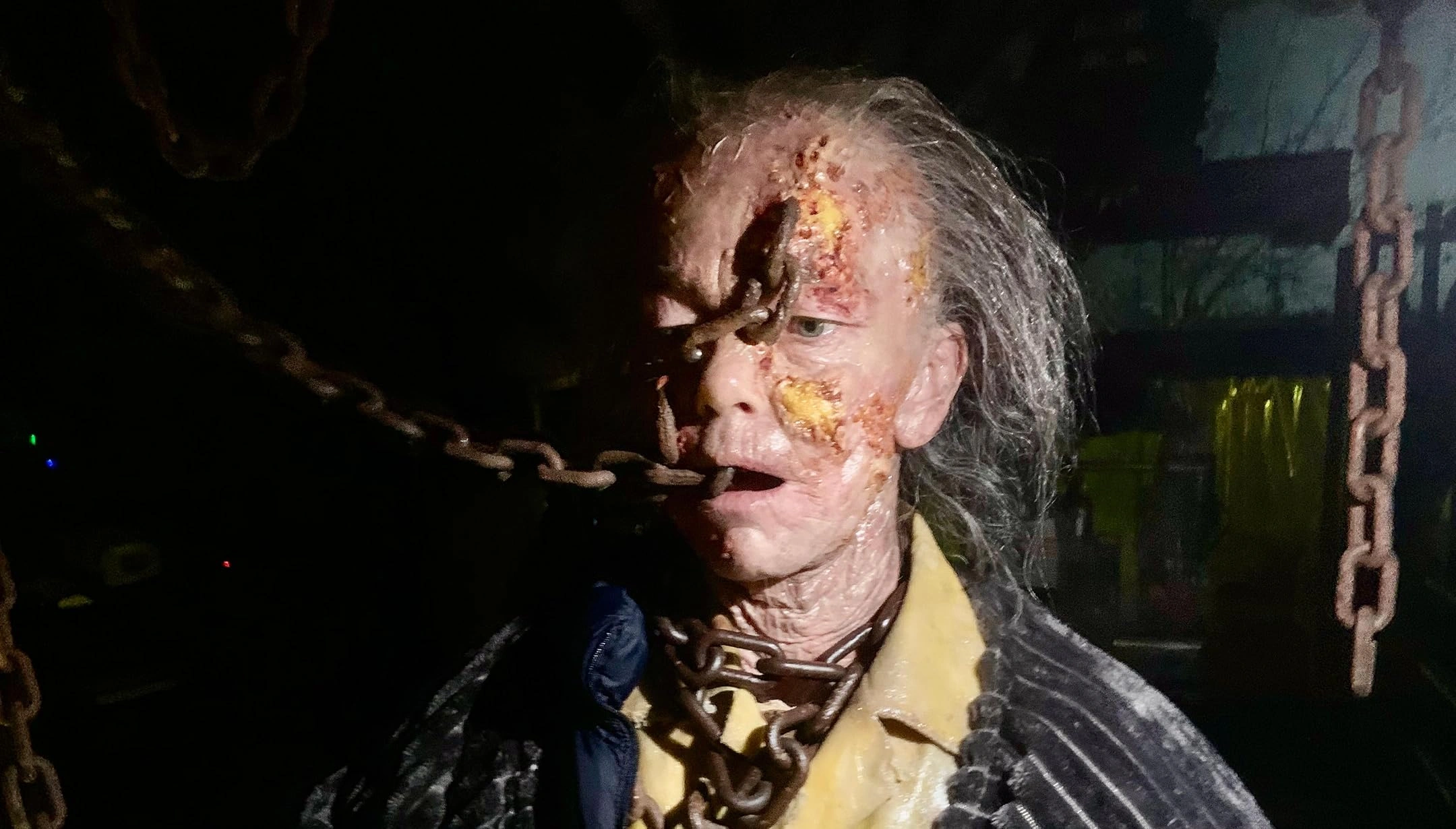
Bright sun exposes the children’s uncanny behavior and strips away any comfort the setting might have offered. Their bodies move in perfect sync, and that shared rhythm turns ordinary play into something deeply unsettling. The playground anchors all of this. It sits at the center of the neighborhood like a living thing, a jungle gym with hostile intent. Its bars and slides become tools for trapping victims, and the practical effects sell the wet, parasitic horror during scenes of infection.
That design choice gives the film a clear mechanical logic. A playground exists for movement, repetition, and social ritual, so turning it into the source of contagion makes the fear feel embedded in the space. The suburban layout feeds that idea as well.
Open lawns and bright streets leave Sasha exposed, and the film uses that visibility to keep the audience tense. There is nowhere to hide from the infection, nowhere to escape the sight of bodies changing in plain view. The hive members add to that pressure through motion alone. Their group behavior carries a kinetic menace that keeps the film active even in quieter moments.
Performances in the Presence of the Uncanny
Xochitl Gomez carries the film with a grounded performance as Sasha. She gives the story a human center strong enough to hold together its stranger elements. Her anxiety feels lived-in, and that gives Sasha a vulnerability that shapes every choice she makes.
The character is driven by guilt after losing the child in her care, and that guilt keeps pushing her deeper into danger. Aaron Dominguez appears as her brother Marco, and their scenes together supply the film’s warmest material. Their rapport feels natural, which matters in a movie built around emotional coldness and social alienation.
The child actors operate on a different register. Their stiffness fits the premise, since these children are meant to feel wrong, controlled, and hard to read. At times, some extras carry a theatrical quality that pulls a scene away from full immersion. Even so, that roughness still feeds the movie’s central tension by making the children feel disconnected from ordinary social behavior.
Their group stares, synchronized movements, and silent pressure turn them into a constant threat. Sasha is forced to think around them, protect herself, and keep control of her mind at the same time. Her drive comes from a need to prove she is capable and to protect someone vulnerable. That personal urgency keeps the film tied to her emotional experience while everything around her grows stranger and harder to trust.
Social Foundations and Creative Growth
The film began as a nine-minute short, and the move to feature length gives its ideas room to stretch. The script engages classism and cultural assimilation through Sasha’s position as a Latino worker entering a wealthy white environment. The gated community functions like a cage, defining who belongs and who does not. That social angle gives the horror a firm structure. Fear grows from infection and pursuit, though it also grows from a neighborhood built around exclusion and sameness.
The visual language supports Sasha’s unraveling. Moving camera shots and Dutch angles track her slipping hold on reality, and the tilted compositions create vertigo that matches her mental state. The pacing shifts in a noticeable way as the story continues. Early scenes lean harder into horror, while the second half makes more room for drama and reflection.
That change reduces momentum, yet it also gives the characters time to process the crisis closing around them. The film’s technical limits show up in its handling of gore, especially in moments where it cuts away from the harshest violence. Even with those shortcuts, the production finds a distinct look for its suburban setting and uses its modest budget with purpose.
The story’s main idea centers on preserving individual identity. Sasha urges others to resist the collective mind by holding onto who they are. That conflict gives the film emotional weight, because survival becomes tied to memory, selfhood, and personal agency. Hive frames conformity as a living threat, one that spreads through a place built to look orderly and desirable. The result gives the suburbs an eerie, infected texture and turns the pressure to belong into something physical, invasive, and hard to shake.
Hive premiered yesterday, April 17, 2026, as a featured Tubi Original. This supernatural horror thriller is currently available to stream for free on the Tubi platform. The story follows a young babysitter whose life takes a terrifying turn when the child in her care vanishes at a local playground, forcing her to confront a parasitic hive mind hiding in broad daylight.
Where to Watch Hive (2026) Online

Full Credits
Title: Hive
Distributor: Tubi
Release date: April 17, 2026
Rating: TV-MA
Running time: 1 hour 31 minutes
Director: Felipe Vargas
Writers: Felipe Vargas
Producers and Executive Producers: Nick Scully, Adam Friedlander, Darren Cameron, Samantha Levine, Ryan Plachcinski, Lance Samuels
Cast: Xochitl Gomez, Aaron Dominguez, Zenobia Kloppers, Victoria Firsova, Tanya van Graan, Jenny le Roux, Thulani Nzonzo, Kelly Chandrapaul
Director of Photography (Cinematographer): Carmen Cabana
Editors: Derek Mansvelt
Composer: Rene G. Boscio
The Review
Hive
Hive delivers a refreshing take on daytime horror by turning a sterile playground into a site of kinetic dread. Xochitl Gomez provides a vital emotional anchor that prevents the story from drifting too far during its slower second half. While budget constraints and pacing issues are visible, the film succeeds as a thoughtful examination of cultural assimilation. It is an ambitious effort that proves Tubi can host creative, narrative-driven genre work. This film is a worthwhile pick for viewers who appreciate horror with a layer of social commentary.
PROS
- Grounded lead performance by Xochitl Gomez.
- Tense atmosphere created by daytime horror settings.
- Memorable and visceral body horror effects.
- Direct exploration of class and identity.
CONS
- Significant pacing slowdown in the final half.
- Inconsistent acting from some minor child characters.
- Visible budget limitations during action sequences.
- Narrative feels slightly thin for a feature length.