



















![Kingdom Hearts Collection [I-III] Review](https://gazettely.com/wp-content/uploads/2026/10/Kingdom-Hearts-Collection-I-III-1-360x180.webp "Kingdom Hearts Collection [I-III] Review: KHII Holds Steady as Newer Entries Fluctuate 37")





Margo’s Got Money Troubles arrives on Apple TV+ as one of the more pleasantly disorienting series of 2025. Created by David E. Kelley (Big Little Lies, Ally McBeal) and adapted from Rufi Thorpe’s 2024 novel, the eight-episode series opens with a deceptively cheerful thud: an animated, pinball-themed title sequence set to Robyn’s “Blow My Mind” that promises candy-colored fun. The show does deliver that, just rarely without something sharper running underneath.
Set in working-class Fullerton, California, the story follows Margo (Elle Fanning), a college freshman whose affair with her married English professor, Mark (Michael Angarano), results in a pregnancy that unravels her plans entirely. Left to raise her son Bodhi alone, she turns to OnlyFans as her financial lifeline. What follows is a story of self-determination, fractured family bonds, and the raw economics of young motherhood, told through a cast that includes Michelle Pfeiffer, Nick Offerman, Nicole Kidman, Greg Kinnear, Thaddea Graham, Marcia Gay Harden, and Rico Nasty.
The show resists easy genre labeling. It is darker than it looks and funnier than its subject matter suggests, and it earns both qualities honestly.
Story, Tone & Themes
The central premise of Margo’s Got Money Troubles is familiar enough: a young woman sleeps with her professor, gets pregnant, and is left to manage the consequences alone. What the show does with that premise is considerably less predictable.
Margo’s decision to keep the baby, naming him Bodhi, sets the series in motion. Mark, having briefly played the charming, attentive professor, stops returning her calls almost immediately. His absence is a fact of Margo’s life she accepts with grim clarity, until his eventual reappearance as a legal threat, filing for full custody on the grounds of her profession, gives the series its sharpest dramatic edge.
The tone is harder to pin down than the plot. Kelley is working in family drama territory, a departure from his crime-focused recent output, and the shift suits him. The show carries his signature: rapid-fire dialogue, speeches that build to emotional crescendos, a preference for resolution over despair. Margo narrates her own story intermittently, with the dry self-awareness of someone who knows she is living inside a situation she would have written differently. That literary self-consciousness gives the series a texture that sets it apart from shinier, more formulaic dramas.
The themes the show circles are worth naming plainly. Young motherhood and the structural difficulty of raising a child alone without money or support. Sex work and the stigma attached to it. The permanence of internet content. What family actually means when the biological version has failed you. The cyclical nature of generational patterns sits beneath all of it: Shyanne’s past and Margo’s present are nearly identical, a fact both women understand and neither can fully accept.
The OnlyFans storyline takes its time arriving. The first two episodes are largely setup, with the platform entering the picture properly in episode three and gradually moving from background detail to narrative engine.
Performance Spotlight
Elle Fanning carries the series with the kind of performance that looks effortless and clearly is not. Margo is smart, warm, and reliably her own worst advisor, and Fanning inhabits all three qualities at once without letting any tip into caricature. Her baby-faced quality, which lesser projects have treated as a limitation, works here in the role’s favor: Margo feels genuinely young, genuinely hopeful, and genuinely in over her head. Fanning’s comic timing, which has been underused across much of her career, gets proper room in the early OnlyFans episodes, where Margo’s creative problem-solving produces some of the series’ funniest moments. Her arc from promising writing student to resourceful single mother is persuasive because each step feels chosen rather than imposed.
Michelle Pfeiffer, as Shyanne, gives the show its emotional center. Shyanne is a character that could have collapsed into type: a former Hooters waitress with a complicated romantic history and a wardrobe of leopard print. Pfeiffer makes her into something far more specific. The performance works through accumulation, a lifetime of disappointment and resilience registered in micro-expressions, in the way Shyanne watches her daughter across a room, in the precision of a reaction she almost, but does not quite, allow to show. Her speeches are the show’s most formally dramatic moments, and Pfeiffer delivers them with simultaneous fury and tenderness, a combination that should feel contradictory and instead lands as deeply true. Shyanne’s core conflict, loving her daughter absolutely while resenting the prospect of becoming a caretaker all over again, and being unable to say any of this out loud, gives Pfeiffer an enormous amount to play. She plays all of it.
Nick Offerman’s Jinx arrives as a recognizable figure, the absent father seeking a second chance, and steadily becomes something richer. The identity crisis running beneath Jinx’s recovery, who is he if not the wrestler everyone loved, gives Offerman genuine dramatic material alongside the show’s gentler comic set pieces. His scenes with baby Bodhi, patiently explaining wrestling moves or the plot of I, Claudius to an uncomprehending infant, are among the warmest the series offers. His sadness, though, is the performance’s real achievement: it sits in him quietly, surfacing in glances and pauses rather than speeches.
The supporting cast fills the frame well. Thaddea Graham’s Susie is the show’s warmest presence and its most underwritten character; Graham exceeds what the scripts ask of her. Greg Kinnear’s Kenny surprises, his arc moving in directions the show’s setup does not predict. Nicole Kidman’s Lace is a welcome burst of energy, if a slightly distracting one. Marcia Gay Harden’s Elizabeth is pure antagonist, icily effective and drawn with an admittedly broad brush.
The OnlyFans Storyline: Handling of Sex Work
The show approaches OnlyFans as a workplace, with all the creative problem-solving, interpersonal negotiation, and brand management that implies. Mainstream television rarely handles the subject with this level of care, and that considered approach shapes how the storyline develops across the eight episodes.
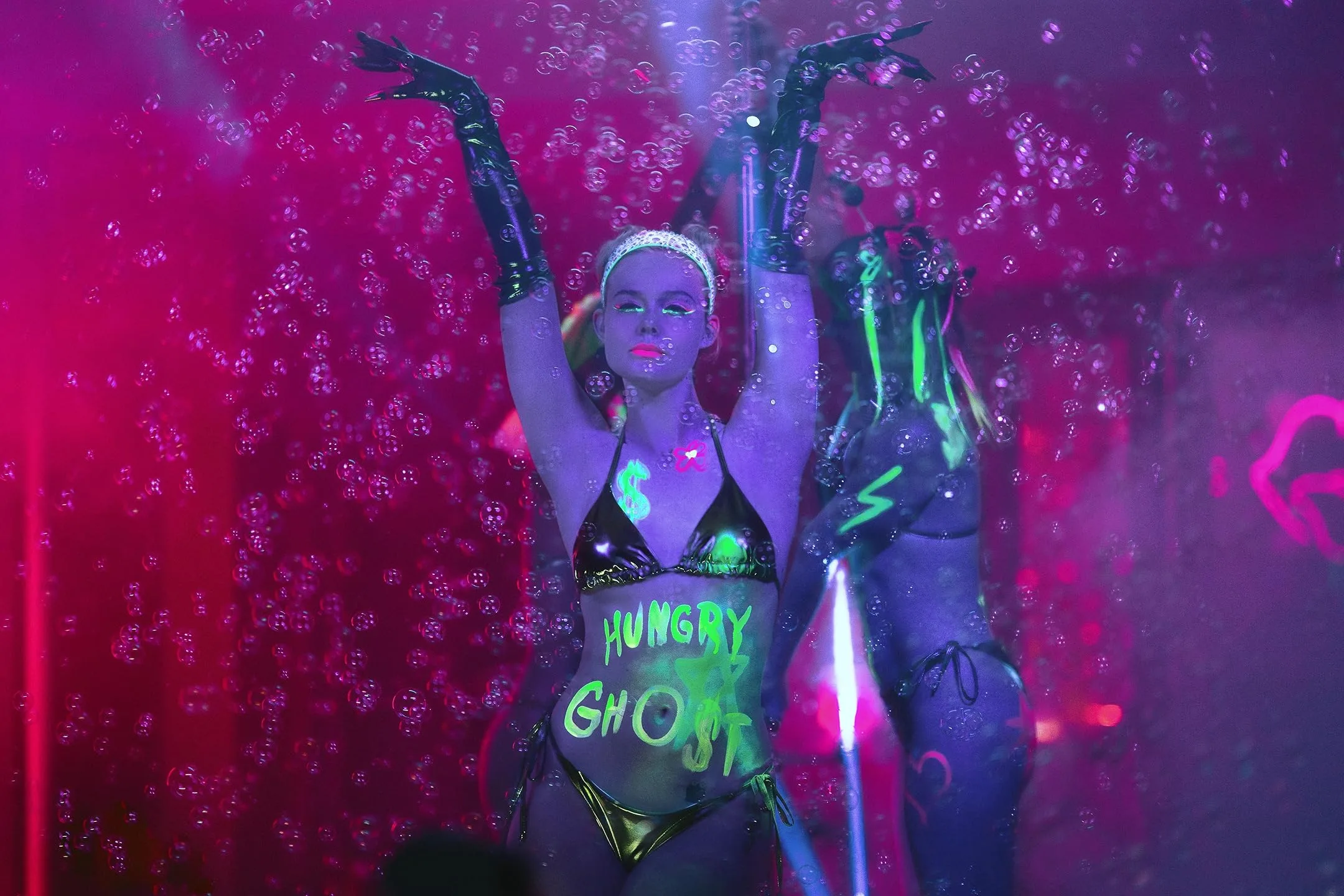
Margo’s entry point is deliberately absurd: for a small tip, she will tell subscribers which Pokémon character their anatomy resembles. It is text-based, safely anonymous, and pitched as satire. Her real creative instincts emerge when she develops HungryGhost, an alien persona that becomes the vehicle for increasingly elaborate sci-fi video content. With Susie’s cosplay expertise, KC and Rose’s professional knowledge, and Jinx’s occasional accidental contributions, the productions take on a genuinely inventive, low-budget B-movie quality. The show frames all of this as entrepreneurship: labor-intensive, imaginative, and legitimately demanding.
Where the series hedges is in how it represents the platform’s sexual content. The explicitly sexual dimensions of Margo’s work are consistently downplayed or kept offscreen, which creates a mild tension in a show that argues openly for the legitimacy of sex work. The real risks, doxxing, harassment, the permanence of uploaded content, are acknowledged but not examined in depth. The financial trajectory Margo follows is quicker and more stable than most real-world accounts would suggest.
Mark’s custody petition, which targets Margo’s profession directly, forces the moral debate into the open. The show’s sympathies are stated clearly, but it earns credit for raising harder questions, even if the answers it settles on tend toward the reassuring end of the scale.
Family Dynamics & Emotional Core
The household at the center of Margo’s Got Money Troubles, Margo, Shyanne, Jinx, Bodhi, Susie, and eventually Kenny, is messy, loud, and held together by bonds that none of its members fully chose. That is the point. The show’s warmth comes from watching people who share no clean history with each other gradually become something that functions like a family, precisely because they have decided to show up rather than leave.

The mother-daughter relationship between Shyanne and Margo is the series’ emotional spine. Shyanne’s conflict, supporting a daughter she loves while watching her repeat the same mistakes, is written with real subtlety. Her disapproval is layered: with self-recognition, with fear about her daughter’s future, and with a deep reluctance to resume the caretaker role she had just begun to set down. Their arguments are recognizable. Their reconciliations are earned.
The show draws a sharp distinction between its two versions of the absent father. Jinx, for all his failures, is genuinely seeking redemption. Mark is protecting his reputation. Offerman’s Jinx earns the more generous arc the show gives him, and Susie’s quiet, consistent presence in Margo’s life offers its own commentary on what loyalty actually looks like.
The generational pattern running through the story, Shyanne’s past as a near-mirror of Margo’s present, gives the series its most pointed emotional register. Survival, the show suggests, can be inherited. The question it leaves open is what shape that inheritance takes in the next generation, and if the weight of it lightens or simply changes form.
Visual Style, Writing & David E. Kelley’s Approach
The show’s visual language is bright and warm, all sun-soaked SoCal palette and bold costuming choices that signal character before a word is spoken. Shyanne’s leopard print and faux fur tell you exactly who she is and how she wants to be seen. The HungryGhost sequences, Margo’s increasingly ambitious sci-fi OnlyFans productions, are shot with cheerful, low-budget inventiveness that suits both the character and the show’s broader sensibility.
Kelley’s writing is strongest in character texture: the specific weight of a conversation between Shyanne and Margo, the precise register of Jinx’s quiet shame. It is less sure-footed in plot architecture, where the show’s preference for tidy resolutions occasionally undercuts the emotional stakes it has carefully built. The show acknowledges its own guardrails, often through Margo’s narration, which functions as both charm and minor limitation: it signals the safety net before you have time to worry about the fall.
The eight-episode structure feels well-matched to the material. There is enough story here for this length, and the series has the good sense to stop before overstaying its welcome.
Margo’s Got Money Troubles is a bold and comedic family drama that premiered globally today, April 15, 2026. Based on the bestselling novel by Rufi Thorpe and developed by multi-Emmy Award winner David E. Kelley, the series follows Margo Millet, a college dropout and new mother who turns to OnlyFans to stay afloat. Reconnecting with her estranged father—a former pro wrestler—she begins applying his “theatrical” wrestling advice to her online persona, finding unexpected success and viral fame. The eight-episode series is an Apple Original production from A24 and is available to stream exclusively on Apple TV+, with the first three episodes available now and subsequent chapters arriving every Wednesday.
Where to Watch Margo’s Got Money Troubles Online


Full Credits
Title: Margo’s Got Money Troubles
Distributor: Apple TV+
Release date: April 15, 2026
Rating: TV-MA
Running time: 60 minutes
Director: Dearbhla Walsh, Kate Herron, Alice Seabright
Writers: David E. Kelley, Eva Anderson, Boo Killebrew, Keiko Green, Rufi Thorpe
Producers and Executive Producers: David E. Kelley, Nicole Kidman, Elle Fanning, Michelle Pfeiffer, Dakota Fanning, Brittany Kahan Ward, Per Saari, Matthew Tinker, Rufi Thorpe, Eva Anderson, Boo Killebrew, Dearbhla Walsh, Checka Propper
Cast: Elle Fanning, Nicole Kidman, Michelle Pfeiffer, Nick Offerman, Greg Kinnear, Thaddea Graham, Michael Angarano, Marcia Gay Harden, Lindsey Normington, Rico Nasty, Michael Workeye, Chris Jericho, Annalise Basso
Director of Photography (Cinematographer): Kate Reid, Catherine Goldschmidt
Editors: Daniel A. Schalk, Jennifer Barbot
Composer: Fil Eisler
The Review
Margo’s Got Money Troubles
Margo’s Got Money Troubles is a big-hearted, pleasantly disorienting dramedy that transcends its sensational premise. Anchored by phenomenal performances from Elle Fanning and Michelle Pfeiffer, the series thoughtfully explores young motherhood, unconventional family dynamics, and the stigma of sex work. While it occasionally softens the harsher realities of its subject matter in favor of tidy resolutions, its sharp dialogue and deep emotional core make it highly watchable. It is a witty, empathetic triumph that balances candy-colored visuals with genuine substance.
PROS
- Nuanced acting across the board, particularly from Elle Fanning, Michelle Pfeiffer, and Nick Offerman.
- Frames sex work respectfully as creative entrepreneurship rather than a simple tragedy.
- Features David E. Kelley's signature rapid-fire writing and deeply resonant emotional crescendos.
- Offers a warm, compelling exploration of unconventional "found family" dynamics and generational patterns.
- Vibrant, sun-soaked SoCal styling paired with highly inventive, low-budget sci-fi sequences.
CONS
- Downplays the explicit dimensions and deep risks of OnlyFans, presenting an overly stable financial trajectory.
- The plot architecture occasionally plays it safe, undercutting the carefully built emotional stakes.
- While the core cast shines, characters like Susie are underwritten, and antagonists like Elizabeth feel one-dimensional.