
























![Kingdom Hearts Collection [I-III] Review](https://gazettely.com/wp-content/uploads/2026/10/Kingdom-Hearts-Collection-I-III-1-360x180.webp "Kingdom Hearts Collection [I-III] Review: KHII Holds Steady as Newer Entries Fluctuate 37")





Haley Z. Boston and the Duffer Brothers shape Something Very Bad Is Going to Happen as an eight-episode spiral into wedding-week terror, set to stream on Netflix in 2026. The story follows Rachel, a behavioral psychology student played by Camila Morrone, and her fiancé Nicky, played by Adam DiMarco.
Their trip to a secluded family estate in upstate New York begins with the promise of celebration and quickly hardens into something airless and menacing. Rachel enters this setting with a keen eye, a trained instinct for reading behavior, and an anxiety that leaves her exposed to every shift in tone.
The Cunningham home becomes the engine of the show’s unease, a place where paranoia grows through strange incidents, inherited customs, and stories that cling to the land. Marriage is framed as a perilous form of transformation, a union so complete it threatens to consume the people inside it.
From its first scenes, the series tells viewers that disaster is coming. A five-day countdown to the wedding locks the story into a tightening schedule and turns each step toward the altar into a source of dread. What emerges is a study of intimacy under pressure and of the histories people carry with them into family life.
The Ritual of Erasure and Marital Decay
Horror has often turned the home into a site of fear, and this series works squarely within that lineage by treating marriage as a mechanism of erasure. The script returns to the phrase “sewing souls together,” and the wording carries a raw violence. It evokes the image of two lives forced into one shape through pain, pressure, and distortion. That idea cuts against the polished fantasy sold through wedding culture and romance programming on streaming platforms.
The show presses on the strain between private identity and the demands attached to lifelong partnership. Rachel steps toward marriage carrying trauma from her past, and her perception of danger is steadily dismissed. Her alarm at the Cunningham family gets reduced to bridal panic or clinical instability.
The series turns that pattern into a pointed portrait of gaslighting. It also touches a cultural nerve that remains familiar: a woman senses a threat, voices it clearly, and gets told that her reading of the room is irrational because it disrupts the social order.
That thread gives the series a sharp social charge. Rachel is written as a contemporary woman with education, self-awareness, and professional training, yet the world she enters demands obedience to customs that feel ancient. The house runs on inheritance, ritual, and hierarchy. Every member of the family behaves as if they are answering to rules older than themselves. Nicky’s relatives operate like a sealed institution, with habits and expectations that make little sense to outsiders and perfect sense to those raised inside it.
The bride is expected to submit to this machinery, and that expectation places gender, family, and power in direct conflict. The show finds its fear in that collision. It draws a line between modern ideals of autonomy and the accumulated baggage people bring into partnership. Marriage here carries class history, family damage, and patriarchal ritual in the same package. Love stays unresolved and uneasy throughout. The series keeps asking how much of the self can survive when commitment starts to resemble surrender.
Class Tensions and the Cunningham Hierarchy
Camila Morrone gives Rachel Harkin a performance rooted in physical tension and emotional intelligence. Rachel’s training in behavioral psychology makes her a natural stand-in for the viewer. She notices details, measures reactions, and tries to build logic from behavior she cannot fully decode.

The Cunninghams resist that logic at every turn. Rachel’s look marks her as separate from the world she is entering. Her visible tattoos and clipped wit signal both defensiveness and self-possession. Morrone plays her as someone trying to keep reason intact while her surroundings push her toward fear. That choice keeps Rachel active in the story. She reads as a person fighting to interpret the irrational on rational terms, and the performance keeps her from slipping into helplessness.
Adam DiMarco’s Nicky fits the mold of the polished family favorite. He has been cushioned by wealth and shaped by a household that shields him from its own ugliness. That privilege leaves him morally soft. As the series moves forward, his instinct to protect Rachel weakens in the face of his need for family approval.
The show uses him to explore a familiar social pattern: the person raised inside power often struggles to see the violence built into its rituals. Nicky does not have Rachel’s clarity, and the gap between their perceptions grows into one of the series’ most unsettling tensions.
The family structure itself is drawn with careful malice. Jennifer Jason Leigh plays Victoria, the matriarch, with a spectral exactness that makes every demand feel ceremonial. She treats the wedding as a sacred event shaped by morbidity and perfectionism in equal measure.
Ted Levine’s Boris adds another strain of unease. His past as a doctor and amateur taxidermist gives the household a physical edge that feels threatening long before the story reaches open violence. The stuffed animals placed throughout the cabin keep that threat visible. They turn preservation into a form of domination and make the family’s urge to control life feel literal.
The siblings widen the pressure around Rachel. Portia, rude and blunt, creates friction as soon as they share a space. Jules, marked as the family outsider, and his wife Nell suggest what married life inside this lineage can become after secrets take hold. Jude, the child, fits the familiar pattern of the eerie young observer who notices what adults work hard to suppress. Even the stranger at the bar, who questions Rachel before she returns to the estate, carries the force of a last warning ignored. Together, these figures create a portrait of wealth as insulation, secrecy as tradition, and family unity as performance.
The Aesthetics of Obscurity and Sonic Disquiet
The visual design leans heavily on the work of cinematographers Bobby Shore and Krzysztof Trojnar, and their images keep the series suspended in menace. Darkness dominates the frame so completely that the Cunningham cabin starts to feel sentient. Rooms recede into shadow.
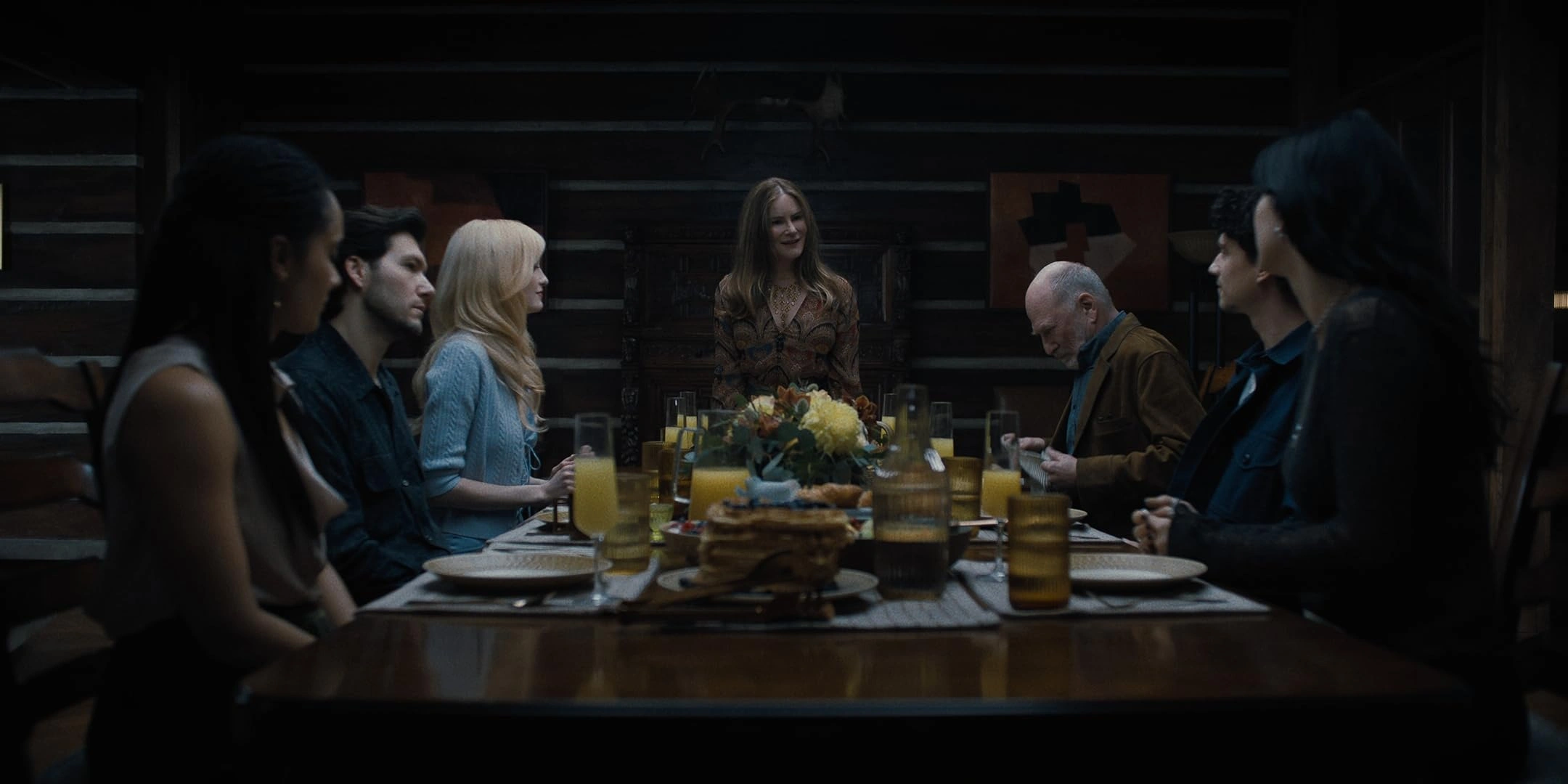
Hallways seem to close around the characters. The camera tilts and rolls in ways that unsettle spatial logic, giving the series a drifting, unstable quality aligned with Rachel’s weakening sense of control. Point-of-view shots and spectral movements through the woods suggest a force in motion around the characters, patient and predatory.
These decisions make the estate feel claustrophobic and watched. They also place the series inside a wider streaming-era habit of using murk and low visibility as mood generators. That tendency has become a recurring point of debate in television, since atmosphere can come at the cost of visual legibility. This show gains texture from that darkness, yet some key details become harder to read.
Colin Stetson’s score gives the images a harsh and heavy counterpart. His use of unconventional instrumentation produces a soundscape that feels industrial, animalistic, and deeply uneasy. The music builds tension without leaning on routine jump-scare punctuation, which gives the fear a slower, more persistent grip. The soundtrack also drops in songs that feel slightly displaced from the moments around them, creating unease through tonal friction.
Production design turns the “cabin” into a lavish woodland compound that remains miserable no matter how polished it looks. Taxidermy returns again and again as a visual marker of the family’s urge to arrest time and preserve what should have been left to decay. Gore and body horror cut through the refined surface of wedding preparations and expose the violence hiding beneath etiquette and ceremony.
Found-footage sequences from the late 1990s interrupt the main visual scheme and supply material tied to the family bloodline. Those segments shift the texture of the series and keep the imagery from settling into one mode. The violence itself lands with force because the effects feel grounded and tactile. Every injury reinforces the sense that Rachel faces a concrete, immediate threat.
Pressure Cookers and the Timing of the Reveal
The five-day countdown gives the narrative its engine. On-screen graphics marking the time left before the “I Do” ceremony keep the viewer fixed on the coming event and strip the story of any illusion that escape will be simple. Each passing day narrows the space around the characters. The opening promise of catastrophe turns the full season into an exercise in waiting for impact.
That structure serves the show well because it creates inevitability without flattening the drama. Early episodes leave room for character work and the slow accumulation of suspicion. Then the story shifts pace. A major revelation arrives earlier than expected and changes Rachel’s role in the plot. She moves from fear and uncertainty into action, and the series gains energy from that pivot. Rachel becomes resourceful, decisive, and painfully aware of what survival may demand.
Red herrings help keep the tension unstable. The local stories about a killer in the woods enter the narrative early and suggest one kind of horror, while the actual threat takes shape much closer to home. That misdirection works because it turns suspicion inward and makes the family itself the true landscape of danger.
Some episodes, including the rehearsal dinner, focus tightly on psychological warfare within the Cunningham clan. Others use found footage to clarify the supernatural dimension tied to the bloodline. The mix of family drama, ritual horror, and backstory holds together for most of the season. The countdown structure pushes every character toward exposure. Masks slip. Loyalty curdles. Fear rises into action.
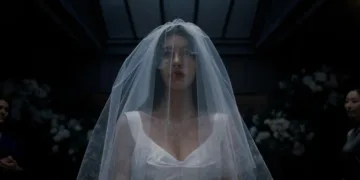
By the time the wedding day arrives, the disaster named in the title is already moving through the house. The ceremony becomes the series’ sharpest symbolic device, a ritual that asks people to give up parts of themselves in service of tradition. Seen through that lens, the show offers a cold view of soulmates and a bleak reading of romantic union. Its final stretch lands with directness and brutality, carrying out the promise of the title without hesitation.
The eight-episode limited series premiered on Netflix on March 26, 2026. Viewers can watch the entire season on the streaming platform, where it has quickly ascended to the top of the global charts. The show centers on a high-stakes wedding rehearsal week that descends into a nightmare of paranoia and supernatural horror. Produced by the Duffer Brothers, this project explores the dark side of devotion and the heavy weight of family heritage.
Where to Watch Something Very Bad Is Going to Happen


Full Credits
Title: Something Very Bad Is Going to Happen
Distributor: Netflix
Release date: March 26, 2026
Rating: TV-MA
Running time: 40–59 minutes
Director: Weronika Tofilska, Axelle Carolyn
Writers: Haley Z. Boston, Ben Bolea, Kate Trefry, Alex Delyle, Alana B. Lytle
Producers and Executive Producers: Haley Z. Boston, Matt Duffer, Ross Duffer, Hilary Leavitt, Andrea Sperling, Weronika Tofilska
Cast: Camila Morrone, Adam DiMarco, Jennifer Jason Leigh, Ted Levine, Gus Birney, Jeff Wilbusch, Karla Crome, Zlatko Burić, Sawyer Fraser
Director of Photography (Cinematographer): Bobby Shore, Krzysztof Trojnar
Editors: Maxime Lahaie, Dev Singh, Roslyn Kalloo
Composer: Colin Stetson
The Review
Something Very Bad Is Going to Happen
This series transforms the mundane anxiety of a wedding into a visceral study of identity erasure. It interrogates the predatory nature of family legacies through a lens of high-stakes horror. The oppressive darkness occasionally hinders the visual experience. Still, the performances and sonic landscape create a suffocating sense of inevitability. The series serves as a cynical critique of the institutions we often romanticize.
PROS
- Visceral performance by Camila Morrone.
- Sonic landscape heightens the atmosphere of dread.
- Countdown structure builds effective pressure.
- Sharp interrogation of patriarchal wedding traditions.
CONS
- Visual clarity suffers from extreme low lighting.
- Predictable narrative shifts in the final episodes.
- Minor plot threads remain unaddressed.







