











![Kingdom Hearts Collection [I-III] Review](https://gazettely.com/wp-content/uploads/2026/10/Kingdom-Hearts-Collection-I-III-1-360x180.webp "Kingdom Hearts Collection [I-III] Review: KHII Holds Steady as Newer Entries Fluctuate 37")





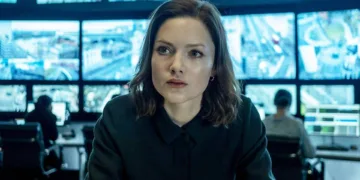
The Capture returns for a third series in a world where digital manipulation has shifted from hidden weapon to public fear. Rachel Carey now serves as Acting Commander at SO15, trying to steady a society in which facts seem permanently under attack.
The new chapter introduces the Carey Cam, a double-lens device built to detect deep-fakes in real time. It stands as a frantic effort to recover a shared sense of reality. The setting has moved out of the technical shadows of earlier years and into a public arena where the state must fight to defend the legitimacy of its own surveillance. As Carey launches the initiative, she faces a conspiracy that tests her perception and her professional integrity.
The story begins at Heathrow Airport, where a suspect changes their digital appearance before the new technology exposes the trick. The victory lasts for a breath. The series soon shifts toward a higher-stakes crisis reaching the highest levels of British government. It imagines a reality where eyesight has lost its status as proof.
The Death of Witness and the Rise of Gaslighting
The primary inciting event is the public assassination of Home Secretary Isaac Turner. Played with frantic ambition by Paapa Essiedu, Turner represents a contemporary political ideal: a successful Black politician positioned to become the next Prime Minister.
His sudden death from a bullet to the head during a press conference lands as a brutal shock. It also removes a character whose presence carried the possibility of representational progress. The aftermath becomes a portrait of institutional panic. The crowd erupts, and the security apparatus fails to control the scene.
Rachel Carey experiences a severe visual rupture during the shooting. She stands close to the gunman and makes direct eye contact with him. That moment gives her a certainty no one else can share. Once digital footage of the assassination appears, the killer’s face has been replaced with someone else’s. The clash between memory and record cracks Carey’s sense of reality. She knows what she saw. The system tells her vision cannot be trusted.
The state uses gaslighting as a tool for protecting its own order. Carey’s colleagues dismiss her account. They choose the clean authority of the digital record over the unstable mess of human memory. The authorities settle on James Whitlock as a convenient scapegoat.
He is a far-right activist who has exposed government irregularities. By attaching the murder to him, the establishment silences a critic and claims to have solved the crime with impressive neatness, the kind of efficiency institutions love when truth becomes inconvenient. This framing of a dissident as a violent extremist reflects a cynical and familiar pattern in modern political debate.
The Carey Cam adds a sharp layer of irony. It was created to identify truth. It fails during the assassination because the manipulators planned around the technology. That failure exposes the weakness of treating trust as a hardware problem. A machine cannot repair a culture willing to accept manufactured evidence over witnessed reality.
The Antagonist and the Deep State Apparatus
The antagonist announces himself with alarming nerve. Noah Pierson is the man Carey saw pull the trigger. Soon after, he is introduced as the new head of SO15. That appointment places Carey under direct threat inside her own workplace. Making her would-be murderer her superior is a clean, nasty stroke of tension. Killian Scott plays Pierson with steely, unreadable control. He walks through power as if consequence is a rumor meant for less connected people.

The series connects Pierson to a secret military unit called the Increment. The group is made up of elite operatives from the SAS and SBS. Their history is tied to covert activity during the war in Ukraine. This backstory gives the series a bleak view of international relations. It suggests past betrayals have returned to the British domestic stage. The conspirators are driven by survival instinct and by the belief that they alone can manage global stability.
The return of CIA agent Frank Napier brings another shade of darkness. Ron Perlman plays Napier with exhausted brutality. His interrogation of Pierson uses methods that would destroy an ordinary citizen. The sequence creates friction between British and American intelligence. It shows agencies moving toward related goals while cutting across each other’s paths with grim confidence.
Carey remains professionally and personally isolated. She lives in a swanky, soul-less penthouse. She drinks a $12 bottle of scotch alone. The image critiques the familiar trope of the powerful career woman stripped of human connection, polished on the surface and hollow underneath. Her relationship with her sister is strained. Inside the police force, she has no allies left. She is a woman who sees the truth inside a world that has decided truth is no longer required for governance.
Algorithms as Authors of the Future
The story turns surreal with the revelation of Simon, an AI dictator capable of predicting future political outcomes. The conspirators believe Isaac Turner’s rise to power would lead to a devastating war. They frame his murder as preventive statecraft, a phrase that sounds tidy enough to make assassination feel like a budget meeting. This move from reactive forgery to proactive algorithmic control marks a key shift in television storytelling. The show expands from the fear of deep fakes into the colder terror of predictive analytics.
That shift changes the series’ pacing. The first two years operated as slow-burn mysteries. The third outing becomes a high-octane action thriller. Characters suddenly display skills that recall John Wick. Hand-to-hand combat sequences arrive with a force that feels detached from the show’s earlier realism. The tension spreads unevenly across the episodes. The opening establishes a methodical rhythm. Later chapters lean on physical stunts to push the plot ahead.
The emphasis on combat sometimes overwhelms the technical puzzles. These scenes can feel like a concession to streaming’s appetite for spectacle, where every cerebral thriller appears to be one algorithmic note away from adding a hallway fight. Plot holes grow easier to spot when the show favors chase sequences over the psychological damage caused by the surveillance state. The tonal shift reflects a wider television trend: series often expand scale to keep audience attention. Here, that expansion sometimes costs the drama its intellectual grip, trading analytical dread for kinetic force.
The Final Surrender to the Machine
The final act unfolds during a public inquiry into the Correction program. Gemma Garland is revealed to be Jacqueline Goldcross. That exposure forces her to testify and confront the cost of her career. The confrontation turns violent when Pierson kills Garland during the inquiry. The public murder marks the collapse of institutional restraint. The system can no longer conceal its own violence.
Carey faces her final choice. She shoots Pierson. The act reads as surrender to the methods she once fought, with justice pushed into a grim moral corner. To protect her career and prove her account, she uses the Correction program herself. She alters the CCTV footage of the shooting so it matches her version of events. This ethical collapse becomes the season’s real tragedy.
Carey is promoted to Commander of SO15. She gains the authority she wanted by sacrificing her integrity. She chooses to ignore Tom Kendricks’ betrayal because he now serves a purpose within her new regime. The final image shows Carey taking a selfie in her apartment. In the digital reflection, she sees the ghost of Gemma Garland. The image chills because it returns the show to its central question: visual evidence cannot be trusted, even when we create it ourselves.
The ending suggests the surveillance state changes the people who operate inside it. Carey has become the monster she was hunting. The series closes on deep cynicism. It argues that in a world built on universal deceit, survival belongs to the person who lies with the greatest efficiency. Carey’s transformation points toward a grim future for the series and toward our own collapsing trust in the digital age.
The third series of The Capture premiered on BBC One and BBC iPlayer on March 8, 2026, following a four-year hiatus that saw the show’s themes of deepfake technology and state surveillance become even more relevant to public discourse. The six-part conspiracy thriller concludes its run this month, with the final episode having aired on April 12, 2026. Viewers in the United Kingdom can currently stream the entire series on BBC iPlayer, while international audiences can access the show through various streaming partners, typically including Peacock in the United States, as part of its global distribution through NBCUniversal.
Where to Watch The Capture Season 3 Online








Full Credits
Title: The Capture (Season 3)
Distributor: BBC One, BBC iPlayer, NBCUniversal Global TV Distribution
Release date: March 8, 2026
Rating: TV-MA
Running time: 60 minutes
Director: Anthony Philipson, Johnny Allan, Ben Chanan
Writers: Ben Chanan
Producers and Executive Producers: Derek Ritchie, David Heyman, Rosie Alison, Sue Gibbs, Tom Coan, Rebecca Ferguson, Ben Chanan
Cast: Holliday Grainger, Paapa Essiedu, Killian Scott, Ron Perlman, Indira Varma, Ben Miles, Lia Williams, Ginny Holder, Joe Dempsie, Andrew Buchan, Hugh Quarshie, Amanda Drew, Linus Roache, Jonathan Aris, Andy Nyman, Nigel Lindsay, Tessa Wong, Daisy Waterstone
Director of Photography (Cinematographer): Rasmus Arrildt, Kieran McGuigan, Philippe Kress
Editors: Carly Brown, Dan Farrell, Matthew Tabern, Kim Gaster, Richard Graham, Emma Oxley
Composer: Ian Arber, Dave Rowntree
The Review
The Capture Season 3
The third series of this BBC thriller evolves from deep-fake horror to a chilling meditation on algorithmic governance. The transition into a high-octane action thriller creates narrative inconsistencies. The psychological weight of Rachel Carey’s moral descent remains devastating. It forces viewers to confront a reality where the state prioritizes predictive order over objective truth. The final scenes leave a haunting impression of systemic decay. This series secures its place as a premier commentary on the death of visual evidence in the digital age.
PROS
- Engaging exploration of predictive AI and the Simon entity.
- Strong lead performance highlighting Rachel Carey’s isolation.
- Tense political intrigue focused on high-stakes statecraft.
- Thoughtful critique of state-sponsored gaslighting and public trust.
CONS
- Uneven pacing across the episodes.
- Occasional over-reliance on familiar action tropes.
- Noticeable plot holes regarding the public witnessing of crimes.
- Sudden shift in established character skill sets.