























![Kingdom Hearts Collection [I-III] Review](https://gazettely.com/wp-content/uploads/2026/10/Kingdom-Hearts-Collection-I-III-1-360x180.webp "Kingdom Hearts Collection [I-III] Review: KHII Holds Steady as Newer Entries Fluctuate 37")



There is a specific brand of English dread that lives in the creases of a well-pressed waistcoat. In the case of Michael Polly, the headmaster of St Bartholomew’s, this dread is as rigid as the cloisters he walks. The disappearance of his wife, Sarah, from their chocolate-box cottage registers as a logistical inconvenience for a man whose life is a monument to order.
We see a landscape of elite academia where predicted grades and rugby victories take precedence over the messy reality of a missing human being. The series operates on the quiet, rhythmic ticking of a clock in a room where no one is speaking.
It presents a world where the search for a person is secondary to the preservation of a reputation. The surrounding Bristol woodland serves as a silent witness to a marriage that appears to have been a long, slow exercise in mutual concealment. Sarah is gone. Michael is present, yet he remains as elusive as the woman he lost.
The Architecture of Emotional Cryogenics
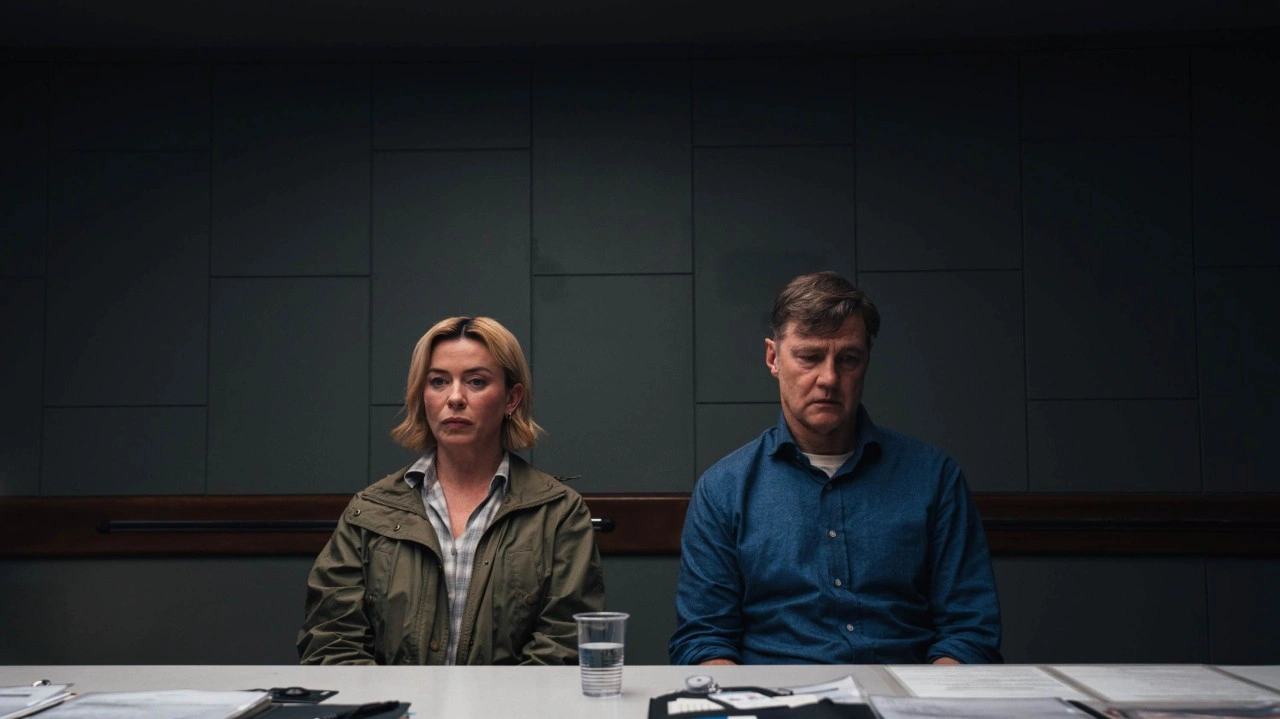
Michael Polly represents a specimen of what we might call “repressive-functionalism.” David Morrissey plays him with a stillness that borders on the geological. He possesses an “iron mask” that appears forged in the nineteenth century. Every movement is a study in controlled physicality. We are drawn to the micro-dramas of his face (a twitching nostril or a momentary tightening of the jaw). These tiny movements replace the traditional weeping we expect from a grieving spouse.
He seems to have undergone a form of emotional cryogenics (the freezing of the self to preserve the institution). His obsession with the 1st XV rugby squad is a ritual of dominance. He coaches them with a relentless, Old Testament intensity. He senses potential greatness in a boy like Dylan Sedgwick and demands it be extracted like ore from a mine.
This is a man who treats human potential as a resource for the school’s prestige. We are left to wonder if he is a monster. Perhaps he is simply a man who has lived so long within the confines of a strict hierarchy that he has lost the ability to exist outside of it.
DS Annie Cassidy is the warmth to Michael’s permafrost. Eve Myles gives us an “everywoman” whose emotional intelligence is her primary tool. She is assigned as the family liaison officer (a role she suspects was given to her by a DI with a dim view of her capabilities). She watches Michael with a dry, skeptical wit.
She recognizes the “funny fish” quality in him immediately. Her own life is a collection of fractures. Her relationship with her ex, Craig, provides a mirror to the themes of dominance found in the Polly household. Craig exhibits a subtle, coercive behavior that suggests control is a common currency in these relationships. Annie sees the cracks in Michael’s facade because she has seen them in her own living room.
The supporting characters inhabit the shadows cast by the school’s stone walls. Alana Polly is a teacher herself. She occupies a liminal space (the daughter trying to reach a father who has replaced his heart with a rulebook). Emma Appleton plays her with a quiet desperation. She is the only person who seems to feel the weight of Sarah’s absence. Dylan Sedgwick is the collateral damage of Michael’s ambition.
He is a boy burdened by a secret. His presence suggests that the school is a place where young men are taught to hide their trauma behind athletic success. Carol provides the necessary observational distance. She is the seasoned voice who understands that powerful men are often the most predictable. She knows that Michael is used to having the world bend to his will. She watches the investigation with the eyes of someone who has seen the “Polly-morphous” nature of guilt before.
The Grey-Blue Purgatory of Somerset
The visual language of the show is an exercise in atmospheric distance. St Bartholomew’s is a character made of stone and tradition. The camera lingers on the cloisters and the palatial buildings (structures designed to make the individual feel small and the institution feel eternal).
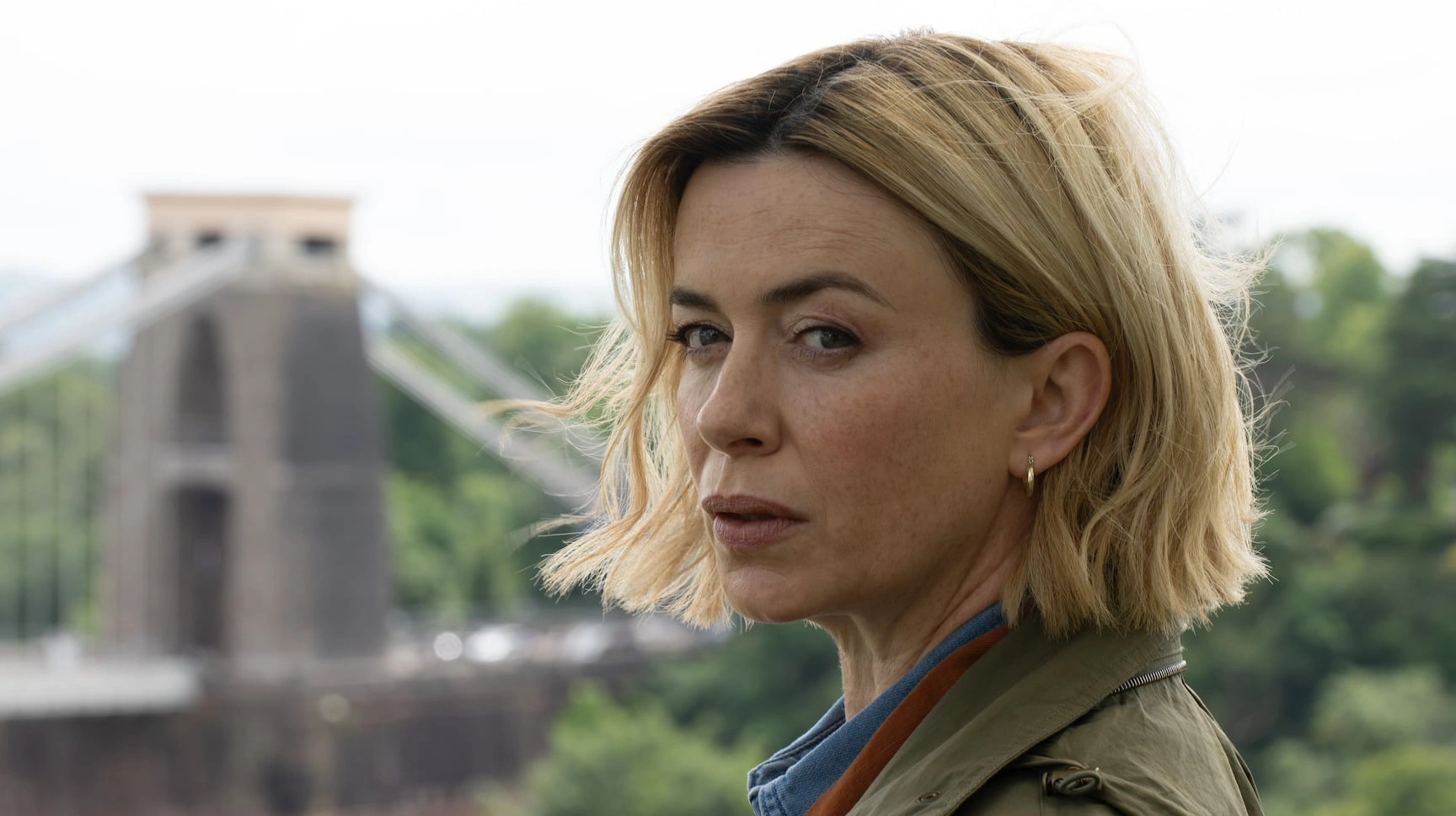
The architecture suggests that secrets have been kept here for centuries. The “grey-blueish” color palette gives everything a ghostly quality. It feels as though the sun never quite manages to reach the interior of the school or the hearts of its inhabitants. This aesthetic choice creates a gothic chill. It reinforces the idea that the characters are living in a purgatory of their own making.
The forest presents an atmospheric counterpoint to the man-made rigidity of the school. These are “well-to-do” woods. The aerial shots reveal a landscape that is beautiful yet suffocating. It is a “posh” crime scene. Dog-walkers wave to each other while a search for a body continues in the undergrowth. There is a “clammy” tension in the air. The beauty of the Somerset countryside is presented with a touch of irony. It is a place where the corpses have the decency to wear expensive outdoor gear. This is a “Barbour-clad tragedy.” The environment offers only more places for things to be hidden.
Sound is used to heighten the sense of inertia. We hear the rhythmic thud of rugby boots on wet grass. We hear the insistent ticking of clocks in silent cottages. These sounds create a gnawing claustrophobia. The setting traps the characters in a world where routine is the only defense against chaos. The inertia is physical. The investigation feels sedated (a cat-and-mouse game played in slow motion). The school and the forest are two sides of the same coin. One is an ordered cage. The other is a wild space where the order is finally breaking down.
The Slow Attrition of Narrative Certainty
George Kay writes with a commitment to the “un-thriller.” The pacing is a deliberate challenge to the viewer. Information is rationed. We receive clues at a rate that mimics the slow realization of a spouse’s infidelity. This is a narrative of attrition. We are forced to sit with the discomfort of Michael’s silence.
The show subverts the usual beats of the genre by refusing to provide a cathartic release. It avoids the “big reveal” in favor of the small, troubling detail. It plays on the idea that we can never truly know the person sitting across from us at the dinner table.
The subplot involving a missing teenager from years prior is a vital component. It connects the current mystery to a history of local failure. It gives Annie Cassidy a personal stake in the outcome. It suggests that the school and the town are built on a foundation of unresolved grief. The interplay between Michael’s professional duties and the police inquiry is handled with precision. The 1st XV rugby match stands as a microcosm of the power struggle running through the story. Michael uses the match to assert his control even as his personal life is being dismantled by the police.
The dialogue is a highlight of the scripting. Annie’s dry humor serves as a necessary counterpoint to the somber environment. Her language is direct and grounded. Michael speaks in a way that is both precise and empty. He uses words to build walls. He talks about “standards” and “predicted grades” to avoid talking about his wife. His speech is a form of linguistic armor. It reflects a man who believes that if he can control the vocabulary of the situation, he can control the situation itself.
The decision to release the show in two-episode blocks (on Sunday and Monday) is an inspired choice. It forces a pause. It gives the audience time to sit with the ambiguity. It prevents the dilution of tension that often happens when a series is consumed all at once. This structured experience mirrors the school term. It creates a sense of dread that builds over weeks, a slow accumulation of pressure that a binge watch would dissolve. We are forced to inhabit Michael’s world. We are forced to wait for the truth to emerge from the mud.
The Banality of the Stiff Upper Lip
The thematic weight of the series lies in its exploration of institutional identity. Michael Polly is a man who has been hollowed out by his role. He is the embodiment of the school. The warning from his predecessor (about the job taking over) is a chilling piece of backstory. He and Sarah “didn’t get out in time.” They were absorbed by the stone and the tradition. Michael’s identity is wholly professional. He is a headmaster first and a husband second. This loss of self is the true tragedy of the story.
The series offers a critique of the “stiff upper lip” (that most English of virtues). We see how this stoicism can become a weapon. It is a form of emotional violence. Michael’s refusal to emote is a way of maintaining power. It keeps the police and his daughter at a distance. It is an anaesthetic that has become permanent. The show asks us to consider the difference between resilience and repression. In Michael’s case, the two are indistinguishable. He has mistaken a lack of feeling for a strength of character.
Coercive control is examined with a subtle hand. Sarah’s diaries provide a voice for a woman who was silenced in life. She describes a man who is “boring” and “laughed at.” This detail humanizes Michael even as it condemns him. It suggests that his rigidity is a defense against his own insignificance. He controls others because he cannot control the way he is perceived. The relationship between Annie and Craig echoes these themes. It suggests that control is a pervasive element in many lives (hidden behind closed doors and polite smiles).
The most revealing moment in the series involves a muddy carpet. When Annie rushes in to tell Michael that a body has been found, his first reaction is to complain about the mud she has trodden into the house. This is the peak of “domestic-obsessionalism.” He prioritizes the preservation of his order over the news of a potential death. It is a peak instance of the banality of a controlled life.
He finds horror in a stain on the rug but remains unmoved by the potential end of his marriage. It is a moment that perfectly encapsulates the theme of the show. We are looking at a man who has replaced his humanity with a set of standards. He is a man out of time. He is a man who has chosen the carpet over the person. It is a story about what happens when the structures we build to protect us end up burying us alive.
The psychological crime thriller Gone premiered on March 8, 2026, on ITV1, with the full six-episode series made available for streaming on ITVX the same day. Set against the atmospheric backdrop of Bristol and a prestigious private school, the narrative follows a high-stakes game of cat and mouse between a stoic headmaster and a perceptive detective following the mysterious disappearance of the headmaster’s wife. Viewers in the United Kingdom can currently stream the entire series on ITVX, while international audiences can find it on regional partners such as STV Player or via All3Media International distribution.
Full Credits
Title: Gone
Distributor: ITV1, ITVX
Release date: March 8, 2026
Rating: TV-MA
Running time: 60 minutes
Director: Richard Laxton
Writers: George Kay
Producers and Executive Producers: Mark Hedges, George Kay, Richard Laxton, Willow Grylls, Matt Sandford, David Morrissey, Elaine Pyke
Cast: Eve Myles, David Morrissey, Emma Appleton, Jennifer Macbeth, Arthur Hughes, Nicholas Nunn, Elliot Cowan, Billy Barratt, Rupert Evans, Jodie McNee, Oscar Batterham, Clare Higgins, Peter McDonald
Director of Photography (Cinematographer): Dirk Nel
Editors: Mark Davis, David Blackmore
Composer: Harry Escott
The Review
Gone
Gone acts as a chilling autopsy of the English "stiff upper lip" tradition. It replaces standard thriller theatrics with a cold, geological study of domestic and institutional control. David Morrissey delivers a masterclass in stillness. He portrays a man whose dedication to order has effectively erased his humanity. While the deliberate pacing might test those seeking instant gratification, the series succeeds as a haunting exploration of the masks we wear. It remains a slow, atmospheric descent into the heart of a very polite, very posh darkness.
PROS
- A magnetic and understated lead performance by David Morrissey.
- Haunting visual aesthetics that create a gothic sense of place.
- Intelligent handling of themes regarding coercive control.
- Immersive and unsettling sound design that heightens the tension.
CONS
- The deliberate pacing creates a sense of stagnation for some viewers.
- Traditional detective tropes occasionally feel overly familiar.
- Secondary subplots sometimes lack the depth of the central character study.








An exceptionally on-target appraisal of this 6-parter, perceptively identifying the principal themes of the storyline.
“Gone” is, indeed, a character study of how an institution can subsume the individuals that fall under its dominion – a cautionary tale of how the imagined “greater good” can destroy and dehumanize those who so desperately want to be something refined.
“Gone” doesn’t break any barriers; it’s another rewrite of familiar themes. However, just because you have heard the story before, does not mean that you can’t enjoy it again; especially when told with human and mortal characters, with emotion, and with passion.
If I would criticize just one thing – the confession scene is more than a little bit contrived. I can’t believe that too many viewers would deny that there was a lot of dramatic build up, for a somewhat soft and non-dramatic reveal.
Great job with the review.