












![Kingdom Hearts Collection [I-III] Review](https://gazettely.com/wp-content/uploads/2026/10/Kingdom-Hearts-Collection-I-III-1-360x180.webp "Kingdom Hearts Collection [I-III] Review: KHII Holds Steady as Newer Entries Fluctuate 37")




The smile is the first and last line of defense. For years, the signature, unwavering grin of All Might was the bedrock of society in My Hero Academia, a symbol of absolute power and security. In the premiere of the final season, that smile returns, but it is a hollow thing, a piece of branding fixed to a metal helmet. It is no longer backed by the world’s strongest quirk, but by hydraulics, desperation, and the sheer, stubborn will of a dying man.
This is the stage set for the series’ ultimate conflict: a quirkless Toshinori Yagi, encased in a suit of armor powered by memory, making a final stand against his nemesis, All For One. The episode is not about a hero expecting to win. It is about a man who has become a pure symbol, examining whether the idea of a hero is enough to hold back the apocalypse, even for a few minutes.
A Legend’s Last Battle: The Spectacle of All Might vs. All For One
The design and function of “Armored All Might” operate as a direct and knowledgeable homage to a specific tradition of American superhero comics. The visual language is undeniable. When the bulky, mechanized suit squares off against a seemingly invincible foe, the parallels to Frank Miller’s The Dark Knight Returns are clear; it is the story of an aging, physically broken hero using technology to wage a final, ideological war.

At the same time, the suit’s reliance on a complex arsenal of gadgets and countermeasures, each deployed with tactical precision, channels the intellectual heroism of Tony Stark’s Iron Man. The narrative significance of this choice is immense. The world is watching the man who once personified overwhelming power return to the fight with none of it, relying instead on the ingenuity and determination that always existed beneath the muscle. His famous smile, now a static feature on his helmet, is a masterstroke of character design. It serves as an anchor of hope for his allies while acting as a profound psychological irritant to an enemy who has always defined him by his strength, not his spirit.
Studio Bones renders this confrontation with exceptional technical skill. The central fight sequence is a maelstrom of kinetic energy, where fluid, weighty animation captures the brutal impact of every collision. The direction is sharp and dynamic, using ambitious camera angles to follow the frantic pace as All Might deploys his varied arsenal against All For One’s storm of stolen quirks. The choice of a driving heavy metal score is perfect, amplifying the intensity to create an atmosphere of epic finality. The production is not without minor flaws; the computer-generated model for the armor can, in certain frames, feel disconnected from the hand-drawn world around it, a brief but noticeable visual hiccup.
This confrontation is also a tactical war of wills, fought through words as much as fists. While shonen anime often gets bogged down by excessive battlefield dialogue, much of the conversation here serves a clear strategic purpose. All Might’s confident taunts and relentlessly positive posturing are weapons. He methodically dissects his opponent’s psyche, reinforcing the very idea of the Symbol of Peace that All For One has spent a lifetime trying to dismantle. This psychological game is set against the terrifying reality of his opponent. Restored to his physical prime by the Rewind quirk, All For One is a monstrous, unbeatable force. This stark power imbalance elevates the stakes of All Might’s stand, transforming it from a simple fight into a monumental and defining act of courage.
The Weight of a Legacy: A Hero’s Inspiration and Inheritance
The episode’s deepest emotional resonance is found within the mechanics of All Might’s suit. It is not merely a weapon; it is a living tribute. Each of its primary functions, from the explosive force of “Bakugo’s” gauntlets to the grappling wires of “Uravity,” is a direct replication of the quirks belonging to his students from Class 1-A.

This design choice is a masterful and poignant full-circle moment for the entire series. For years, All Might was the singular, untouchable ideal that an entire generation of heroes aspired to. Now, in the twilight of his life, their growth, creativity, and unique powers have become his inspiration and his arsenal. This is the literal embodiment of the “passing the torch” theme that has always been central to the show’s narrative.
It illustrates a reciprocal relationship where the mentor is now empowered by the very students he once guided. It is a powerful statement about the nature of legacy, suggesting that his true impact was not the transfer of the One For All quirk, but the web of connections he forged and the potential he nurtured in others.
This act brings the series’ foundational question to a definitive conclusion. All Might’s stand redefines heroism, divorcing it from the concept of overwhelming power and equating it instead with selfless, strategic sacrifice. His goal is not personal victory; he explicitly enters the fight expecting to die. His entire purpose on the battlefield is to create a future where the next generation can succeed.
He is fighting to delay an unstoppable evil just long enough for his successor, Izuku Midoriya, to arrive and have a fighting chance. This is a direct echo of his very first lesson to a quirkless Midoriya: the impulse to save others is what truly makes a hero. By sacrificing everything for a world he will not live to see, All Might provides the ultimate proof of his own teachings, closing his own character arc in a deeply satisfying manner.
A Traitor’s Redemption: The Aoyama Subplot
While the titans clash, the premiere wisely carves out space for the more intimate character arc of Yuga Aoyama, whose journey is one of the episode’s quiet triumphs. His actions here represent a crucial and definitive step on his path to redemption. The narrative effectively frames his choice to fight as a break from his past as a coerced informant for All For One.
He is no longer a passive, terrified victim, but an active participant who, despite his fear, makes a conscious decision to stand with his friends. The episode allows us to see his internal struggle, acknowledging his anxiety while celebrating his newfound resolve. This shift marks a significant evolution for a character who has been largely defined by his feelings of inadequacy and his desperate need for acceptance.
His moment to shine is a testament to this growth. In a well-coordinated attack, Aoyama unleashes his Navel Laser, and the invisible Toru Hagakure uses her body to refract the beam, creating an unpredictable and devastating blast that neutralizes a formidable villain.
This is not just a display of power; it is a demonstration of trust and teamwork, fully reintegrating him into the heroic fabric of Class 1-A. The sequence serves as a small but meaningful victory that carries substantial weight for his character. It powerfully affirms the show’s belief that every hero, regardless of their past mistakes or perceived weaknesses, has a vital role to play in the larger battle.
Structural Faults and Narrative Missteps
For all its thematic resonance and spectacular action, the premiere is hobbled by a significant structural problem. The decision to devote a substantial portion of the episode’s first half to a recap of the Season 7 finale is a critical miscalculation.

In the modern landscape of weekly anime releases, where audience engagement is sustained by forward momentum, this choice brings the narrative to a grinding halt. For viewers who are caught up with the series, the extended flashbacks feel entirely redundant and serve only to delay the start of the new material. A season premiere, particularly for a final season, should explode out of the gate, but this one spends far too much time idling.
The episode’s focus also feels messy and distracted at times, an issue compounded by its editing. The abrupt cuts from the apocalyptic struggle between All Might and All For One to the Aoyama subplot, while important for character, are jarring.
They repeatedly puncture the tension of the main battle, deflating the epic atmosphere that the animation and sound design work so hard to create. The story also stumbles into a tired anime trope with an ill-timed fan service joke involving Hagakure’s nudity. The attempt at levity feels tonally deaf in the context of a desperate war, undermining the grim reality of the situation for a cheap gag.
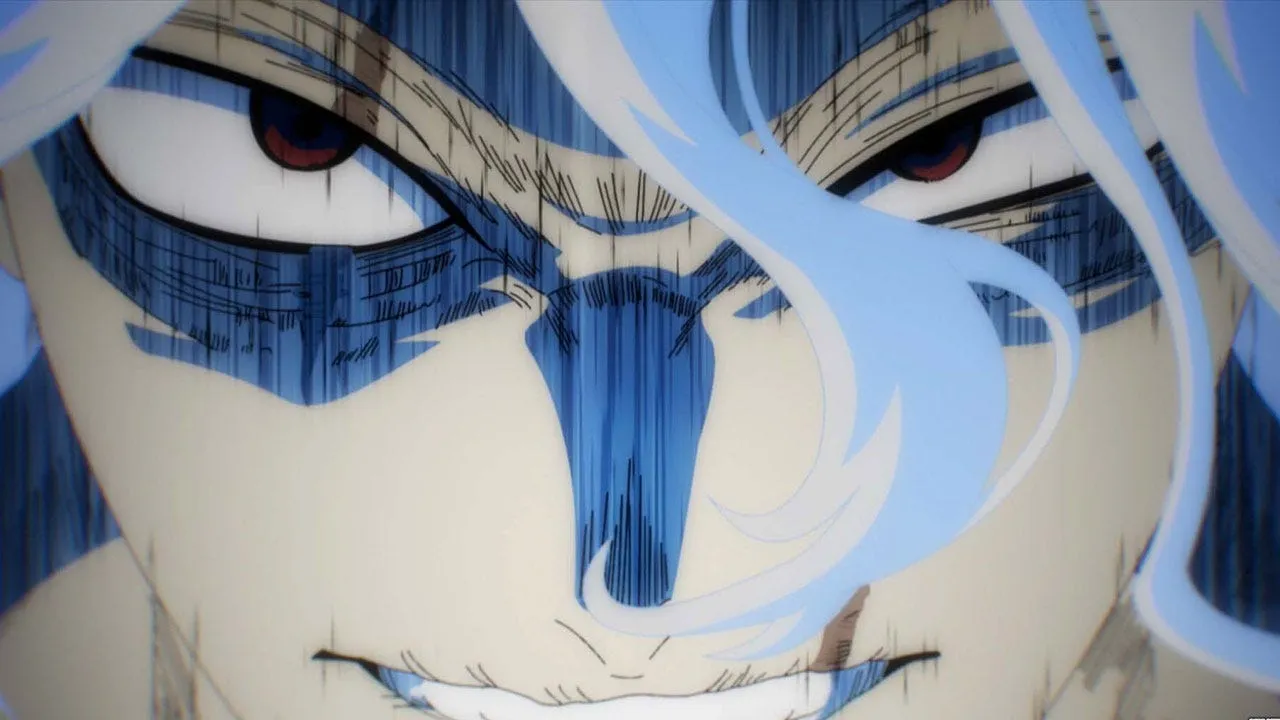
The narrative does, however, regain its footing in the closing moments with a shocking twist. The sudden appearance of the hero-killer Stain, who intervenes to paralyze All For One, is a well-executed and genuinely surprising development. His arrival injects a fresh surge of energy and intrigue into the plot, immediately re-establishing the forward momentum that was lost earlier. It is a compelling hook that complicates the hero-villain dynamic and leaves the audience with a tantalizing set of questions for the episodes to come.
My Hero Academia’s eighth season is the concluding season of the beloved anime television series, based on the manga by Kōhei Horikoshi. The series continues the story of Izuku Midoriya and his classmates as they face the climactic confrontation with the League of Villains and All For One. The season, produced by Studio BONES, premiered on October 4, 2025. You can watch My Hero Academia streaming on the platform Crunchyroll.
Full Credits
Director: Kenji Nagasaki, Naomi Nakayama
Writers: Yōsuke Kuroda, Kōhei Horikoshi
Producers and Executive Producers: Yoshihiro Ōyabu, Hayato Saga, Mirei Tsumura, Hiroya Nakata, Fumi Miura, Lu Xiana, Ryouta Katou
Cast: Daiki Yamashita, Nobuhiko Okamoto, Yuki Kaji, Ayane Sakura, Kaito Ishikawa, Marina Inoue, Toshiki Masuda, Aoi Yūki
Director of Photography (Cinematographer): Mayuko Furumoto
Editors: Kumiko Sakamoto
Composer: Yuki Hayashi
The Review
My Hero Academia Season 8
My Hero Academia’s season 8 premiere is a story of frustrating contradictions. It delivers one of the series' most spectacular and thematically rich battles, a poignant examination of heroism and legacy anchored by All Might's incredible last stand. However, this brilliant core is severely hampered by baffling structural choices, including a ponderous recap that consumes half the runtime and jarring cuts that kill the narrative's momentum. It is a powerful, emotional, and deeply flawed beginning of the end.
PROS
- A spectacular and emotionally resonant central fight between All Might and All For One.
- Powerful thematic exploration of heroism and legacy through All Might's student-inspired armor.
- Excellent animation and an effective musical score during key action sequences.
- A meaningful character moment for Yuga Aoyama.
- A shocking final twist that creates strong momentum for the next episode.
CONS
- Nearly half the episode is a redundant recap that severely damages the pacing.
- Jarring cuts between plotlines deflate the tension of the main conflict.
- A tonally inappropriate fan service moment feels out of place.
- Occasional clunky integration of CGI with 2D animation.