

























![Kingdom Hearts Collection [I-III] Review](https://gazettely.com/wp-content/uploads/2026/10/Kingdom-Hearts-Collection-I-III-1-360x180.webp "Kingdom Hearts Collection [I-III] Review: KHII Holds Steady as Newer Entries Fluctuate 37")





Virgin River arrives in its seventh installment, still functioning as a sanctuary for those worn down by the frantic digital age. The season picks up after the wedding of Mel Monroe and Jack Sheridan, a union serving as a stable center in a world defined by volatility. The town operates as a form of Agri-nostalgia (a longing for a rural simplicity that likely never existed). The landscape plays silent observer, its forests and waters offering visual reprieve. The setting remains peaceful, yet residents encounter trials that test their emotional foundations.
The show holds its focus on the shared human condition within this isolated geography, examining how individuals lean on one another during life-altering shifts. The quiet beauty of the surroundings serves as a canvas for the search for home. As the newlyweds settle into their roles, the community manages its own fluctuating loyalties. This chapter highlights the strength of social bonds in a rural refuge, suggesting that community is the only true defense against the uncertainties of fate.
The Architecture of Chosen Kinship
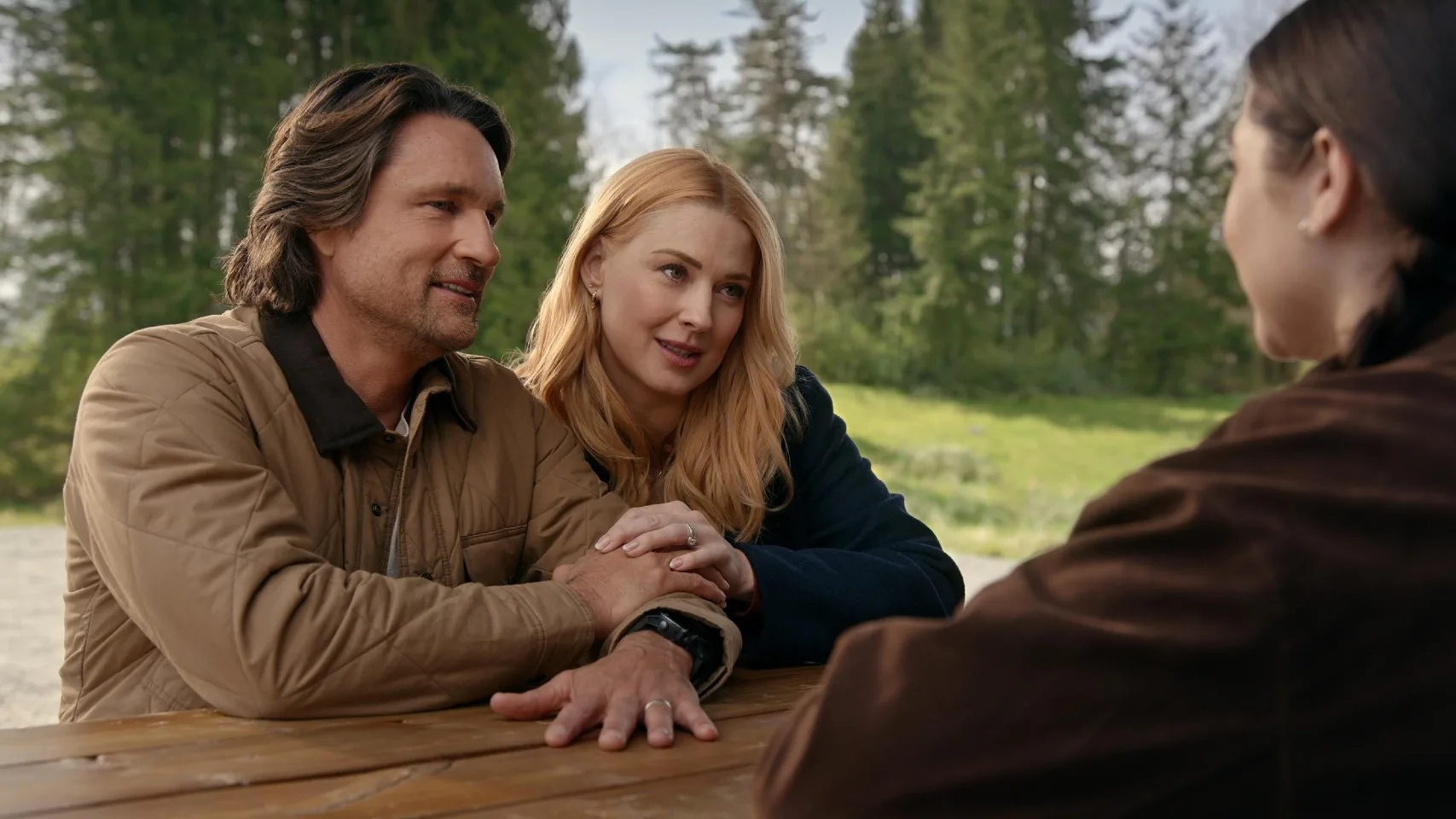
The arrival of Marley presents a moral crossroads for the Sheridans. Her offer of adoption forces Mel to balance professional distance against a primal yearning for family. The result is psychological friction. Mel must act as a nurse while her heart demands she act as a mother. One sees the “Hero-healer” archetype struggling with the “Aching-empty” self.
The debate over a honeymoon in Italy or Hawaii provides a necessary pause. These scenes offer a dry look at the “first-world problems” of a couple perched on the edge of a massive life change. The tension between the dream of escape and the reality of responsibility produces a playful tug-of-war that acts as a narrative buffer, protecting the audience from the heavier emotional tolls ahead.
The finale brings the weight of motherhood into sharp focus. Alexandra Breckenridge delivers a performance stripped of vanity. She captures the jagged edge of “hope-ache” (the specific pain of wanting something so much it hurts to hold it). The medical crisis involving the infant strips away the soapy veneer, exposing a raw biological vulnerability. Mel uttering the words “I’m his mother” carries a sociological weight, asserting that motherhood is a choice of the soul, a declaration independent of biological fact.
Jack and Mel utilize their history to survive these pressures, avoiding the familiar traps of miscommunication. Their relationship evolves into a partnership defined by endurance. Love is a labor. It requires constant maintenance. The adoption arc challenges traditional ideas of lineage, replacing “blood-logic” with a commitment to presence. Families, the show suggests, are built through shared suffering and intentional joy.
The Biological Imperative of the New Guard
Lizzie and Denny represent the shift in the town’s social fabric. Their transition into parenthood is depicted with a surprising lack of “trauma-kitsch.” The labor scene is visceral, reminding us that birth is a messy physical reality regardless of how beautiful the scenery is. Lizzie transforms from a flighty youth into a grounded pillar of the community. Sarah Dugdale conveys the exhaustion of a woman pushed to her limit, executing the difficult scenes with a precision that makes the character feel entirely real.
Denny steps into his role with a quiet determination, rejecting the trope of the hesitant young father. His support during the recovery process is a study in “steady-state” masculinity (a refusal to fold under pressure). This birth serves as a communal event, bringing together figures like Hope and Connie in a way that recalls the village structures of the pre-industrial era.
A child in Virgin River belongs to the town, reinforcing the theme of the extended family as a survival mechanism. The younger generation finds meaning in the repetition of ancestral cycles. They accept the burdens of the past to build a stable future for the next resident. This narrative choice positions the show as a study in social continuity. The presence of the baby acts as a symbol of hope for a town often haunted by the mistakes of the previous generation.
The Decay of Local Sovereignty
The senior members of the community face a different type of extinction. Doc Mullins deals with a health department investigation that feels like a personal betrayal. The tension with Dr. Hayes is palpable, representing the clash between old-world medicine and modern bureaucratic oversight.
This is “Capitalist-care” (the intrusion of corporate efficiency into the healing arts). Hope returns to her political roots to fight this encroachment, realizing the town council may no longer share her vision of small-business supremacy. Her battle is a microcosm of the death of the American main street. She fights against the medical conglomerate with the ferocity of a leader who knows her time is limited.
Muriel’s cancer diagnosis is handled with a commendable lack of sentimentality. She displays a grace that suggests the dignity of a fading aristocracy. The show sidesteps the usual tropes of the “sickbed drama,” focusing on the internal strength required to face one’s own mortality. Teryl Rothery provides a performance that is both fragile and fierce.
A quiet moment between Doc and Hope hints at a prequel, suggesting their love is a historical monument. They are the keepers of the town’s secrets. Their struggle to maintain control over their practice and their lives is a philosophical meditation that asks if a person can truly remain relevant when the world around them demands constant modernization. They represent the “Ancestral-anchor” of Virgin River. Without them, the town risks losing its specific, stubborn identity.
The Currency of Misplaced Loyalty
Brie makes a definitive choice. She leaves the safety of Mike for the volatility of Brady. This decision is an admission that comfort is often a poor substitute for truth. Mike represents the “polite-patrimony” of a stable life, the man one should want. Brady, the man she cannot forget, represents the “Rust-belt Romantic” (the allure of the damaged and the familiar).
His financial ruin at the hands of Lark adds a layer of “Rural-ruin” to his arc. He is a man perpetually paying for sins he has already forgotten. This relationship remains messy and complicated, refusing to provide the easy answers typical of the genre.
Preacher’s move toward independence is a tectonic shift for the series. His departure from the bar signals a break in the social order. Jack’s Bar has always been the town’s living room, and Preacher moving on suggests that even the most stable institutions eventually change. His relationship with Kaia suffers from “silence-rot” (the slow destruction caused by things left unsaid).
They fail to communicate their needs, creating a distance that even the strongest attraction cannot bridge. These shifting loyalties reveal the town as a place of constant negotiation. Every character is trying to balance their own desires against the expectations of their neighbors. The romantic realities are often harsher than the vistas suggest. Loyalty is shown to be a precarious currency, devalued by a single secret or a sudden career change.
The Shadows in the Sun-Drenched Valley
The pursuit of Charmaine continues in the background. The death of Calvin casts a shadow over the “Visual-valium” of the forest. This is the “Rural-noir” aspect of the show, suggesting that danger is always lurking near the riverbanks. Charmaine and her twins on the run provide a frantic energy to an otherwise slow-moving season.
The arrival of Clay, a new farmhand with a hidden cache of weapons, introduces a new threat. His presence is a reminder that the town is an open system, capable of being infiltrated by the same violence it seeks to escape. He is the “Unknown-outsider” who brings the chaos of the city into the sanctuary of the woods.
The production remains consistent in its aesthetic choices. The scenic shots provide a sense of atmospheric safety. The finale then shatters this peace with four distinct cliffhangers. Brady’s motorcycle accident is a classic dramatic device, forcing the viewer to confront the fragility of the characters they have grown to love. The medical uncertainty regarding the Sheridan baby poses a much deeper threat, challenging the season’s central promise of happiness.
These narrative hooks ensure that the audience remains tethered to the screen for another year. The path forward is obscured by these sudden shifts. The show proves that even in a place as predictable as Virgin River, the world can change in an instant. The cycle of hope and tragedy remains the only true constant, holding its status as a comfort show that declines to let the viewer get too comfortable.
The seventh season of the beloved romantic drama Virgin River premiered globally on Netflix on March 12, 2026. This installment continues the journey of nurse practitioner Mel Monroe and bar owner Jack Sheridan as they navigate their new life together following their wedding. Set against the breathtaking backdrop of British Columbia, the series remains one of the streaming platform’s most consistent hits, offering a mix of small-town charm and high-stakes personal drama. All ten episodes were released simultaneously, allowing fans to dive straight back into the evolving lives of the town’s tight-knit community.
Where to Watch Virgin River Season 7 Online


Full Credits
Title: Virgin River Season 7
Distributor: Netflix
Release date: March 12, 2026
Rating: TV-14
Running time: 40–54 minutes
Director: Andy Mikita, Martin Wood, Gail Harvey, Tim Matheson, Felipe Rodriguez, Jem Garrard, Monika Mitchell
Writers: Sue Tenney, Robyn Carr, Patrick Moss, Amy Palmer Robertson, Debra Fordham, Jackson Sinder, Erin Cardillo, Richard Keith
Producers and Executive Producers: Sue Tenney, Roma Roth, Chris Perry, Ian Hay, Amy Palmer Robertson, Patrick Moss, Robyn Carr
Cast: Alexandra Breckenridge, Martin Henderson, Tim Matheson, Annette O’Toole, Colin Lawrence, Benjamin Hollingsworth, Sarah Dugdale, Zibby Allen, Marco Grazzini, Mark Ghanimé, Kai Bradbury, Kandyse McClure, Teryl Rothery
Director of Photography (Cinematographer): David Pelletier, David J. Frazee, Toby Gorman, Ronald Richard
Editors: Daria Ellerman, Nicole Ratcliffe, Lara Mazur, Kirk Hay, Adina Moore, Lianne Oelke
Composer: Jeff Cardoni
The Review
Virgin River Season 7
The seventh season operates as a study in "Stasis-tension" (the anxiety of maintaining peace in a world designed for chaos). It favors character-driven patience over the frantic "Plot-vomit" of earlier seasons. While some subplots feel half-baked, the central exploration of parenthood remains emotionally resonant. The show functions as a visual sedative for the modern soul. It asks if domestic happiness can survive the intrusion of reality. It is a flawed but necessary exercise in televised comfort.
PROS
- Authentic depiction of emotional maturity in the lead couple.
- Grounded focus on the physical realities of childbirth and recovery.
- Sensitivity in the portrayal of serious health challenges.
- Scenic cinematography that maintains the town's welcoming atmosphere.
CONS
- Inconsistent writing quality for secondary character arcs.
- Glacial pacing in the bureaucratic medical investigation subplot.
- Weak romantic tension in the newly formed pairings.
- Reliance on abrupt cliffhangers to generate artificial stakes.







