




























Before the Marvel Cinematic Universe reorganized global pop culture, Marvel’s presence in games lived through the flicker of arcade cabinets and home consoles. The MARVEL MaXimum Collection arrives in 2026 as a link between those older formats and current hardware. Limited Run Games assembles six titles that frame a particular slice of the early 1990s.
That period carried little of the narrative unity associated with present-day blockbuster storytelling. Its energy came from the immediate force of 8-bit and 16-bit style. The set includes X-Men: The Arcade Game, Captain America and The Avengers, Spider-Man: Separation Anxiety, Spider-Man: Maximum Carnage, Spider-Man and the X-Men in Arcade’s Revenge, and Silver Surfer.
Seeing the saturated, comic-accurate sprites of the SNES on sharp 2026 displays throws the scale of that technical change into clear view. The thirteen versions gathered here also show how regional hardware limits once shaped play in direct ways. As a preservation project, the collection records a period when superhero media moved in several directions at once and carried an experimental spirit.
Technical Fidelity and the Mechanical Cross-Section
The library serves as a survey of arcade power and console experimentation. X-Men: The Arcade Game is the central attraction. Its oversized sprites and digitized voice clips capture a distinct phase of Japanese arcade design built for pure sensory force. The combat is straightforward. It favors crowd control and constant motion. That design gives the game an immediacy that still reads clearly on modern hardware.
The two Spider-Man games, Maximum Carnage and Separation Anxiety, shift that energy into a street-level brawler style with a heavier, rougher feel. In Maximum Carnage, the Green Jelly soundtrack ties the game to a specific current in 1990s Western counterculture. These titles reveal a close relationship between mechanics and source material, with the weight of each hit echoing the grit of the comics that shaped them.
Silver Surfer takes the collection into a very different form through its side-scrolling shooter structure. Its reputation for severity remains intact. The hit detection is still harsh, asking players to memorize screen patterns with near-clinical precision. Captain America and The Avengers opens another line of comparison through its regional versions. The arcade release leans into frantic combat.
The NES release moves toward a slower platforming rhythm. That split shows how ports once reflected different priorities across markets and hardware. Across the full suite, the emulation is smooth. Moving from one game to another happens instantly. Input response feels exact, preserving the snap of the original hardware for players encountering these games through a contemporary global release. The software gives those older difficulty spikes a steady platform, leaving timing as the deciding factor.
Modern Preservation and Legacy Customization
Bringing these games into the present calls for work that goes past basic emulation. The collection includes tools that soften the punishing logic of arcade-era design. Rewind options let players remove a fatal mistake with a single press. Save states offer a route around the absence of checkpoints in older console structures.
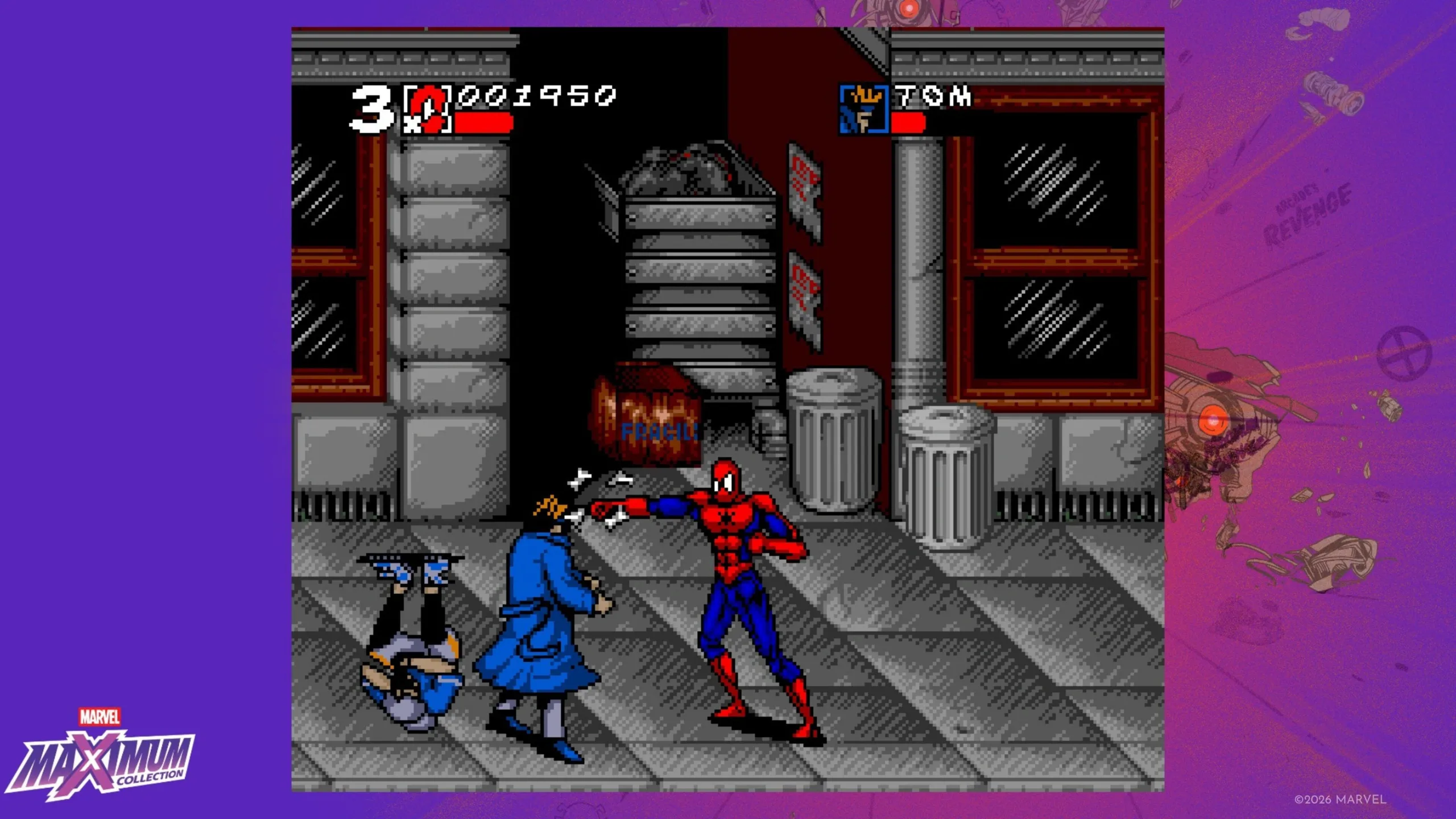
These additions open the collection to players who do not have the hours needed to internalize decades-old patterns. Toggleable cheats, including infinite lives and power-ups, strip away a good deal of frustration. That shift places greater emphasis on visual storytelling and sprite craft.
The visual options show similar care. High-quality CRT filters recreate the softer glow and scanlines associated with older televisions, keeping the pixel art close to its intended appearance. Players can choose a 4:3 aspect ratio, with custom border art filling the unused space on widescreen displays. The Vault adds historical texture through high-resolution scans of manuals, box art, and original design documents.
That material restores some of the physical identity these games once had as objects on shelves and in rental stores. The music player reaches the same level of detail. It allows users to swap between console sound chips and hear the way separate hardware rendered the same compositions. That degree of technical control shows respect for the work done by the original sound designers.
Connected Play and Network Realities
Cooperative play remains central to the beat ’em up form. X-Men: The Arcade Game preserves its six-player setup through online support. Rollback netcode keeps latency low during the chaos of screen-filling attacks. That choice matters because the game’s pace depends on responsiveness.

Local co-op also stands out in the Spider-Man and Venom games. Moving through those stages with another player recreates the social feeling of 1990s living room play, when superhero games often lived through shared screens and shouted directions.
Multiplayer support is not fully consistent across the set. This is most visible in Captain America and The Avengers, whose port lacks the four-player option found in the original arcade cabinet. In that version, players also cannot switch characters during a continue screen. Those gaps reflect the fragmented condition of the source code.
Online activity in 2026 is also somewhat thin, which makes it harder to assemble a full six-player X-Men session without arranging a group in advance. The network structure exists and works. The quality of the experience depends on the size and energy of the active player base. Even with that limitation, the collection creates a meaningful link between the solitary conditions of home play and the communal atmosphere that defined the arcade floor.
The Review
MARVEL MaXimum Collection
This release provides a necessary archival record of the 1990s superhero landscape. It prioritizes technical stability and historical accuracy over modern polish. The variance in software quality across the six titles prevents it from being a masterpiece. It remains a valuable resource for those studying the evolution of licensed media. The preservation tools make even the most punishing titles approachable for a modern audience.
PROS
- Rollback netcode for arcade play.
- High resolution archival scans.
- Stable 2026 emulation performance.
- Flexible CRT visual filters.
CONS
- Inconsistent port features.
- Small library of six games.
- Low online player activity.