









The sun comes up over the San Diego coast in 1890, and Steel Ball Run wastes no time making a loud entrance. Promoter Steven Steel unveils a transcontinental horse race that stretches four thousand miles to New York City, with fifty million dollars waiting at the end.
The pitch alone could make a person faint, and plenty of riders answer it anyway. Among them is Johnny Joestar, a fallen jockey whose life has narrowed into paralysis and resentment. Then he crosses paths with a foreigner named Gyro Zeppeli, a man carrying spinning steel balls with enough force to make Johnny stand for a brief moment.
That instant sends Johnny after the mystery behind Gyro’s power and into the race itself. The series uses the event as a reset point for a new JoJo timeline, shifting the family saga to the American frontier, where horses, camels, and runners all chase money, status, and survival. From the first stretch, the race feels huge, strange, and hungry for trouble.
The Logistics of a Fifty Million Dollar Manifest Destiny
Steel Ball Run understands scale, and it shows off. Four thousand miles of brutal American land sit between San Diego and New York, broken into nine separate stages that each bring their own environmental punishment. The first leg drops the field into searing desert conditions, where heat and exhaustion arrive before open hostility from fellow competitors has even fully kicked in. Fifty million dollars hangs over every choice, so desperation comes built in. That prize pulls in a crowd big enough and odd enough to make the starting line feel like a travelling circus with a death wish.
The rules are loose to the point of mischief. Steven Steel permits horses, camels, and runners to enter the same event, which gives the race a wild technical identity from the outset. The 1890s backdrop matters here. The country sits in a period shaped by expansion and industrial unease.
Locomotives point toward an approaching future, yet this grand spectacle depends on bodies, animals, endurance, and brute force. Steven Steel carries himself like a showman intoxicated by the drama of the American Dream, while privately seeming rattled by the fear that his enormous financial gamble could implode in front of everyone.
The opening surge sells that anxiety with real bite. Thousands of riders crash into narrow choke points, and those bottlenecks turn the start into a pileup of violence. The anything-goes approach pushes the race away from sport and into combat.
Riders shove, trample, and batter each other through the pack. The pacing in the premiere follows that same panic-stricken rhythm. It makes the event feel like a machine built to chew people up. The westward myth of American expansion hovers over the whole thing, lending grandeur to a spectacle that is brutal enough to leave hoofprints on the fantasy.
Jockeys, Outlaws, and the Pursuit of the Spin
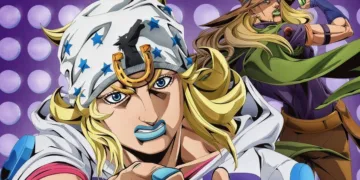
Johnny Joestar enters the story with splinters already in him. Once a prodigy, he lost everything through a single flash of arrogance, and the series keeps that wound close to the surface. His paralysis defines his daily reality, yet his bitterness has even sharper edges. He dresses in a star-spangled outfit with blue lipstick, a look that plants him in the frame like a dare.

His goal is pleasingly blunt. He wants the secret behind Gyro’s power because he wants his legs back. Patriotism does not drive him. Adventure does not drive him. Johnny is chasing a miracle with tunnel vision, and he first sees Gyro as the instrument that might give it to him.
Gyro Zeppeli arrives as if subtlety offended him personally. The wide-brimmed hat and gold-embossed grills do half the introduction before he says a word. He commands the Spin, a technique centered on two green steel balls that refuse to behave like ordinary objects.
Gyro jolts Johnny back into motion, mentally and physically, and his oddball charisma keeps the show from choking on its own intensity. The “Nyo-ho-ho” laugh lands like a rhythmic cue every time the mood needs a sly release valve. What begins as a deal built on secrets starts to pick up emotional weight once the trail begins pressing both men through the same hardship.
The supporting racers enter with the kind of flair that suggests future folklore. Diego Brando stands out as a British racing genius with a predator’s stare and a polished, scheming presence that marks him as danger right away. Sandman brings a different texture to the field. He runs on foot, seeks to buy back his ancestral land, and endures open discrimination from the riders around him.
His presence gives the fantasy a harsher historical grain. Pocoloco moves through the madness under the banner of supernatural luck, wearing confidence like he won the race in a dream last week. Urmd Avdul shows up with a camel and treats the desert like a tactical companion. Every one of these ambitions collides in the dust, and the first stage already feels crowded with people trying to outrun fate, history, or both.
Runway Aesthetics on a Dusty Frontier
The look of Steel Ball Run swings hard away from familiar Western imagery, and the series seems delighted by that choice. Characters are drawn with elongated proportions and staged through a fashion-forward sensibility that recalls haute couture and editorial photography.
The wardrobe across the cast feels lifted from a luxury spread and dropped into a hostile frontier, which gives the show a visual wit all its own. Saturated colors push against the browns and yellows of the setting, keeping the principal figures visually dominant in nearly every shot. It is a dusty race across America staged with magazine-cover confidence. Strange combination. Very good one.
David Production handles the mechanics with real precision. Hand-drawn 2D animation works alongside 3D horse models, giving the racing scenes speed and consistency while keeping the movement believable at a full sprint. The adaptation also preserves the twisted, highly specific poses associated with the source material, and those held images carry force instead of feeling rigid.
Manga stylization turns up across the screen through onomatopoeia bubbles that punch up the sound of galloping hooves and split-screen compositions that let multiple racers occupy the same burst of momentum. The editing uses those devices well, letting chaos read clearly without sanding down the frenzy.
The race cinematography does strong work with scale. Wide shots reduce the riders to tiny marks against a giant landscape, which sharpens the sense of isolation built into the route. Once the final scramble of the first leg arrives, the camera closes in and becomes aggressive. Speed lines slash across the frame, and the collisions land with more force because the visual language tightens around them. The American West is treated here like an arena for stylized spectacle, full of graphic intensity and deliberate artifice. Realism is not the point. Expression is.
The Rhythmic Resonance of the Steel Ball Run
The soundtrack comes in with swagger. Yugo Kanno returns to the franchise and builds a score that mixes folk and jazz, giving the series a frontier pulse without flattening it into simple period flavor. The recurring choral cry of “Steel Ball Run” arrives at key moments with the kind of theatrical confidence that can either fall flat or raise the roof. Here, it works. The music grants the race ceremonial weight, making the event feel huge, fated, and a little unhinged in the best JoJo fashion. It supports the sense that this story marks the arrival of a new era.
The sound design stays just as important at ground level. The Spin has a tactile sonic identity, with the steel balls humming in a way that feels metallic and charged before they strike. When they hit wood or flesh, the impact lands with heavy resonance.
Diego Brando gets his own sharp, hostile audio signatures that fit his riding style and make his movement feel pointed and dangerous. Around all of this sits the desert itself: wind cutting through open space, thousands of hooves hammering the earth, tension rising from the sheer density of noise. The episode understands that a race this large should never feel sonically empty.
The vocal performances seal the international sweep of the cast. Kaiji Tang gives Gyro Zeppeli a charismatic and mysterious presence, catching the character’s humor and the sense that there is much he keeps concealed. Daman Mills plays Johnny Joestar with a raw quality that holds onto vulnerability while letting grit gather over time.
Across the supporting cast, the range of accents and vocal textures helps sell the competition as a truly global event. Each rider sounds like a person carrying a separate history into the same stretch of dust. For a premiere built on motion, spectacle, and collision, that individuality matters. The race has barely begun, and it already sounds like myth trying to make itself heard.
Steel Ball Run: JoJo’s Bizarre Adventure officially premiered on Netflix on March 19, 2026, marking a monumental shift for the long-running franchise. This adaptation explores a new continuity set in the 1890s American West, focusing on a transcontinental horse race that stretches from San Diego to New York City. The series debuted with a special, extended 47-minute episode to establish its high stakes and distinctive Western atmosphere. Fans can currently stream the series exclusively on Netflix, which serves as the global home for this seventh part of the Joestar saga.
Where to Watch STEEL BALL RUN JoJo’s Bizarre Adventure Online


Full Credits
Title: Steel Ball Run: JoJo’s Bizarre Adventure
Distributor: Netflix
Release date: March 19, 2026
Rating: TV-MA
Running time: 47 minutes for the premiere episode, 24 minutes for standard episodes
Director: Toshiyuki Kato, Yasuhiro Kimura, Hideya Takahashi
Writers: Yasuko Kobayashi, Hirohiko Araki
Producers and Executive Producers: Fumihiro Ozawa, Mirai Miyamoto, Noriko Dohi, Takamitsu Sueyoshi, Yuko Kawae, Akihiro Kawamura, Masahiro Nojima, Shotaro Usui, Takumi Ito, Tsuneo Takechi
Cast: Daman Mills, Kaiji Tang, Damien Haas, Cedric Williams, Alejandro Antonio Ruiz, Jamieson K. Price, Frankie Kevich, Nazeeh Tarsha
Director of Photography (Cinematographer): Kazuhiro Yamada, Shiho Imaizumi
Editors: Kiyoshi Hirose
Composer: Yugo Kanno
The Review
STEEL BALL RUN JoJo’s Bizarre Adventure
Steel Ball Run delivers a masterful reset for a franchise that thrives on chaos. It abandons the weight of past continuity for a high-octane race that feels visceral and artistically daring. The central dynamic between Johnny and Gyro grounds the flamboyant action in genuine human desperation. While the technical shift to 3D horses might startle some purists, the stylistic payoff is immense. This is a bold, rhythmic odyssey across a beautifully distorted American West. It captures the spirit of adventure with a sharp, fashion-forward edge.
PROS
- Striking character designs influenced by high fashion.
- Nuanced protagonists with complex moral trajectories.
- Effective integration of 3D models into fast-paced sequences.
- Atmospheric score that enhances the Western setting.
- Accessible entry point for newcomers.
CONS
- Frequent use of still frames to handle intricate details.
- Early segments occasionally lean on heavy exposition.
- Visual density requires intense focus.