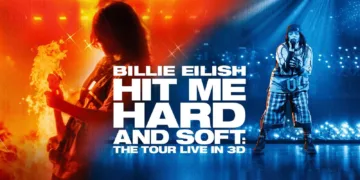



























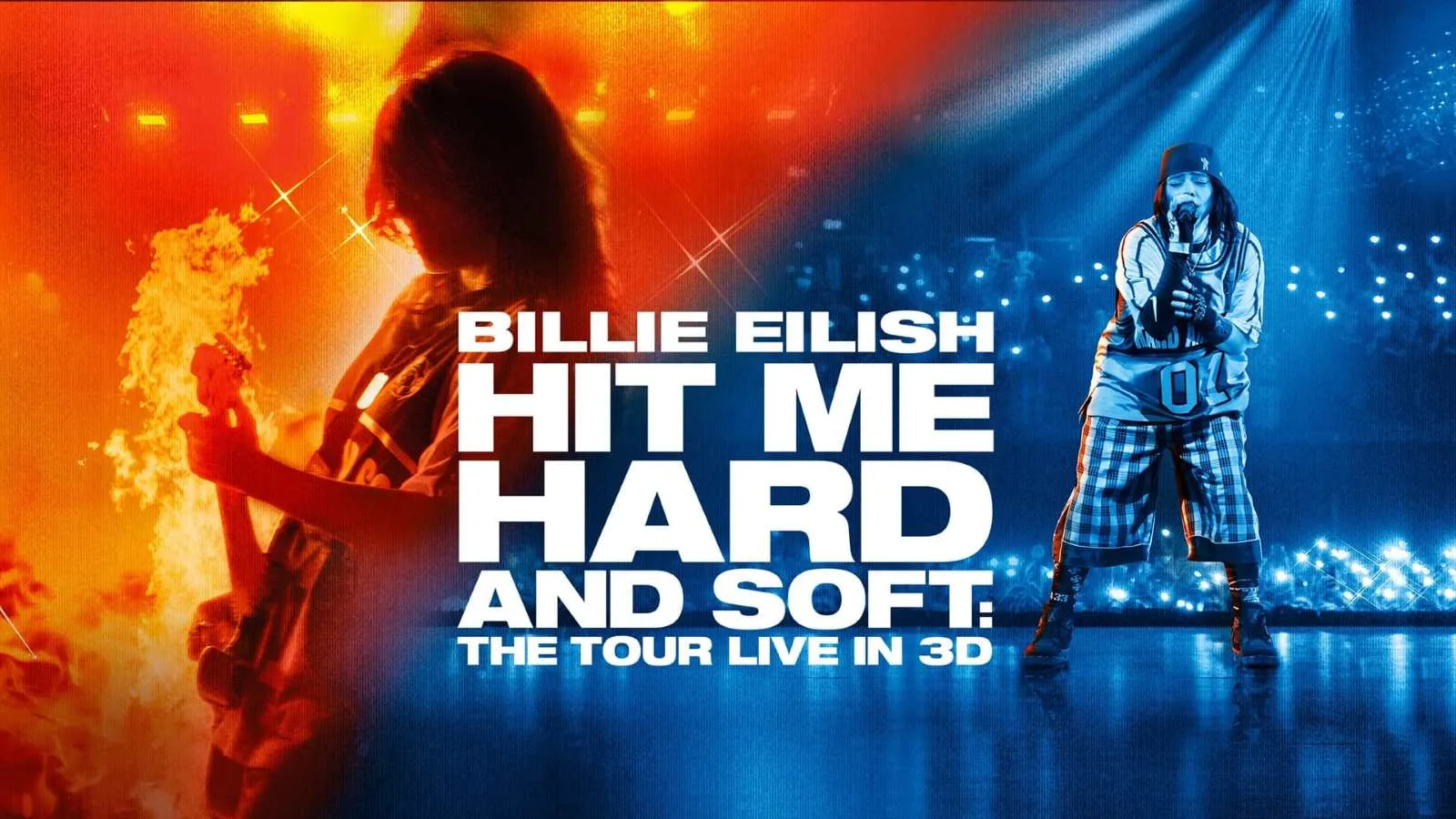

There are pop stars, and then there is Billie Eilish. At 24, she holds ten Grammy Awards, an Academy Award, and a tour record that no 21st-century artist has matched. “Billie Eilish: Hit Me Hard and Soft — The Tour (Live in 3D)” arrives as the logical extension of that ascent: a cinema event co-directed by Eilish and James Cameron, the 71-year-old architect of Titanic and Avatar, shot over four nights at Manchester’s Co-op Live arena in July 2025 with 17 strategically placed cameras. The film bills itself as a reinvention of the concert experience.
That is a significant claim, and the film is only partially equal to it. What it more honestly offers is a carefully curated proximity to one of the most singular pop artists alive, and a meditation, perhaps unintended, on what it means to be seen and to see in the age of mass devotion. The opening shot is a time-lapse of the gargantuan stage being assembled in a cavernous arena, followed by the slow fill of tens of thousands of screaming fans. This is a film that knows, from its first frame, that it is a film.
The Minimal Stage as Maximum Argument
Eilish performs on a long, spare rectangular platform set in the middle of the arena floor, stripped of dancers, costume changes, and the ornamental excess that defines her A-list contemporaries. Her wardrobe is athletic: basketball shorts, a jersey worn over layers, a baseball cap. She does her own hair and makeup.
The effect is deliberate and she says so herself, citing the male rap and hip-hop artists of her youth as the template for a physical performance freedom she had never seen a female pop star claim. On this bare stage, her body becomes the primary instrument. She runs. She pogos. She lies flat on the floor for “When the Party’s Over,” asking a packed arena for one minute of silence to record the looped harmonies that haunt the track. For “Lunch,” she bounces with such force that, she admits, her shins have ached for months.
The choreography, if it can be called that, feels more like the grammar of a restless mind than a rehearsed routine. The precision beneath the casualness reveals itself slowly: in the exact tilt of her head, the split-second shift from tender to sly, the uncanny control of 20,000 people’s emotions from the far end of an extended stage arm. There is something existentially interesting here. She has built a language of apparent spontaneity so rigorously that it reads as freedom. That is a kind of philosophy.
The film’s most purely cinematic moment arrives early. A white cube glows in the center of the stage before turning transparent to reveal Eilish inside. The film then rewinds eleven minutes to show how it happened: she folded herself into a flight case and was wheeled, hidden, across the arena floor. A point-of-view camera tracks the entire journey. It is, in miniature, the film’s thesis: that the mechanics of live performance and the art of cinema can illuminate each other without either surrendering its power.
Cameron’s Eye and the 3D Gamble
James Cameron has always treated technology as argument. In “Hit Me Hard and Soft,” his 3D is immersive rather than aggressive, deepening the image’s field instead of hurling objects at the audience. The result, at its best, is genuinely arresting. You can see the fuzz on Eilish’s arms in close-up, the flex of her fingers as she grips a microphone stand, the individual tears tracking down the faces of fans several rows deep.
The camera oscillates between panoramic arena scope and something approaching bedroom intimacy, and this rhythm suits her music precisely. Her songs operate on the same principle: they move from barely-there whispers to oceanic emotional releases, sometimes within a single verse.
The 3D is less persuasive in the film’s quieter passages. The technology struggles with lasers, which lose their physical menace on screen, and the backup singers occasionally carry an uncanny quality, present but slightly displaced, like figures inhabiting a simulation just adjacent to the real one. When the setlist turns to longer ballads and the energy drops, the filmmaking has fewer tools with which to compensate.
The interstitial segments, Cameron interviewing Eilish on a couch or backstage between shows, reveal a genuine generational dynamic. He is reverential, even a little awed. She is precise and self-aware, sketching shot ideas on her phone’s notes app, collaborating on the film’s visual grammar as fluently as she does on its music. “The credits are gonna read, ‘Directed by Billie Eilish,’ and then in small print below, ‘and James Cameron,'” he jokes early on. The longer the film runs, the less it feels like a joke.
The Religion of the Audience
The concert film has always been a document of desire. What distinguishes this one is the particular quality of the desire on display. Eilish’s fans do not merely sing along; they perform. Every lyric, every hand gesture, every sob arrives with the conviction of liturgy. The cameras linger on them: young women and queer people of every presentation, faces carrying something between ecstasy and grief, tears fused with singing into a single act.

The fan interviews woven through the film’s second half are earnest and occasionally disarming. One person declares that Eilish’s music did what parents and therapy could not. These testimonials are offered without irony, and the film receives them without irony. This is, of course, a choice. A more probing documentary might have asked what it means for a 24-year-old to carry that weight, to be positioned as healer, confessor, and proof of existence for millions of strangers. The film declines to ask. Some phenomena resist annotation, and there is a kind of honesty in that refusal.
What the film does capture, with real acuity, is the strange doubling that occurs in the modern arena. Fans film the concert on their phones while simultaneously living inside it. They want to possess the experience and be possessed by it. By singing every lyric, they do not merely celebrate Eilish; they become her. Her incandescence, for the duration of the show, is transferable. Eilish herself understands this with quiet clarity. The scrapes on her hands, left by fans reaching for her at the stage edge, are worn with something close to pride. “I come from being that fan,” she says. The line carries more weight than it might appear to.
Proximity and Its Discontents
The off-stage material is warm and occasionally charming: a puppy room stocked with rescue dogs from a local shelter, Eilish tending to chronic shin splints and sprained ankles, meticulous attention to her phone notes during rehearsal. Cameron moves through these sequences with avuncular curiosity, though his interview style can tip into the fawning. The access, for all its apparent openness, feels managed. A love letter is always selective in what it chooses to see.
The film’s most honest moment arrives at the very end. After the final notes have faded and the last confetti has dropped, Eilish climbs into a waiting SUV. She rolls down the window. Cameron’s camera stays with her as the car moves through the dark. “I never used to leave the hotel except to go to the venue,” she says quietly. “These drives would be the only time I would smell fresh air.” She does not finish the thought. The car disappears into the night, and the film ends there, granting her, with unexpected grace, the distance it has spent two hours collapsing.
This is the film’s most truthful gesture. We have been given the illusion of intimacy, the sensation of closeness engineered by 17 cameras and the deepest pockets in Hollywood. We leave knowing we were always on the outside, pressing our faces to the glass. Which is, of course, precisely where the audience has always lived.
Released on May 8, 2026, Billie Eilish – Hit Me Hard and Soft: The Tour (Live in 3D) is a landmark concert film documenting Eilish’s seventh headlining world tour. Co-directed by Academy Award-winner James Cameron and Eilish herself, the film was primarily captured over four nights at Manchester’s Co-op Live arena using cutting-edge 3D technology. It offers an intimate, high-definition look at the artist’s minimalist stagecraft and her deep connection with her fans. You can currently experience the film in IMAX and 3D-equipped theaters worldwide via Paramount Pictures.
Where to Watch Billie Eilish – Hit Me Hard and Soft: The Tour (Live in 3D) Online









Full Credits
Title: Billie Eilish – Hit Me Hard and Soft: The Tour (Live in 3D)
Distributor: Paramount Pictures
Release date: May 8, 2026
Rating: NR (Not Rated) / PG-13 (Regionally variant)
Running time: 114 minutes
Director: James Cameron, Billie Eilish
Writers: James Cameron, Billie Eilish
Producers and Executive Producers: James Cameron, Billie Eilish, Jon Landau, Maggie Baird, Justin Lubliner, Michelle An, Tom Colbourne
Cast: Billie Eilish, Finneas O’Connell, Andrew Marshall, Solomon Smith, Abraham Nouri, Tom Crouch, Jane Horner, Ava Horner, James Cameron
Director of Photography (Cinematographer): John Brooks
Editors: James Cameron, Shaun Aprahamian, Katerina Fox-Matamua, Ben Murphy, Jorge Sandoval
Composer: Billie Eilish, Finneas O’Connell
The Review
Billie Eilish – Hit Me Hard and Soft: The Tour (Live in 3D)
A visceral, high-tech meditation on stardom that successfully bridges the gap between bedroom-pop intimacy and arena-sized spectacle. While Cameron’s 3D occasionally stutters during visual extremes, the collaboration captures Eilish’s raw athleticism and meticulous control with breathtaking clarity. It is a beautifully managed "love letter" that understands the religion of the modern audience, even if it avoids asking the hardest questions about the weight of that devotion. An essential, immersive document of a generational icon at her absolute peak.
PROS
- Cameron’s 3D adds genuine depth and "bedroom intimacy" to a massive arena setting.
- Eilish’s athletic, minimal stage presence offers a refreshing departure from pop excess.
- The "flight case" reveal and phone-note sketches provide a fascinating look at the mechanics of the show.
- Effectively captures the "liturgy" of the fan experience without irony or judgment.
CONS
- The 3D technology struggles with lasers and backup singers, creating an "uncanny" simulated effect.
- Some segments between Cameron and Eilish lean toward being overly reverential or fawning.
- The "all-access" feel is carefully curated, avoiding deeper critiques of the fame machine.