


















David Tryhorn and Ben Nicholas open Cantona with the force of a flare thrown into a quiet room. The documentary presents Eric Cantona, the volcanic French football superstar, as an existential pressure system. Athlete feels like too small a category for the figure placed before us.
During the 1990s, English football changed from a gritty working-class pastime into a hyper-commodified media circus, and Cantona becomes the polarizing catalyst of that mutation. The film’s method joins hyperactive archival history to quiet, highly stylized present-day reflection. Myth enters the interview room and takes a seat.
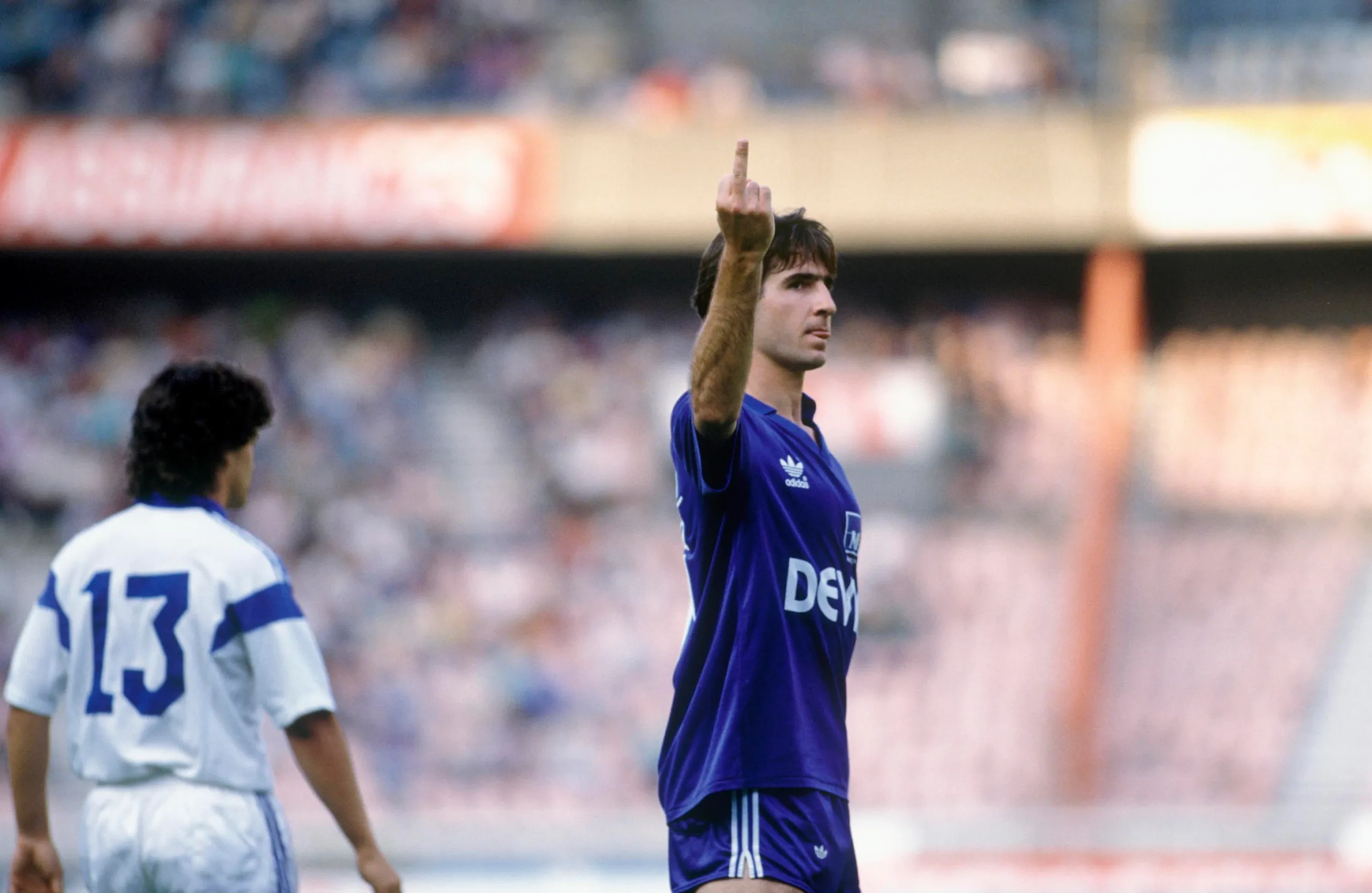
That opening blast sets the terms for a dense study of performance, fame, and individual rebellion against institutional power. By skipping the gentle biographical ramp, the filmmakers announce that Cantona requires a physical reaction first and a thesis second. His arrival in the English game is framed as near-imperial conquest, a collision of athletic mastery and theatrical defiance. The pitch becomes his stage. Modern celebrity culture receives a new grammar, written in volleys, collars, silences, and scowls.
The Limits of Solocentricity
The film moves through its biographical timeline at sprint speed. It rushes across Cantona’s early career transitions in France, tracing his volatile periods under figures such as Guy Roux and the equally combative businessman Bernard Tapie. This frantic opening stretch maps his nomadic instability before he finds an anchor at Leeds and Manchester United.
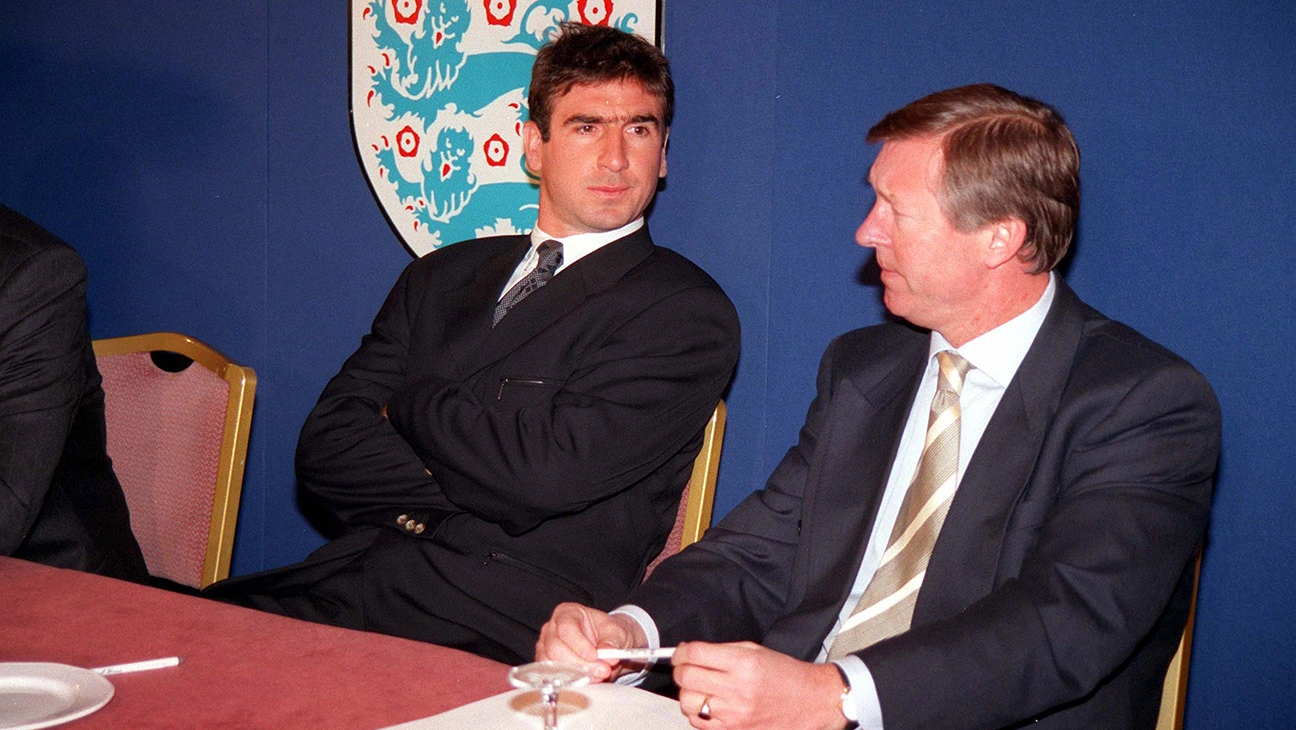
For this history, the directors make a severe editorial choice. The modern interview pool is limited to six voices (a sanctified inner circle): Cantona himself, his parents Albert and Éléonore, his manager Alex Ferguson, and his teammate David Beckham.
That isolation carries heavy critical fallout. The absence of major Manchester United contemporaries such as Roy Keane, Ryan Giggs, and Lee Sharpe leaves the club’s intricate team mechanics largely unexamined. The film favors a celebratory, hagiographic profile. The narrative worships individual aura. Football success becomes the product of singular genius, which is a seductive idea and a slightly deranged one, like believing a cathedral was built by the gargoyle.
At first, this narrow view feels like an ideological failure. A sports team is a collective system, a synchronized machine of labor, timing, and shared sacrifice. Then the film follows Cantona after football, through acting roles in Elizabeth and Ken Loach’s Looking for Eric, then through later massive action paintings, and the isolation gains a strange coherence. The film mirrors Cantona’s ego. The directors feed the myth and leave the sporting machinery in shadow. The result is a portrait of magnificent, selfish isolation.
The Liturgy of the Self-Tormentor
The documentary builds its sharpest intellectual charge around dualism. The staging makes that split visible. Cantona gives his present-day reflections from inside a vacant church, turning a site of religious penance into a theater of the self. High literature sharpens the inquiry. He recites Charles Baudelaire’s poetry from Les Fleurs du Mal, identifying with the divided speaker who is simultaneously the wound and the knife.
His language during these interviews has brilliant, calculated theatricality. He shifts fluidly between English and French, using each transition to control dramatic weight and comic timing. This is performance with grammar as choreography. It reveals a man fully aware of his own legend-management apparatus, which may be the most 1990s celebrity skill imaginable.
That intellect steadies his volatile temperament. The film studies his relationship with Alex Ferguson, showing two fierce personalities forming a precise, protective alliance. Ferguson understood that tactical systems needed a spark of erratic brilliance to thrive. Order required combustion. Football, like politics, often pretends to hate chaos while secretly hiring it.
That protective environment leaves Cantona entirely unapologetic about his darkest moments. Discussing the infamous 1995 kung-fu incident at Selhurst Park, he remains unrepentant and doubles down on his actions. The film also returns to his iconic, cryptic prose poem about seagulls following a trawler, a moment that exposed the absurdity of the media circus. He stands here as an anti-authoritarian folk hero during an age of corporate consolidation.
Acid House and Kinetic Architecture
The formal strength of Cantona rests on aggressive audiovisual rhythm. The directors build an intense sensory field from screaming red-on-black text and a blaring electronic foghorn. Sonic violence creates permanent urgency. Paul Hartnoll’s score uses electronic acid house grooves to fix the film inside the cultural climate of the British 1990s. The directors mix those rave rhythms with sudden classical arrangements, producing a jarring dissonance that matches the subject’s internal friction.
The historical match footage is cut with thriller velocity. Rhythmic, fast-paced editing organizes archival clips of stunning goals, precise passes, and violent on-field altercations. The footage rises above routine sports documentation and becomes frantic psychofootball. Through rapid sequencing, the viewer can sense the geometric angles aligning in Cantona’s mind before a pass.
These sensory choices work because cinematic form and human psychology move together. The frantic audio and hyperactive editing shed standard biographical decoration and replicate Cantona’s internal velocity. The film moves like its subject: erratic, beautiful, and occasionally dangerous. It captures an era when sport was loud, hazardous, and deeply unscripted, an era that helped teach modern celebrity how to sell rebellion back to the crowd.
Cantona premiered in May 2026 at the 79th Cannes Film Festival as part of the Special Screenings selection. Produced by Pitch Productions, the biographical documentary features direct access to the iconic sportsman. Following its festival run, international distribution handles wide availability across select theatrical venues and global streaming platforms.
Full Credits
Title: Cantona
Distributor: Cinetic Media, Plus M Entertainment
Release date: May 16, 2026
Running time: 115 minutes
Director: David Tryhorn, Ben Nicholas
Writers: Stevan Riley
Producers and Executive Producers: Sean Richard, Stevan Riley, David Tryhorn, Ben Nicholas, Jon Owen, Jonathan Rogers, Oli Slipper, Max Dobbyn
Cast: Eric Cantona, Alex Ferguson, David Beckham, Guy Roux, Albert Cantona, Éléonore Cantona
Director of Photography (Cinematographer): Carl Burke
Editors: Andrew Hewitt, Nas Parkash
Composer: Paul Hartnoll
The Review
Cantona
Cantona succeeds as a striking, visually aggressive profile that mirrors the fierce spirit of its subject. It strips away standard sporting documentation to focus heavily on psychological tension and individual celebrity. While it overlooks team dynamics in favor of personal myth-making, the stylized direction and intense score ensure an engaging experience. It offers a captivating look at a football icon who refused to compromise his principles.
PROS
- Visually aggressive, thriller-style editing of archival footage.
- Evocative score by Paul Hartnoll that captures the 1990s era.
- Candid, theatrical interviews with Cantona himself.
- Deep intellectual exploration of dualism and personality.
CONS
- Excludes core teammates, skewing the sporting reality.
- Hagiographic style that favors myth over team dynamics.
- Pacing feels overly rushed during early biographical segments.