




























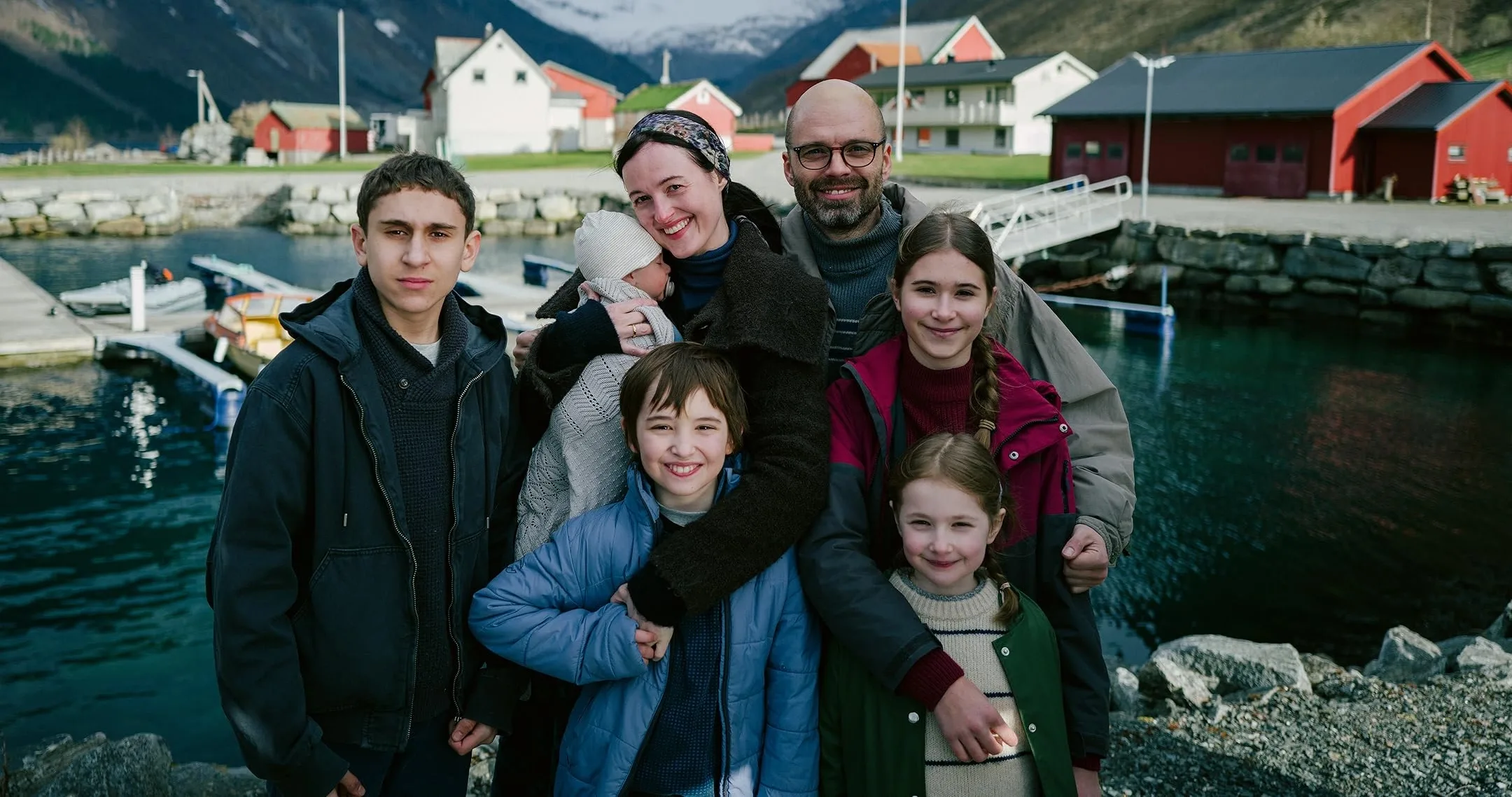

A bleak mountain panorama above a muted Norwegian fjord gives Cristian Mungiu’s first feature filmed outside Romania the shape of a moral weather system. The Gheorghiu family, seven people transplanted from Romania to a coastal Scandinavian refuge, enters a place that reads as serene from a distance and punitive at close range.
Mihai, an immigrant father played by Sebastian Stan, and Lisbet, a Norwegian mother portrayed by Renate Reinsve, raise their children under strict Evangelical Christian doctrine. Their domestic order collides with the progressive, agnostic liberalism of the surrounding community.
After a gym teacher notices bruises on the neck of their eldest daughter, Elia, the state child protection agency, Barnevernet, enters the home through the full force of law. Its machinery accelerates with frightening speed, removing all five children, including a breastfeeding infant, as a formal investigation begins. Through an international cast, Mungiu shapes a severe inquiry into institutional intervention and the social assumptions that give such intervention its moral confidence.
Semantic Warfare and Systemic Fractures
Mungiu draws the story away from ordinary melodrama and into a precise study of systemic friction, bureaucratic design, and cultural mistranslation. The pressure gathers during official interrogations, where language itself becomes contested terrain. Mihai describes his physical discipline as a minor corrective slap, a gesture he understands as ordinary parenting through the cultural grammar he carries with him.
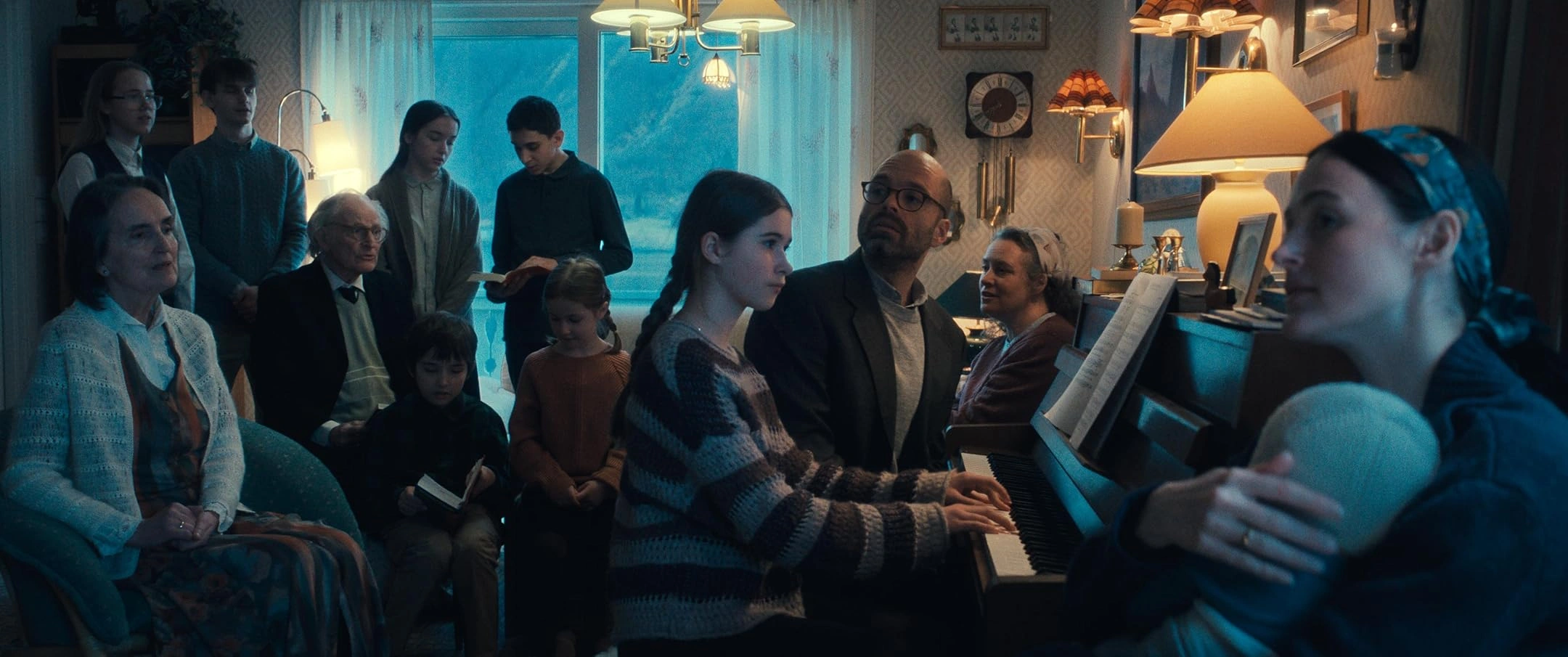
Norwegian officials reject that category entirely, treating every form of physical correction as abuse under a legal structure that allows no private exception. The state’s clinical gaze widens fast. Physical evidence opens the door to scrutiny of ideology, marital belief, religious instruction, and daily conduct. Traditional definitions of marriage voiced by the children at school mark the household as a civic anomaly, converting private theology into municipal evidence.
As the legal net tightens, domestic anguish turns into a public battle with global reach. Mihai answers the bureaucracy by mobilizing conservative activist groups overseas, recasting his family’s pain as a political cause. Social media platforms and emotional broadcast appeals allow him to move around local judicial channels and speak to a wider ideological audience.
A local dispute over family discipline grows into an international proxy fight over religious freedom, parental autonomy, and bureaucratic overreach. The courtroom takes on the air of political theater, with geopolitical fears passing through the intimate wreckage of one household. Digital culture appears here as an accelerant, capable of hardening private crisis into public combat.
The script loses some of its force when Mungiu follows secondary threads that thin the pressure of this main conflict. The middle act carries pacing issues tied to subplots that draw attention away from the legal standoff. The romantic attachment involving Noora, the neighbor’s adolescent daughter, moves into familiar adolescent drama and gives little weight to the trial narrative.
Scenes devoted to Lisbet’s palliative care duties also swell the film’s structure, repeating evidence of her nurturing nature without deepening the legal drama. These passages break the film’s concentration and pull energy from the alarming mechanisms of the family’s confrontation with the state.
Inscrutable Grief and Rigid Adversaries
The film’s emotional design depends on performances of restraint, pressure, and hard psychological opacity. Sebastian Stan plays Mihai through bodily containment, giving shape to the solitude of an outsider who needs a translator during decisive legal proceedings. Stan rejects easy sentiment and theatrical fury. Anxiety calcifies inside Mihai until it becomes cold, righteous anger, a quality that complicates the viewer’s sympathy. The performance understands stubbornness as a prison built from conviction.
Across from him, Renate Reinsve holds the film in a register of quiet devastation. Her portrayal gives physical form to the trauma of abrupt separation, most sharply during a collapse outside the family residence after her maternal purpose has been taken by force. The state’s assault on domestic life reaches the body when stress stops her ability to lactate, a stark image of institutional violence impressed upon maternity.
The supporting ensemble strengthens the chill of the legal proceedings and gives institutional power a human face made of protocol, certainty, and restraint. Lisa Carlehed brings grounded stability to Mia, the empathetic neighbor who becomes defense counsel. Her measured presence meets state representatives who see the family through the lens of absolute compliance.
Ellen Dorrit Petersen plays the caseworker, Gunda, with icy, single-minded conviction, making her a figure of bureaucratic zeal. Christian Rubeck gives the prosecuting attorney the precision of a cutting instrument, using cross-examination to dismantle the family’s character. These clinical performances counterbalance the uneven work of the young actors, whose wooden delivery reduces the emotional charge in scenes following the displaced children.
The Architecture of Distant Splendor
Director of photography Tudor Vladimir Panduru frames this ideological struggle through desaturated grandeur. The widescreen images draw from sleety blues and icy greys, creating a visual climate that mirrors the family’s emotional condition. Panduru’s deep-focus compositions ask the viewer to watch with forensic patience.
Human activity often unfolds in the middle distance, where conversations, surveillance, and peripheral gestures acquire moral weight. The frame becomes a civic instrument, suggesting a world where space itself participates in observation. Editor Mircea Olteanu sustains that pressure by balancing the parents, legal actors, and children, withholding catharsis and easy emotional release.
Environmental metaphor carries much of the film’s thinking, and its precision varies from scene to scene. Avalanches recur on the mountainsides behind the village, giving visual form to a state apparatus that falls upon individual lives with the blank force of nature. The image works because it treats systemic logic as impersonal, immense, and indifferent.
Mungiu strains harder when magical realist details enter the film’s otherwise clinical register. Moments in which characters walk on water feel too emphatic, pushing the material toward overt allegory. The film is strongest in its gray zones, where modern multicultural life reveals its strain under institutions that choose judgment over comprehension.
The psychological drama Fjord held its world premiere in the main competition section at the 79th Cannes Film Festival on May 18, 2026, where it emerged as a highly debated contender for the Palme d’Or. Marking the English and Norwegian feature debut of acclaimed filmmaker Cristian Mungiu, the international co-production follows a conservative Romanian-Norwegian immigrant family whose lives are thrown into total disarray following an aggressive intervention by the local child welfare apparatus. Audiences will be able to watch the film via theatrical and streaming releases handled by Neon in the United States and United Kingdom, while global sales and distribution operations are managed internationally by Goodfellas.
Full Credits
Title: Fjord
Distributor: Neon, Goodfellas
Release date: May 18, 2026
Running time: 146 minutes
Director: Cristian Mungiu
Writers: Cristian Mungiu
Producers and Executive Producers: Cristian Mungiu, Tudor Reu, Vincent Maraval, Pascal Caucheteux, Gregoire Sorlat
Cast: Sebastian Stan, Renate Reinsve, Lisa Carlehed, Ellen Dorrit Petersen, Lisa Loven Kongsli, Henrikke Lund-Olsen, Vanessa Ceban, Jonathan Ciprian Breazu, Markus Scarth Tønseth, Christian Rubeck
Director of Photography (Cinematographer): Tudor Vladimir Panduru
Editors: Mircea Olteanu
The Review
Fjord
Fjord is an intellectually demanding, formalist study of cultural alienation and bureaucratic rigidity that succeeds through its exceptional lead performances and precise, deep-focus visual grammar. While the production falters when straying into extraneous adolescent subplots and heavy-handed magical realism, its strength lies in its refusal to offer easy emotional comfort or clear moral resolutions. By transforming a private domestic crisis into a chilling analysis of institutional overreach, Cristian Mungiu delivers a striking, deeply uncomfortable examination of modern systemic power.
PROS
- Exceptionally restrained, nuanced lead performances by Sebastian Stan and Renate Reinsve.
- Precise, desaturated deep-focus cinematography that visually reinforces the themes of isolation and surveillance.
- A highly complex script that avoids standard melodrama to explore semantic and cultural friction.
CONS
- Runtime bloat caused by unnecessary adolescent and domestic subplots.
- Jarring transitions into magical realism that disrupt the established realistic tone.
- Stiff, wooden performances from the supporting child actors.







