




























Danish director Nicolas Winding Refn returns to feature filmmaking after a ten-year absence with Her Private Hell, a surrealist psychodrama co-written with Esti Giordani. The film hurls the viewer into a rain-polished, neon-sick dystopian metropolis, where decay has acquired its own climate. A mysterious mist presses over the city with the moral humidity of psychic infection, a weather system for a civilization that has quietly gone rancid.
Elle, played by Sophie Thatcher with a buried animal ferocity, moves through this world as an actress arriving at the towering Tower Hotel. The building is luxury sharpened into architecture, a corporate monument with expensive surfaces and rotten familial plumbing.
Her arrival draws out family trauma through a chilly, transactional triangle involving her estranged, wealthy father, Johnny Thunders (Dougray Scott), and her new stepmother, Dominique (Havana Rose Liu), formerly Elle’s lover. Daddy issues rarely come with such flattering lighting.
A second, dreamlike track moves along the streets beneath this opulent cage. Private K (Charles Melton), a brooding and stoic soldier, patrols the misty pavement in a desperate search for his missing daughter, carrying the air of a man stranded outside his proper century. Above these two narrative currents hangs the Leather Man, a mythic, fetish-clad serial killer who stalks young women and threatens the hotel guests’ fragile grip on reality.
The Architecture of Somnambular Cinema
The plot moves with the anti-logic of a sleepwalker crossing a crime scene. Refn abandons traditional linear progression and lets the film drift between the hotel psychodrama, a campy neon space-opera film-within-a-film called Candy Floss, and a displaced historical underworld. That fractured design feels painfully current. It resembles doomscrolling in cinematic form: family trauma, historical violence, glossy consumer pop, and eroticized dread flattened onto the same glowing pane.
The screenplay lives through mood, gesture, and suspended threat. Dialogue arrives in stilted, theatrical, agonizingly slow pulses, as if every actor has been instructed to speak from beneath a velvet sedative. The effect can be maddening. It can also be perversely funny, since everyone appears to be waiting for civilization to finish buffering.
Narrative gaps define the experience. Private K’s violent street encounters and Elle’s hotel-bound family trauma remain severed from ordinary cause and effect. Perhaps Private K exists as Elle’s projection, an idealized father figure produced by her subconscious to counter the vacancy left by her actual father’s neglect.
The film works through isolated sensory triggers, a kind of visual ASMR with blood on its manicure. Coherent character motivation gives way to atmospheric mythology built around celebrity fixation, hollow desire, and parental abandonment. In flattening story into sensation, the film studies a culture skilled at turning genuine pain into commodified aesthetic material. The choice frustrates, then seduces, then frustrates again. Refn wins the argument by refusing to argue fairly.
Chromatic Dissonance and Auditory Anchors
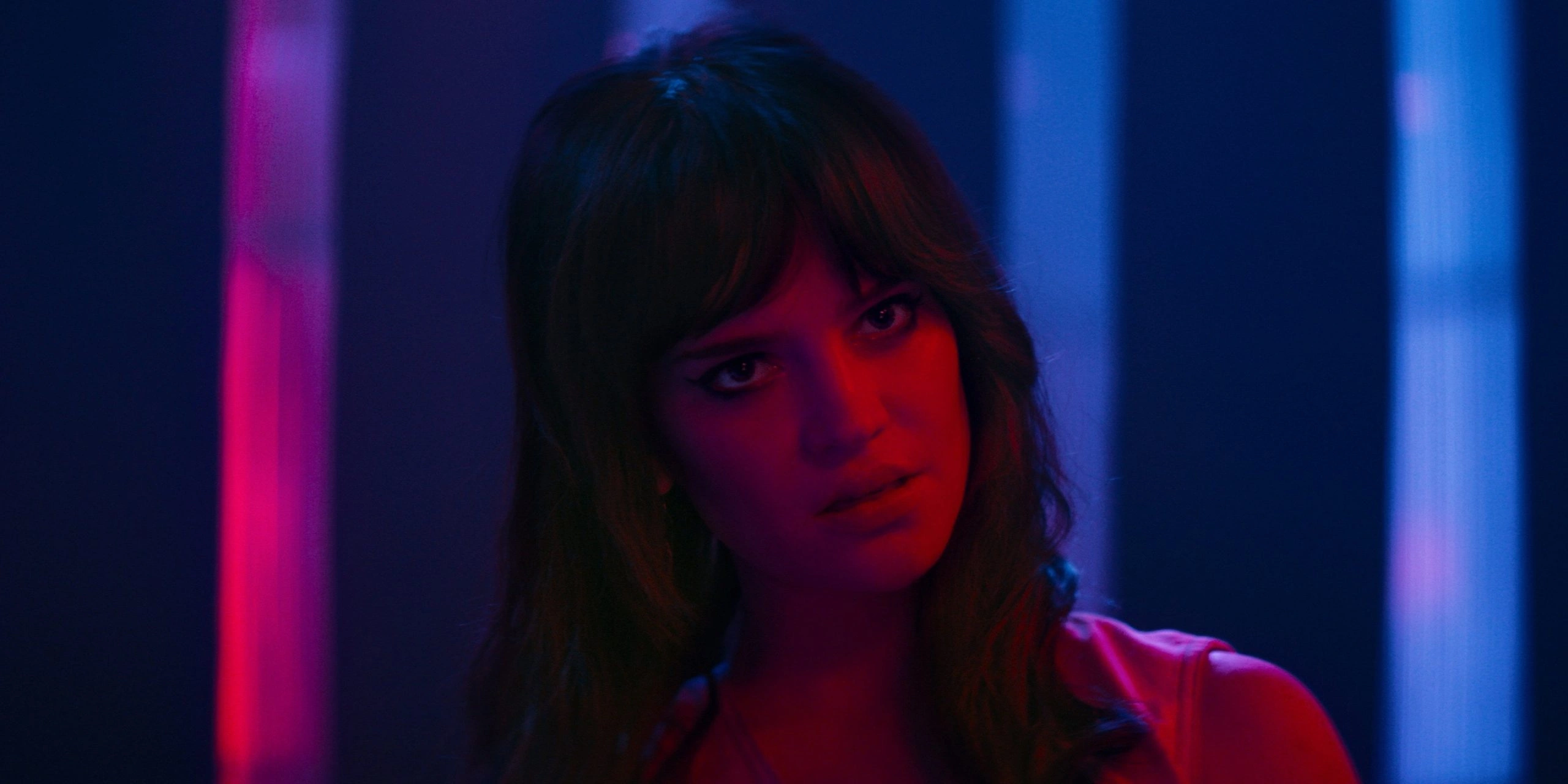
The technical construction of Her Private Hell dominates the viewing experience, turning the screen into a battleground of pure formalism. Cinematographer Magnus Nordenhof Jønck floods the frame with saturated purple, red, and blue neon lighting gels, then smothers those colors in a dense and relentless fog-machine haze. The image frequently slides toward abstraction, swallowing the actors until they nearly dissolve into décor.
That visual alienation relies on Gitte Malling’s brilliant production design. Malling builds a stark architectural split between the gold-gilded, cavernous corridors of the Tower Hotel and the minimalist, stripped-back netherworlds of the city streets. The hotel becomes a gilded cage for modern high society. The streets suggest a timeless purgatory, an urban afterlife where history keeps wandering around in bad weather.
Veteran Italian composer Pino Donaggio supplies the operatic synth and string score. His lush, classical melodies steady the fragmented imagery, giving the audience an emotional anchor amid the chaos. Donaggio’s music brings old-fashioned romanticism to a film constantly flirting with emptiness, and that warmth matters. It keeps the film from becoming a beautiful refrigerator.
Refn cushions his kinetic sequences with this sonic tenderness. The violent street altercations and the stylized brutality surrounding the Leather Man unfold through meticulous slow-motion choreography. These scenes feel like a grim, transgressive ballet. Graphic violence loses its thrill, leaving a heavy, unspoken sadness in its place.
Mannequins in the Capitalist Netherworld
The ensemble cast works inside a rigid directorial system that prizes posture above psychological depth. The actors hover between human feeling and cold abstraction, like mannequins granted intermittent access to pain.
Sophie Thatcher gives an exceptional performance as Elle. Her sharp, edgy presence supplies needed grounding for Refn’s desultory cadence, and she captures the authentic hurt of a daughter caught in a patriarchal nightmare. Thatcher gives the film its most legible wound.
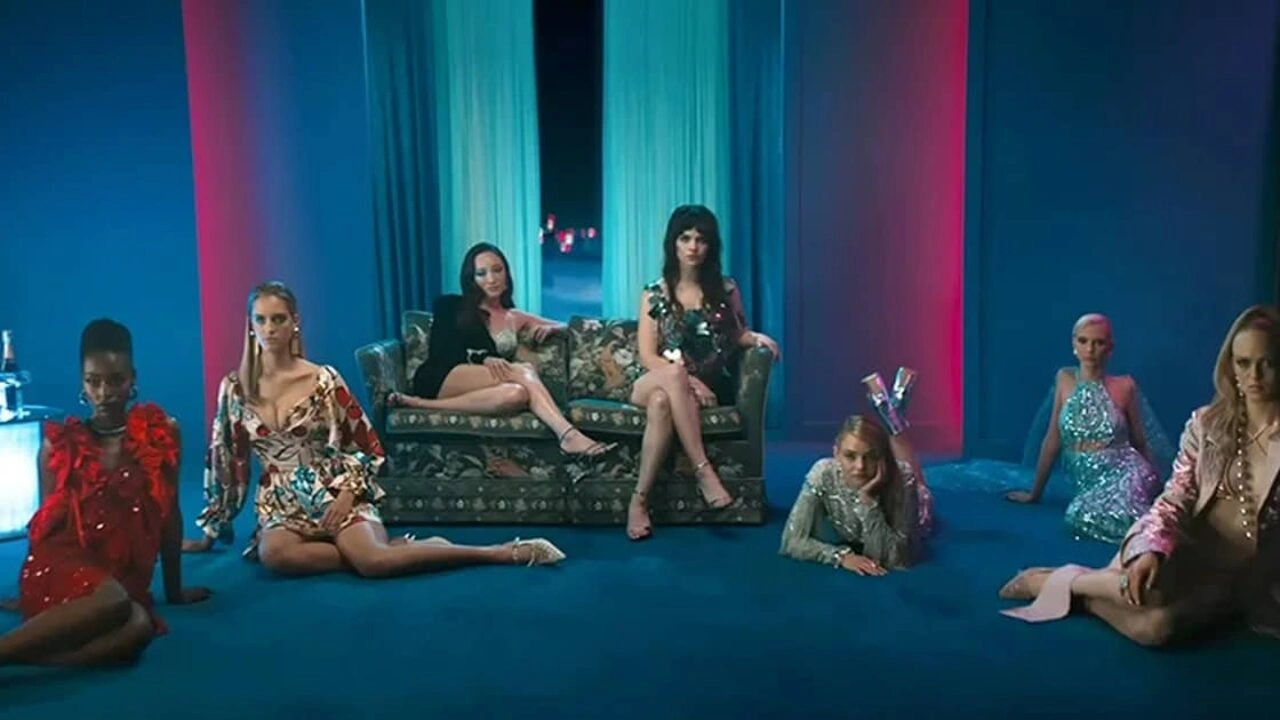
The chemistry between Thatcher, Kristine Froseth as superficial influencer Hunter, and Havana Rose Liu is intentionally detached and tense. Refn often films these actresses like static models in an avant-garde fashion advertisement. The technique turns them into stylized archetypes with scant room for full inner life, a visual argument about celebrity culture and its appetite for converting people into lovely objects.
Dougray Scott plays the dissolute Johnny Thunders as a grotesque caricature of wealth, vanity, and parental neglect. He embodies the spoiled, decayed interior of an elite class obsessed with beautiful surfaces.
Charles Melton’s Private K becomes a silent, mask-like blank. Melton leans on physical presence and sharp facial architecture to express quiet, agonizing grief. His performance feels like a monument to withheld speech, which is either profound restraint or Refnian constipation, depending on one’s patience at any given minute.
Amid the somber, hypnotic ensemble, Diego Calva brings a brief and welcome pulse of life. Appearing as a seductive lothario, Calva injects rare traditional panache and energy into the film, opening a fleeting escape hatch from the surrounding neon hell.
Her Private Hell is a 2026 psychological thriller and sci-fi film that had its highly anticipated world premiere out of competition at the Cannes Film Festival on May 18, 2026. Set in a rain-slicked, neon-soaked futuristic metropolis engulfed by an oppressive mist, the plot centers on a troubled actress who faces intense family trauma while a mysterious serial killer known as the Leather Man terrorizes the city. Audiences can watch the film when it releases theatrically in the United States via Neon on July 24, 2026.
Where to Watch Her Private Hell (2026) Online






Full Credits
Title: Her Private Hell
Distributor: Neon
Release date: May 18, 2026
Running time: 109 minutes
Director: Nicolas Winding Refn
Writers: Nicolas Winding Refn, Esti Giordani
Producers and Executive Producers: Nicolas Winding Refn
Cast: Sophie Thatcher, Charles Melton, Havana Rose Liu, Kristine Froseth, Dougray Scott, Diego Calva, Shioli Kutsuna, Aoi Yamada, Hidetoshi Nishijima
Director of Photography (Cinematographer): Magnus Nordenhof Jønck
Editors: Matthew Newman
Composer: Pino Donaggio
The Review
Her Private Hell
Her Private Hell is a mesmerizing yet maddening exercise in pure formalism. By trading narrative coherence for visual ASMR and stilted psychodrama, the film successfully captures the numbing, fragmented nature of modern celebrity culture. However, its deliberate slow-motion pacing and emotional detachment will alienate viewers looking for a complete artistic meal rather than a sequence of lavish, neon-soaked vibes. It remains a gorgeous, shallow purgatory built solely for the director's own indulgence.
PROS
- Stunner of a synth and string score by Pino Donaggio that provides a much-needed emotional anchor.
- Breathtakingly stylized, neon-drenched cinematography and opulent production design.
- A grounded, edgy performance by Sophie Thatcher amid the cold abstraction.
CONS
- Agonizingly slow, sleepwalker pacing and a stilted dialogue delivery style.
- A fragmented, anti-logical plot with massive narrative gaps and unresolved threads.
- Reduces talented actors to static, hollow mannequins in service of style over substance.