
























![Kingdom Hearts Collection [I-III] Review](https://gazettely.com/wp-content/uploads/2026/10/Kingdom-Hearts-Collection-I-III-1-360x180.webp "Kingdom Hearts Collection [I-III] Review: KHII Holds Steady as Newer Entries Fluctuate 37")





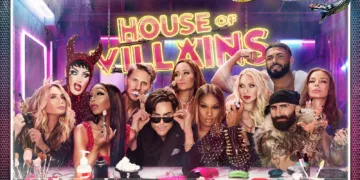
The preservation of cultural infamy has found a digital afterlife on Peacock. The move away from E!’s linear enclosure suggests a larger change in the way television stores its shared misdemeanors. Eleven figures from reality history gather inside the Villains’ Lair, competing for a $200,000 prize and the title of America’s Ultimate Super Villain.
The phrase carries a deliciously rancid logic: moral friction becomes a résumé line. Joel McHale presides over the absurdity like a sardonic officiant, firing off enough sarcasm to remind the participants of their modest place in the cultural pecking order. He mocks the contestants, then turns the same blade toward the contest’s own flimsy architecture.
The cast arrives as a carefully arranged gallery of infamy. Tiffany “New York” Pollard returns with Tom Sandoval, Drita D’Avanzo, Tyson Apostol, and Kate Chastain. The season opens with a choreographed dance routine, a bit of ceremonial foolishness that declares the project a farce before anyone can pretend otherwise. Personality collision takes priority over sportsmanship. The show salutes the “celebreality” age, a zone where affection matters less than recall value.
The Architecture of Incentivized Malice
The Lair’s internal logic runs on rewarded treachery. Success demands command of “deception-capital,” which I define as the conversion of falsehood into social profit. Each week, the challenge winner receives the Super Villain title. That position grants the power to choose two allies. The trio then nominates three peers to the Hit List, the elimination shortlist. The removal process has a blunt, ritual quality. Two people from the Hit List face a final challenge, and one leaves the residence.
New environmental features give this social combat a proper stage. The Stronghold exists for tactical plotting. The Super Villain suite turns hierarchy into square footage, a luxury enclave that lifts the temporary victor above the common rabble. One might call it “stratification-porn,” and one would be correct, or at least mildly entertained. The challenges frequently lean into psychology. Players identify housemates through tactile facial exploration. They take part in public roasts. These tasks peel away the varnish of civility.
The format borrows from social strategy models and clears away the sanctimony of “playing for the right reasons.” It creates a vacuum where vicious alliance building becomes the most rational survival method. The game celebrates the darker impulses of the human social drive. Participants use past reputations as tactical assets. The system is engineered for maximum friction with minimal exertion, a fine metaphor for modern spectacle culture, sadly enough.
The Social Darwinism of the Infamous
The house becomes a microcosm of reality television’s scattered tribes. A chief conflict develops between Kate Chastain and a male collective led by Tyson Apostol and Tom Sandoval. Kate’s arc functions as a study in “reactive-dominance.” She spots the looming threats and dismantles them with quiet, icy efficiency. She proves that a sharp wit can cut deeper than a raised voice.

Tiffany “New York” Pollard remains the gravitational force. She holds her HBIC status through theatrical indignation and now feels like an institutional fixture of the series. Her longevity suggests that reality stardom may be a life sentence, which is funny until it starts sounding like sociology. Surprising flashes of “misfit-solidarity” appear between Plane Jane and Paul Abrahamian. Their bond hints that shared cultural outcast status can create a real tether.
Drita D’Avanzo follows a cleaner path. Her success rests on raw likability, and she avoids the tangled manipulation practiced by many of her peers. Christine Quinn takes a colder route. She spends much of the run as an ornamental presence, then executes a sudden betrayal of Drita. The move is a late-game pivot that privileges victory over the social contract. Ashley Mitchell generates strain through wavering loyalties. Johnny Middlebrooks creates friction with the female cast. Together, these exchanges form a jagged social terrain.
The season treats betrayal as the house’s most dangerous weapon. Each participant brings a different flavor of malice to the collective table. The collisions expose the vanity built into the television archetype: villain, victim, strategist, clown, survivor. Watching this social warfare is exhausting and strangely hypnotic, which may be the correct emotional response to a culture that turns reputational damage into entertainment currency.
The Unmasked Producer and the Meta-Farce
The series separates itself through a visual language of “radical-transparency.” It punctures the illusion of unscripted reality with cheerful vandalism. One outdoor shower scene shows the camera zooming out to reveal a production assistant pouring water over a contestant. The gag admits the genre’s artificiality in plain sight. Production audio frequently stays in the final cut. Producers interrupt confessionals to challenge a contestant’s volume and point out logical gaps. This commentary pulls the viewer into the show’s machinery.
Humorous interstitials let the cast lean into their assigned identities as entertainers. One example is the mock sitcom intro titled “Two Guys,” created by Tom Sandoval and Tyson Apostol. It underlines the performative nature of their villainy. Joel McHale keeps drawing comparisons to prestigious titles, reminding the audience that the series understands its own rung on the cultural ladder. The editing moves at high velocity, using “cliffhanger” structures to keep urgency humming.
Beneath the chaos, brief human connections survive. Contestants help one another with elaborate costumes. They share personal struggles. These moments offer a small counterweight to the show’s governing theme of betrayal. The series stages manufactured drama while allowing quick flashes of genuine feeling. It is a spectacle fully aware of its own spectacularity, which gives the whole enterprise a cracked philosophical grin.
House of Villains Season 3 premiered on February 26, 2026, marking the show’s transition to its new exclusive home on Peacock. The season brought together 11 notorious reality television icons to compete in the “Villains’ Lair” for a grand prize of $200,000 and the title of America’s Ultimate Supervillain. Hosted by Joel McHale, the competition concluded its third season on April 17, 2026. Fans of the series can currently stream the entire third season, along with previous installments, exclusively on the Peacock platform.
Where to Watch House of Villains Season 3 Online








Full Credits
Title: House of Villains
Distributor: Peacock
Release date: February 26, 2026
Rating: TV-14
Running time: 43–64 minutes
Director: Zach Kozek
Writers: John Irwin, Dave Kuba, Eli Frankel, Matt Odgers
Producers and Executive Producers: John Irwin, Dave Kuba, Eli Frankel, Matt Odgers, Justin Rae Barnes, Joel McHale, David Mills, Jessica O’Byrne, Thomas Wilhoit
Cast: Drita D’Avanzo, Christine Quinn, Kate Chastain, Tiffany “New York” Pollard, Paul Abrahamian, Tyson Apostol, Tom Sandoval, Johnny Middlebrooks, Ashley Mitchell, Plane Jane, Jackie Christie
Director of Photography (Cinematographer): Bruce Ready
Editors: Alan Wain, Adam Varney, Gerry Becerril, Tiffany Risucci
Composer: Chad Rehmann, Jude Christodal
The Review
House of Villains Season 3
This season functions as a high-definition study in reputation-recycling. It succeeds because it embraces its own absurdity rather than hiding behind the pretense of noble competition. While the finale logic remains somewhat murky (a recurring issue for the franchise), the trajectory is a masterclass in meta-entertainment. It is essential viewing for those who appreciate the theater of the human ego. It manages to reward the wicked while winking at the audience throughout the entire ordeal.
PROS
- Strategic casting of legacy antagonists who understand the performance-arc.
- The radical-transparency of the production style that punctures reality tropes.
- Joel McHale’s dry commentary on the genre’s inherent vanity.
CONS
- The jury-based finale structure occasionally leads to anticlimactic results.
- Certain participants function as narrative-placeholders for long stretches.







