




















Phuong Mai Nguyen transforms AJ Dungo’s graphic memoir into cinema with a strong awareness of the hand-drawn page, preserving the tactile charge of its origin. AJ enters the story as an artist whose private world is shaped by sidewalk edges, skateboard wheels, and the steady rasp of pen against paper.
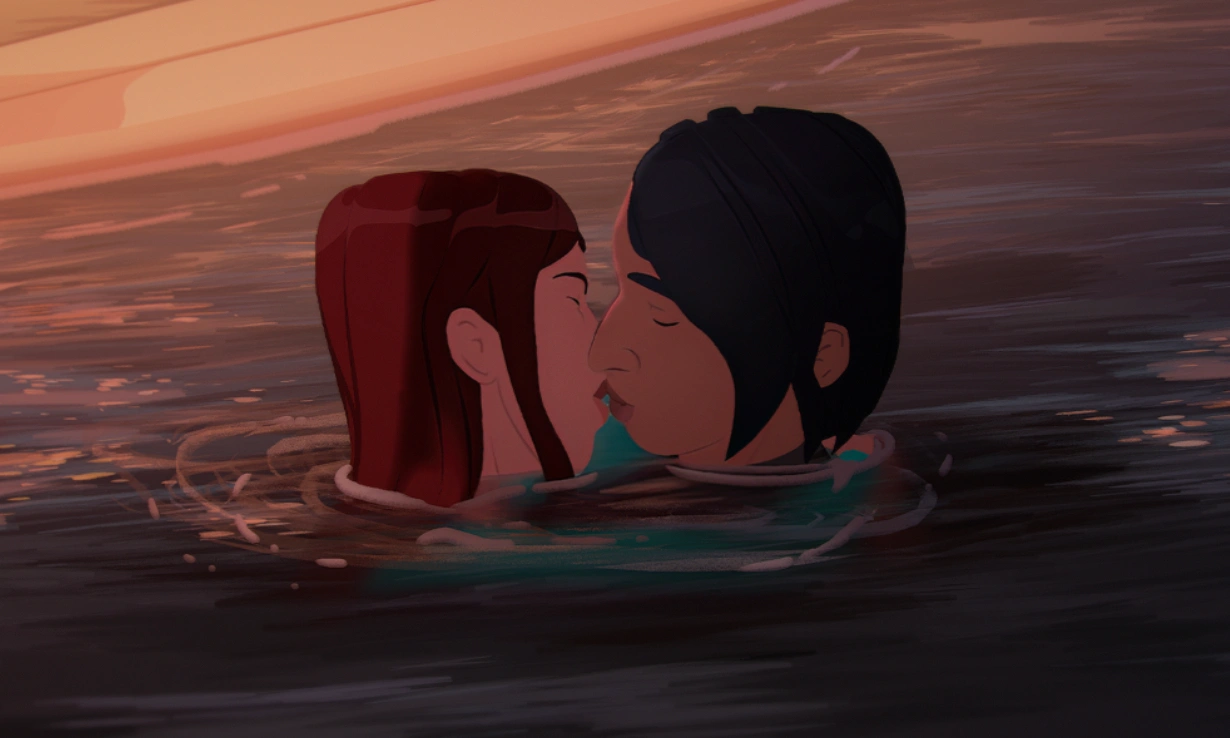
His fear of water sets him apart from the coastal life around him, turning the ocean into a visible emotional threshold. That threshold begins to shift at a high school gathering in Huntington Beach, where he meets Kristen, a surfer whose calm confidence gives the sea a devotional presence.
She treats the ocean as a spiritual sanctuary, and her arrival loosens the grip of AJ’s insular creative routine. Their bond grows within a close circle that includes Kristen’s brother Jeff and their friend Eon, whose presence gives the romance a social texture grounded in ordinary teenage intimacy. Surf City USA becomes a living frame for the story, its tides echoing the gradual movement between two people learning a shared rhythm.
The Triple Lens of Animation
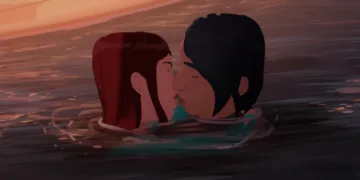
The film’s visual design moves through three distinct modes, each tied to a different emotional register and temporal plane. Nguyen renders the early romance in warm, sunlit watercolor, giving those passages the saturated softness of first attachment. The images seem to breathe with the rush of discovery, carrying the lightness of days that feel suspended above consequence.
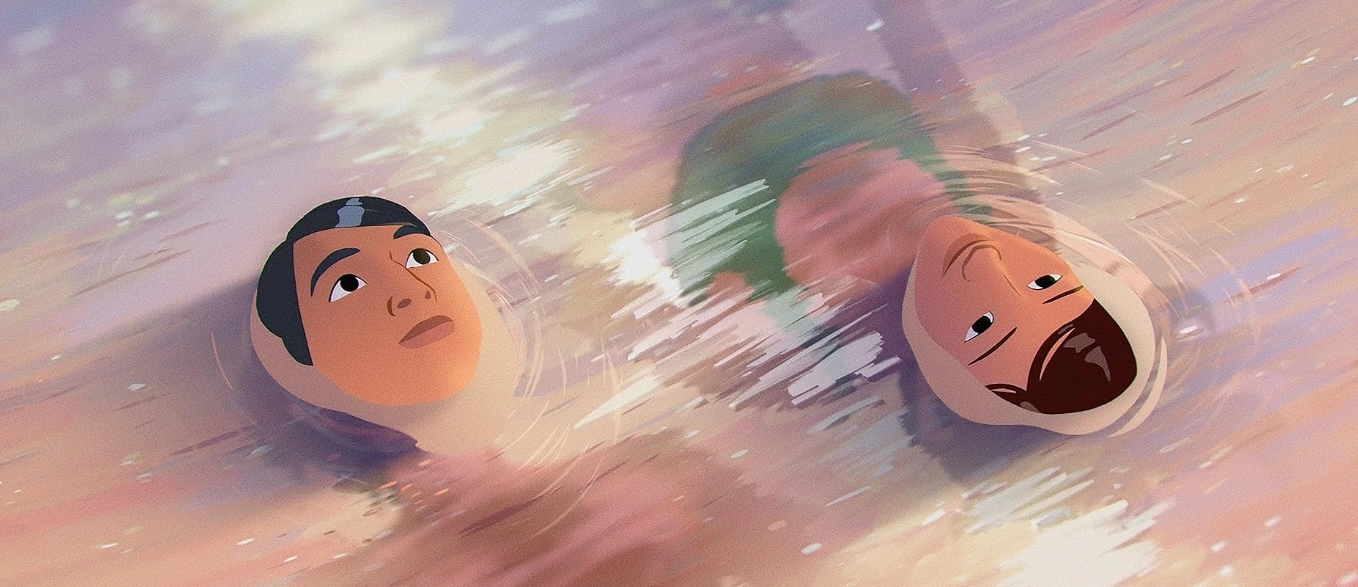
A second visual language arrives through monochrome pen and ink sequences, which trace the origins of surfing with spare lines and sharp contrast. These historical passages feel like archival sketches set into motion, modest in surface detail and charged with cultural memory. A third timeline follows a solitary AJ in a desaturated future, where quiet sorrow gathers before the narrative names its source.
The alternation among these styles makes the story feel filtered through an artist’s eye, shaped by memory, touch, and mark-making. Line weight and color wash carry emotional information with a fluency that speech cannot match. Art becomes the connective tissue between private recollection and inherited history, binding romance, loss, and cultural legacy into one visual grammar. The muted future scenes press against the earlier brightness, creating a hushed awareness of grief waiting inside the frame.
Legacy and the Fluidity of Motion
Surfing becomes the story’s most expressive bridge, a shared philosophy carried through bodies, boards, and salt water. Kristen teaches AJ the mechanics of the board while introducing him to the legacy of Duke Kahanamoku, placing the sport within a history that carries reverence and rupture.
The film recalls how colonial missionaries in Hawaii tried to suppress a culture that had endured for centuries, giving every movement on the water a charged historical undertow. The wave gains meaning as motion, inheritance, and resistance. Nguyen’s animation translates the sensation of catching a wave into a language of release.
Gravity appears to soften as the characters move through the Pacific, their bodies seeming to join the water’s intelligence. For the families in the story, particularly through their Philippine American heritage, the ocean becomes a site of cultural continuity.
Surfing opens a way to reclaim space and identity, making the act physical, communal, and symbolic. The wave recurs as an image of joy at its peak and hardship in its pull. AJ’s movement from fearful observer to participant signals his growing willingness to meet life’s instability with his body, his art, and his attention. The ocean offers the characters a fragile equilibrium amid the pressures gathering around them.
The Sound of the Pacific and Final Echoes
The story darkens as a health crisis tests the endurance of AJ and Kristen’s relationship. Will Sharpe and Stephanie Hsu give vocal performances that anchor the stylized animation in immediate human feeling. Hsu’s Kristen carries tenacity without slipping into the expected sentimental patterns of the genre; her agency and spirit remain clear through the crisis that surrounds her.
Sound becomes a major part of that grounding. The whoosh of surf and the rhythmic scrape of markers on paper give the film a tactile presence, making the world feel close enough to touch. As the story moves toward the Pacific Northwest, the environment introduces a new visual atmosphere.
Mossy greens and icy blues register the altered emotional weather around the characters, carrying the chill of change without draining the film of tenderness. Jeff and Eon remain essential figures, forming a communal support system that gives shared grief its proper human scale.
The film carries the weight of the situation with quiet dignity, attending to small moments of connection that survive amid uncertainty. Its final movement is felt in atmosphere, in frames heavy with honesty and grace, where memory keeps moving like water after the body has left the shore.
In Waves premiered today at the opening of the Cannes Critics’ Week, marking a historic moment as the first animated film to lead the section. Directed by Phuong Mai Nguyen and adapted from the graphic novel by AJ Dungo, the film offers a sensitive look at a love story between a shy artist and a spirited surfer in Southern California. The production utilizes a distinct visual language that shifts between sun-soaked watercolors for the central romance and starker aesthetics for historical and future timelines. Viewers can see the film during its festival run throughout May 2026, with a wider theatrical release scheduled for July 2026. Partners such as Amazon Prime Video and France Télévisions supported the production, which suggests a path to streaming services following its cinema debut.
Full Credits
Title: In Waves
Distributor: Diaphana Distribution, Anonymous Content, Charades
Release date: May 13, 2026
Rating: TV-14
Running time: 91 minutes
Director: Phuong Mai Nguyen
Writers: Fanny Burdino, Samuel Doux, AJ Dungo
Producers and Executive Producers: Priscilla Bertin, Judith Nora, Nick Shumaker, Yohann Comte, Pierre-Emmanuel Mouthuy
Cast: Will Sharpe, Stephanie Hsu, Charles Melton, Lyna Khoudri, Rio Vega, Paul Kircher, Birane Ba, Gauthier Battoue
Director of Photography (Cinematographer): Phuong Mai Nguyen
Editors: Nazim Meslem
Composer: Oklou, Rob
The Review
In Waves
In Waves serves as a profound meditation on the intersections of history, art, and personal loss. The film bypasses sentimental traps through its rigorous visual language and grounded performances. Its ability to weave the legacy of Hawaiian surfing into a contemporary narrative of grief creates a work that feels both ancient and immediate. While some narrative beats follow a recognizable path, the execution remains elevated by an atmospheric score and tactile animation. It is a graceful exploration of how memory resides in the rhythm of the ocean.
PROS
- Sophisticated use of three distinct animation styles to denote temporal shifts and emotional states.
- Thoughtful integration of indigenous surfing history and cultural heritage into a modern setting.
- Restrained and authentic voice performances that ground the stylized visuals in human reality.
- Tactile and immersive sound design that enhances the sensory experience of the coastal environment.
CONS
- Certain narrative elements regarding the health crisis follow conventional cinematic patterns.
- The historical detours occasionally feel detached from the immediate momentum of the central romance.