




























Eivind Landsvik enters feature filmmaking in a near whisper with Low Expectations, a patient anatomy of psychological deceleration. The film follows Maja, a twenty-nine-year-old musician who returns to her suburban Norwegian childhood home after a severe panic breakdown cuts short her international pop career. Under her mother’s watch, she accepts temporary work as a high school exam invigilator, exchanging arena voltage for the punitive precision of ticking clocks.
Landsvik builds the film from that exchange: spectacle drains into silence, fame into domestic enclosure, motion into suspension. Humanity tends to flee empty space; Low Expectations asks what happens after escape fails. The childhood home becomes a small chamber of moral and psychic pressure, where getting through the day carries the weight of a verdict. Maja lives in the negative space between a public self that nearly consumed her and a private self she can barely recognize. The film studies inertia with grave patience. It listens to the pause. The pause has teeth.
Performance, Presence, and the Nordic Blues
Marie Ulven gives Maja’s vacancy a stripped, unsentimental force. In her screen debut, the real-world pop artist brings bone-deep exhaustion to the role, warping the familiar image of the tortured creative into something colder, flatter, and harder to theatrically consume. Her performance lives in defensive posture, lowered gaze, and a silence so leaden it seems to have mass.
This bodily numbness produces an icy charge inside the childhood home. With Astrid, played by Tone Mostraum with delicate restraint, the air tightens around unspoken grief. Mother and daughter move carefully through rooms thick with knowledge, circling Maja’s hidden coping rituals, including wine bags hidden in the wardrobe.
The domestic gloom loosens in the high school staff room, where Landsvik introduces Johannes, played by Anders Danielsen Lie, and Oscar, played by Snorre Kind Monsson. Their deadpan exchanges about the formal perfection of Michael Mann’s Heat bring a dry comic current into the bleakness.
A small mercy: academia may yet survive on crime-thriller obsession. Johannes regards Maja with calm, almost Zen interest, becoming a quiet point of orientation in a workplace that feels foreign to her. Aida, played by Embla Berntsen, recognizes Maja from online stardom and approaches her as an artistic peer. Their cross-generational connection gives Maja a faint reflected image of the creative drive she has misplaced.
The Weight of Temporal Void
Landsvik turns time into a physical adversary, reworking the psychological thriller’s ticking clock into a mechanism of existential dread. Maja’s job as a test monitor places her before undecorated minutes, each one stripped of spectacle, narrative momentum, and mercy. The pacing mirrors modern depression through suspension: the film slows until stillness itself becomes action.
Around her, adolescents plan futures with the blunt optimism of people who have yet to meet the invoice. Maja reads that environment as accusation. The school becomes a cruel measure of squandered possibility, a bright institutional space where her own sense of failed agency hardens. Free will here feels cramped, a small practical question: can she stand in a room without fleeing?
The film carries this weight with sharp observational comedy, especially during a local clothing-store encounter. A pretentious former collaborator boasts about imminent record deals, trapping Maja in the social theater of professional success. She buys expensive sunglasses she cannot afford to hide her panic, an act of economic folly with the elegance of a bad survival strategy.
The scene lands with the exquisite discomfort of awkward episodic television. Landsvik’s narrative control weakens in the final movement. After building a messy, unglamorous portrait of identity loss, the script tidies Maja’s psychological trauma with too much assurance. The final resolutions drift toward coming-of-age convention, smoothing the thorny realities of mental recovery into a clean arc.
Chiaroscuro of the Mind
The visual design of Low Expectations lifts it above standard domestic drama through a vocabulary close to psychological noir. Andreas Bjørseth’s textured 16mm cinematography gives the Norwegian suburbs a tactile grain, turning quiet rooms and streets into surfaces of melancholy. Light behaves like diagnosis. The film draws on chiaroscuro and expressionistic framing to make Maja’s inner crisis visible, using shadow, reflection, and domestic geometry as psychic architecture.
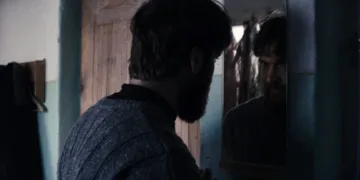
The camera frequently isolates her within the frame; architectural lines press around her like bars, polite Scandinavian bars, which may be worse. Mirrors recur as zones of estrangement, catching Maja as she stares at herself with the blank scrutiny of someone assessing a stranger. Shot composition becomes a study of identity under erasure. Even camera movement feels governed by hesitation, aligned with a protagonist whose body seems to have forgotten forward motion.
Landsvik extends this visual psychology through surreal, fluid flashbacks in which Maja’s adult self physically enters childhood memories, most hauntingly at a local public swimming pool. The device turns memory into a room she can reenter, then fail to master. Identity appears unstable, shaped by performance, family, fame, shame, and the old ethical fog of what one owes to the self after collapse.
Sound design sharpens that instability. Landsvik avoids the expected sonic grammar of music films and commits to a severe economy of sound: ambient stillness, muffled schoolyard chatter, the rhythmic scratch of pens during exams. These sounds manipulate audience perception with quiet cruelty.
They narrow the world to texture and pressure, recreating the sensory isolation of a musician who has silenced her voice. The absence of musical catharsis becomes its own kind of score. Low Expectations makes the audience sit inside Maja’s retreat, counting minutes, hearing paper, watching light die properly. Noir always did enjoy a room with bad options.
Low Expectations had its highly anticipated world premiere on May 19, 2026, screening in the prestigious Directors’ Fortnight section at the 79th Cannes Film Festival. This international co-production between Norway and Denmark marks the feature-length directorial debut of Eivind Landsvik. The film serves as the screen acting debut for popular Norwegian indie-pop musician Marie Ulven, globally recognized by her stage name Girl in Red. Audiences looking to catch the film following its festival run can look forward to its theatrical rollout, with a domestic release scheduled in Norwegian cinemas via Nordisk Film on September 11, 2026.
Full Credits
Title: Low Expectations
Distributor: Nordisk Film, Salaud Morisset
Release date: May 19, 2026
Running time: 105 minutes
Director: Eivind Landsvik
Writers: Eivind Landsvik
Producers and Executive Producers: Synnøve Hørsdal, Lotte Sandbu
Cast: Marie Ulven, Anders Danielsen Lie, Tone Mostraum, Embla Berntsen, Snorre Kind Monsson, Clara Dessau, Fredrik Stenberg Ditlev-Simonsen, Helene Bjørneby
Director of Photography (Cinematographer): Andreas Bjørseth
Editors: Patrick Larsgaard
Composer: Frederikke Hoffmeier, Bendik Hovik Kjeldsberg
The Review
Low Expectations
Low Expectations is a textured, slow-burning portrait of psychological deceleration that swaps the glamor of artistic breakdown for the heavy, unadorned weight of everyday survival. While the script resolves Maja’s deep-seated existential anxieties a bit too neatly in its final act, the film remains a visually striking, deeply felt exploration of modern depression.
PROS
- Marie Ulven delivers a remarkably vulnerable, unglamorous acting debut rooted in expressive silence and weary physical precision.
- Andreas Bjørseth’s rich, grainy visual language beautifully externalizes Maja's internal isolation.
- The script balances heavy themes of identity loss with dry humor and painfully accurate social discomfort.
CONS
- The narrative trajectory wraps up complex psychological trauma a bit too cleanly near the end.
- The deliberate focus on monotony and empty time may test the patience of viewers seeking traditional dramatic momentum.