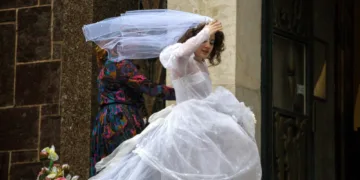











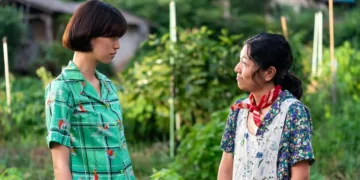



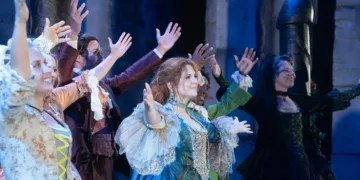



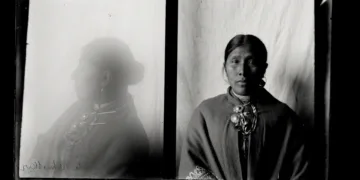









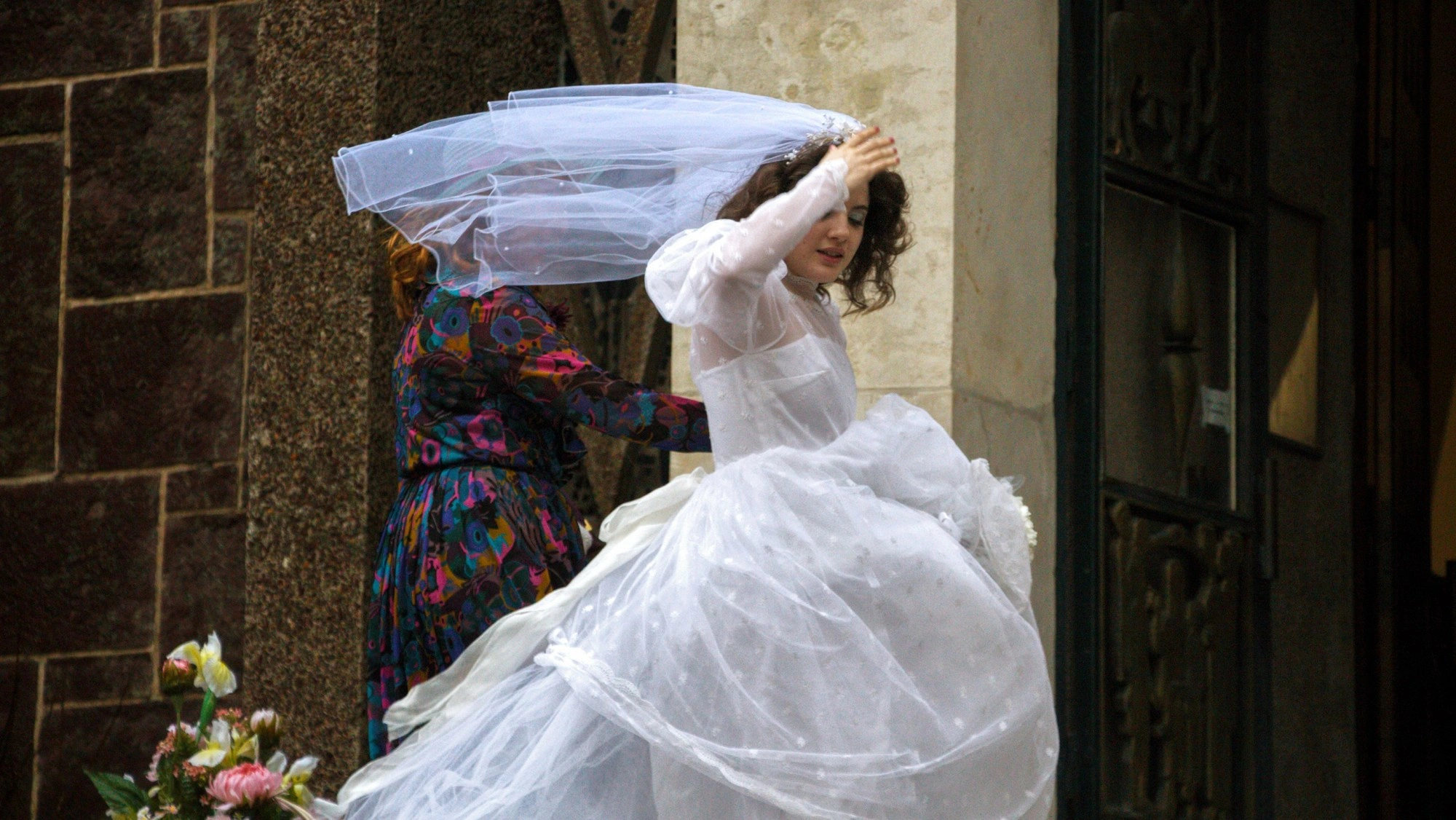

Christophe Honoré leaves his familiar Parisian terrain and roots Orange Flavoured Wedding in a harsher, more localized reality. He adapts the emotional frame of his stage production, Le Ciel de Nantes, shifting the action to the working-class outer rings of that western French city. The date, March 11, 1978, matters with almost bureaucratic cruelty. On that day, pop icon Claude François died in a sudden, freak electrocution, a national shock that leaks into the wedding of the youngest Puig sibling, Jacques, and his fiancée, Martine.
The celebration carries panic from its first moments. Honoré begins with a noisy caravan of cars, a mobile village sealed inside metal and exhaust. The Puig family moves as a loyal, defensive organism, visibly cracked by old resentments that nobody wants to name. They drink, dance, and laugh under a brittle varnish of festivity. Family ritual here becomes civic archaeology, with history pressing its thumb into every toast.
Chronocircuitry and the Ghosts of Post Colonial France
The film’s structure resists the tidy march of a standard wedding drama. Viewers must develop what I will call chronocognition, piecing together the sprawling family tree while characters shout across the reception hall. Honoré gives few soft landings. He trusts sideways glances, interrupted exchanges, and emotional debris to explain who belongs to whom. This unruly present is haunted by a glaring absence: the exiled family patriarch, whose cruelty still circulates through his children like inherited weather.
Three sudden flash-forwards rupture the festive timeline, sending the story into the early 2000s to reveal future illnesses, estrangements, and deaths. These leaps have a severe intelligence. They puncture the party’s sweaty euphoria and make the young, laughing guests appear already shadowed by decline. A wedding album turns into a medical file. Romantic, yes. Cheerful, less so.
Honoré links private damage to the untreated wounds of the French state. One brother carries the unstable burden of post-traumatic stress disorder from his conscription during the Algerian War. His volatility reflects a national refusal to face that colonial conflict with honesty. The film balances political memory against ordinary family chaos, though the crowd of subplots sometimes weakens the force of its historical argument. The movie wants to hold the family and the republic in the same clenched fist. At times, the fist overflows.
Handheld Hues and Sonic Friction
Jeanne Lapoirie captures the film’s manic charge with cinematography that feels like documentary intrusion at a private party. Her restless handheld camera cuts through crowded rooms, retreats to observe the dance floor’s social choreography, then lunges toward faces with almost impolite curiosity. The framing catches small collapses: fatigue around the eyes, tears erased in dark corners, laughter bursting through background noise like a survival reflex.
The visual palette rejects polished period nostalgia. Lapoirie uses a grainy analogue texture and muted, imperfect lighting that gives the film a lived-in physicality. This 1978 does not gleam from a museum case. It sweats, smokes, stains, and forgets where it left its drink.
The soundscape becomes a psychological battleground. The opening pairs celebratory car horns with the weeping strings of Guillaume Lekeu’s nineteenth-century Adagio, creating an immediate clash between public joy and private dread. Across the reception, the soundtrack moves from the sugary pop of Claude François to the rougher rock of Python Lee Jackson. These selections mark cultural divisions among the guests while turning popular music into a national weather report. Personal anxiety and collective mourning share the same speakers.
The Architecture of the Puig Ensemble
This crowded experiment depends on the ensemble’s heavy labor. Paul Kircher gives Jacques a fragile, tender quality that steadies the film. His work becomes especially vital during the confrontation with his estranged father, a scene charged with real danger. Malou Khebizi plays Martine with watchful restraint. She registers as the outsider, reading the Puig family’s historical damage through quiet, precise looks.
Adèle Exarchopoulos is spectacular as Claudie, shaping a performance defined by emotional volatility. She presents a woman broken by mental instability and a failed marriage, moving between manic heat and deep depression with painful speed.
Vincent Lacoste provides a sharp counterweight as Dominique. He plays the life of the party, a man hiding panic over a recent firing behind cheerful buffoonery. The remaining siblings, played by actors including Alban Lenoir and Nadia Tereszkiewicz, resist simple archetypes. Each performer carries a different piece of the family’s past, suggesting that shared blood can pass down the same wound in radically different disguises.
Orange Flavoured Wedding premiered in France at the Cannes Film Festival as part of the Cannes Première section. The production wrapped up rapidly in early spring to secure its festival debut, offering an intimate look into a family crisis. Viewers looking to see the feature can find it screening at international film festivals throughout the season, with a wider theatrical release scheduled by distributor Ad Vitam for November 18, 2026.
Full Credits
Title: Orange Flavoured Wedding
Distributor: Ad Vitam Distribution
Release date: May 20, 2026
Running time: 115 minutes
Director: Christophe Honoré
Writers: Christophe Honoré
Producers and Executive Producers: Philippe Martin, David Thion
Cast: Adèle Exarchopoulos, Vincent Lacoste, Paul Kircher, Alban Lenoir, Nadia Tereszkiewicz, Malou Khebizi, Noée Abita, Park Ji-Min, Myriem Akheddioui, Saadia Bentaïeb
Director of Photography (Cinematographer): Jeanne Lapoirie
Editors: Chantal Hymans
The Review
Orange Flavoured Wedding
Orange Flavoured Wedding succeeds as a raw, emotionally demanding portrait of familial survival that trades sentimentality for historical weight. Christophe Honoré’s theatrical roots show in the crowded narrative density, but the brilliant temporal disruptions and Jeanne Lapoirie’s restless cinematography prevent it from feeling stage-bound. While the sheer volume of characters occasionally borders on the overwhelming, the exceptional ensemble performances turn this chaotic celebration into an enduring study of shared trauma and hard-won affection.
PROS
- A phenomenal ensemble cast, particularly grounded by Paul Kircher and a volatile Adèle Exarchopoulos.
- Immersive, grainy handheld cinematography that perfectly captures the frantic energy of a 1978 celebration.
- Brilliant use of flash-forwards to reframe immediate joy with prophetic, melancholic weight.
CONS
- The narrative density can feel unwieldy, making it difficult to follow every family connection.
- Certain heavy subplots, including wartime trauma, are introduced without receiving deep thematic exploration.