
























![Kingdom Hearts Collection [I-III] Review](https://gazettely.com/wp-content/uploads/2026/10/Kingdom-Hearts-Collection-I-III-1-360x180.webp "Kingdom Hearts Collection [I-III] Review: KHII Holds Steady as Newer Entries Fluctuate 37")





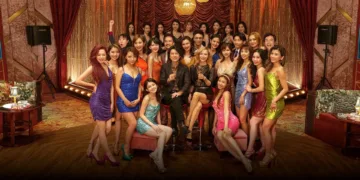
Night King sets its story in 2012, anchoring the audience in a specific moment of decline for the East Tsim Sha Tsui district of Hong Kong. The legendary neon glow of the 1980s and 90s has faded to a dim flicker as establishments shutter their doors. Club EJ survives as a relic of old-school luxury, closely mirroring the famous Club BBoss in its opulent design.
Foon, played by Dayo Wong with his characteristic sharpness, manages the floor with a stubborn adherence to traditional hospitality values. He resists the sleazier business models adopted by competitors, working to preserve dignity for his staff. The arrival of Dame V, Foon’s ex-wife, disrupts this fragile equilibrium. Sammi Cheng portrays V with icy, proactive efficiency.
She enters as the new CEO with plans to modernize the establishment using “fighter jet” hostesses to maximize profit. Stakes rise with Prince Fung, a playboy corporate heir who betrays V and attempts to dismantle the club for personal gain. This betrayal forces the former spouses into an uneasy alliance, pushing them to find common ground to protect a vanishing way of life from predatory corporate interests.
Rhythm, Wit, and the Found Family
The film’s comedic engine runs on the rapport between Foon and his assistant, Turf. Yeung Wai-lun brings a restrained, awkward physicality to the role that pairs naturally with Dayo Wong’s cynical wit. Their exchanges feel rhythmic and sharp.
A standout moment features a role-reversal exercise where Turf acts as a demanding customer and Foon demonstrates hostess techniques, a scene that highlights the technical precision of their timing. Beyond the humor, the film anchors itself in the performances of its leads.
Sammi Cheng provides a strong foil to Wong’s sardonic energy. Their shared scenes in a Macao casino suite offer a quieter, grounded look at their history as ex-spouses, allowing the characters to drop their professional masks. The hostesses form a found family that gives the story its human weight. Louise Wong as Coco and Fish Liew as Mimi provide distinct perspectives on the industry.
Mimi carries a significant portion of the narrative weight, as her physical resemblance to a regular client’s deceased wife becomes a functional tool in the club’s survival strategy. Supporting players, including the linguistically challenged Kwei-fong and the weary ChiLing, receive enough attention to feel like individuals. Each performer contributes to a sense of community that feels authentic to the setting.
The Heist Against Capitalist Decay
The narrative structure adopts a ticking-clock mechanism when V grants Foon a 30-day window to prove the club can be profitable. This deadline provides the necessary momentum for the first half, pushing characters to innovate within a dying industry.

The story pivots from a character-driven dramedy into a high-stakes heist caper, as the crew attempts to swindle Prince Fung out of the 80 million dollars required to buy back the establishment. This shift feels earned because the characters’ desperation drives it organically.
The script offers a sharp critique of material wealth, prioritizing loyalty over financial gains, and balances jaunty jazz energy with moments of clear-eyed realism. The film confronts the financial anxieties of its workers directly. The episodic structure manages several threads, including a love triangle involving Foon, V, and Mimi, and avoids feeling disjointed.
The narrative threads converge effectively on the final scam, handled with a sense of logic that keeps the viewer anchored in the high-stakes environment. The story grounds its entertainment in relationships with actual consequences across a harsh economic landscape.
Aesthetic Brilliance and the Final Stand
Anthony Pun’s cinematography defines the visual identity of this production. The palette draws on gold and glitter to evoke bygone glamour, filling smoky rooms and lush furniture with a sultry, immersive atmosphere. Rapid camera movements capture Club EJ at peak performance, mirroring its frantic energy, then pull back to reveal the dull, tarnished reality when the house lights go up and bills are due.

The production design meticulously recreates nightclub interiors, focusing on details like hemlines and furniture to establish a specific sense of place. Hanz Au and Iris Liu provide a score characterized by rolling drums and blaring horns, establishing a buoyant pace from the opening sequence. Jack Ng’s direction shows a sophisticated ability to manage tension, channeling high-stakes conflict through verbal exchanges and shady motivations alone.
His collaboration with familiar actors creates a polished theatrical experience. The film functions as a parable for a changing society, celebrating a never-say-die attitude among people refusing to be discarded by corporate shifts. This thematic focus gives the entertainment a lasting weight. The film records the death of an era while honoring the people who stayed until the end.
Released in February 2026 as a cornerstone of the Lunar New Year cinematic season, Night King marks the sophisticated second feature from director Jack Ng. Set in the declining nightlife district of Tsim Sha Tsui East in 2012, the film reunites the creative team behind the record-breaking A Guilty Conscience. As of May 2026, the film is currently concluding its successful theatrical run across Hong Kong, the United Kingdom, and Australia, with a digital release expected to follow on regional streaming platforms later this year.
Where to Watch Night King (2026)
Full Credits
Title: Night King
Distributor: Edko Films, Trinity CineAsia
Release date: February 17, 2026
Rating: Category IIB, 12A
Running time: 132 minutes
Director: Jack Ng
Writers: Jack Ng, Ho Miu-ki, Jay Cheung
Producers and Executive Producers: Bill Kong, Ivy Ho, Jack Ng
Cast: Dayo Wong, Sammi Cheng, Louise Wong, Fish Liew, Yeung Wai-lun, Lo Chun-yip, Ho Kai-wa, Renci Yeung
Director of Photography (Cinematographer): Anthony Pun
Editors: Alan Cheng, Angie Lam
Composer: Iris Liu, Hanz Au, Jolyon Cheung
The Review
Night King
Night King serves as a polished, character driven study of a vanishing era. It balances sharp comedic timing with a serious examination of corporate greed and personal loyalty. While the runtime feels slightly extended and certain subplots distract from the central conflict, the chemistry between the leads and visual flair make it a worthy successor to Ng's previous work. It honors the spirit of Hong Kong cinema with a grounded, adult perspective on survival.
PROS
- Sharp comedic timing between the leads.
- Opulent cinematography by Anthony Pun.
- Grounded performances that avoid caricature.
CONS
- Runtime feels excessive at 132 minutes.
- Subplots occasionally clutter the narrative flow.
- Sanitized portrayal of the hostess industry.







