
























![Kingdom Hearts Collection [I-III] Review](https://gazettely.com/wp-content/uploads/2026/10/Kingdom-Hearts-Collection-I-III-1-360x180.webp "Kingdom Hearts Collection [I-III] Review: KHII Holds Steady as Newer Entries Fluctuate 37")



Hong Kong Mixtape reads like a field report from a city that keeps changing the map while you are still walking it. Director San San F. Young positions herself as narrator and guide, shaping the documentary as a personal essay about a metropolis under heavy pressure. Many outsiders frame Hong Kong through its corporate skyline and financial reputation. Young keeps her camera closer to street level.
The film tracks the collision between the 2019 protest movement and the 2020 National Security Law, treating that legal turn as the spark that reshapes every creative decision. In Young’s telling, making art becomes a political act with real risk attached. She follows the way identity and day-to-day survival tighten together as the rules of public speech shift. What emerges is a portrait of a city shedding familiar textures, with residents working to hold on to heritage through whatever creative channels still feel possible.
The Director as Observer and Subject
Young builds the film around her own history, using voiceover that leans into intimacy instead of newsroom distance. She revisits her years as a rebellious teenager and describes how Western directors helped her find a voice. Her mixed-race background gives her a specific angle on the city, one shaped by split loyalties and layered belonging.
Time away from Hong Kong sharpens that angle further. She returns carrying insider knowledge, yet she often sounds like someone relearning the place in real time. That gap becomes part of the film’s narrative engine, since it lets her register changes as discoveries rather than footnotes.
The documentary keeps returning to what she missed and to the altered routines of people who stayed. Young turns those observations into structure: memory, return, recalibration. Her family threads through that structure, especially in conversations with her mother, which pull the political story into domestic space.
The mother-daughter exchanges sketch a generational divide in how residents read the new restrictions. Her mother voices a steadier, more cautious orientation toward authority. Young, meanwhile, tries to align her creative instincts with a social environment that keeps narrowing. The film treats that tension with seriousness, and with a faint edge of irony: the essay form offers freedom, yet the world around it keeps shrinking the room.
Creativity on the Fringes
The most kinetic stretch of Hong Kong Mixtape captures a brief period when street art and performance became a shared public language. Young introduces a range of artists, including visual artist Kacey Wong and rapper Luna, and follows the way each medium absorbs the chaos outside the studio. The variety matters.
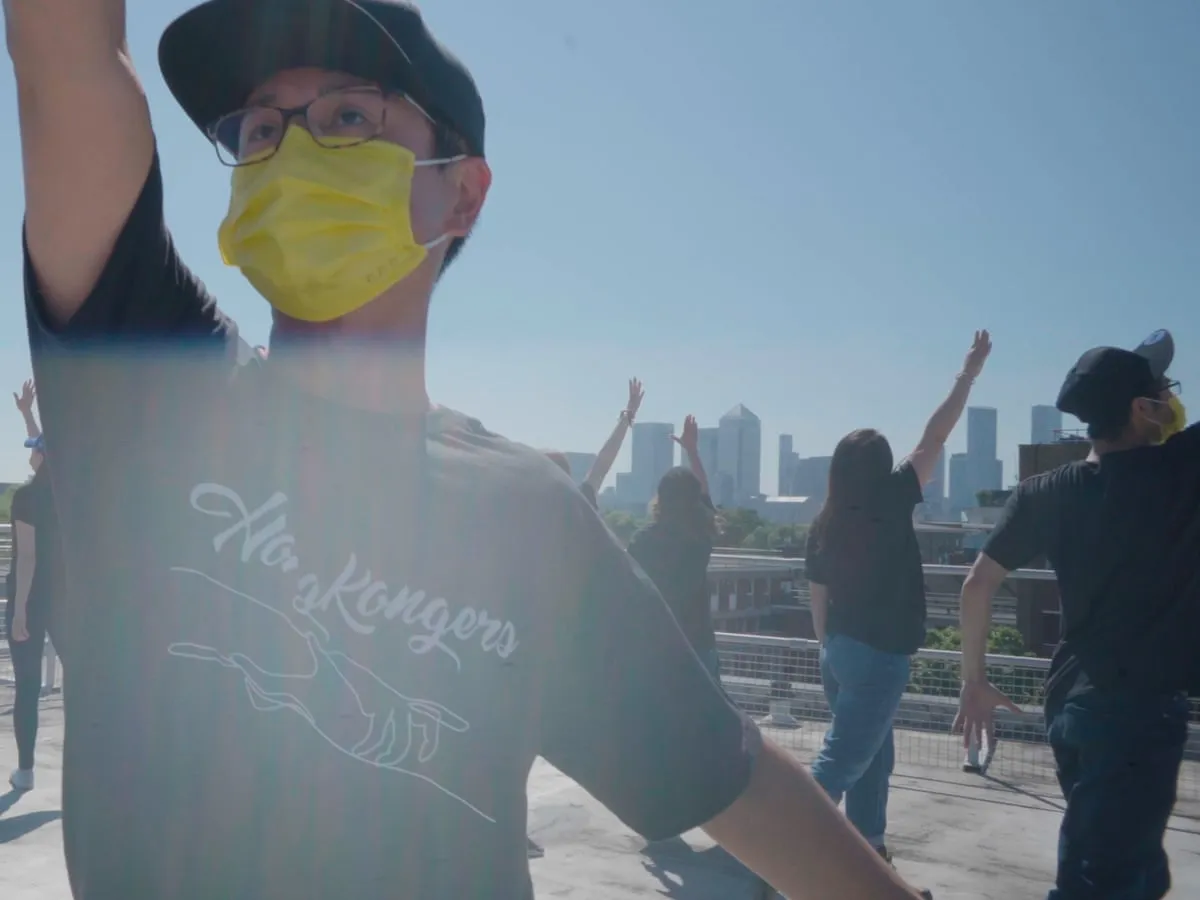
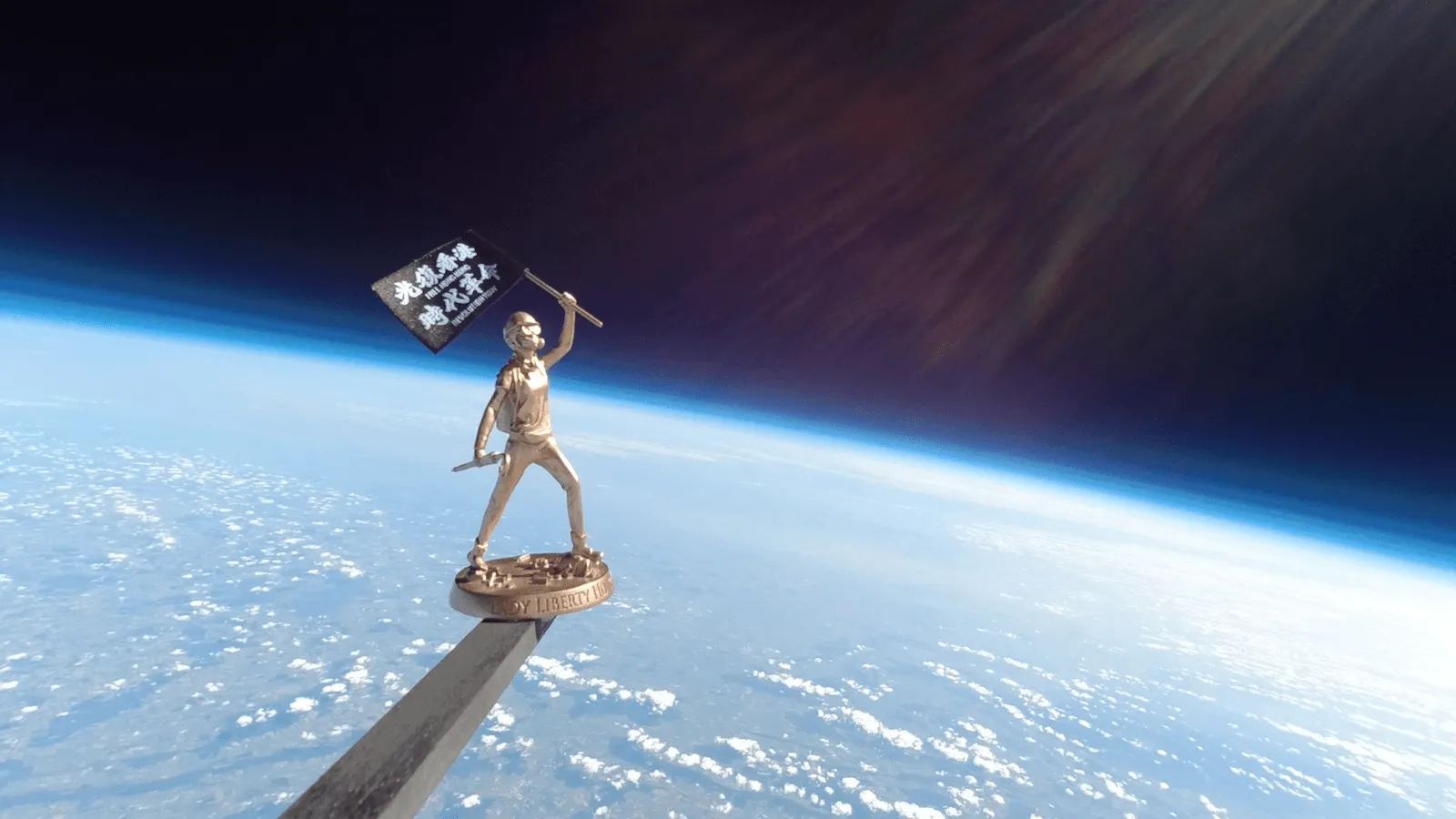
The film moves from hip hop performances that feature hand gestures later classified as illegal, to sculptors assembling Lady Liberty statues in secrecy, to dancers using the city’s mountains as a stage for defiant movement. Each choice of form doubles as a choice of visibility, and Young films that calculus without pretending it is abstract.
Her visual approach matches the moment’s electricity. Glossy neon shopping districts sit alongside rough, handheld protest footage, and the contrast carries a clear point about what gets marketed versus what gets lived. Hip hop lands as an especially sharp tool in this section, tied to a global history of resistance yet rooted in a local emergency.
Young shows artists using banned slogans and covert installations to claim space, even as official directives push the city toward a cleaner, quieter surface. The documentary’s energy here can feel like a countdown, with every beat haunted by the sense that the window will close.
The Silence of the Security Law
Once the 2020 National Security Law arrives in the film’s timeline, the tone drops into something colder and heavier. Young records the literal removal of the movement’s public trace: city workers painting over murals, power-washing slogans from walls, scrubbing away evidence as if cleaning could rewrite memory. The crowded street scenes thin out. In their place comes a watchful isolation that the film communicates through absence as much as through argument.
Young then follows the creative community into harder choices. The documentary shows artists weighing silence, continued work, and the pull of leaving. Many subjects decide to depart for Taiwan, the United Kingdom, or Australia, concluding that their art cannot keep existing inside Hong Kong under the new conditions. The film’s final movement shifts from public defiance to private persistence, tracking how creative life continues after visibility becomes a hazard.
Young frames this as diaspora, a scattering that turns Hong Kong into something carried rather than inhabited. The “mixtape” idea becomes both metaphor and method: a digital and physical collection of projects dispersed across countries, linked by memory and by the need to keep speaking in altered forms. The closing passages sit with that reality. The visible sites of resistance have been cleared. The cultural record remains, quieter now, and spread across many places at once.
Hong Kong Mixtape is a poignant documentary that premiered in early 2023 at the Glasgow Film Festival and later screened at major international festivals like Hot Docs. The film explores the drastic changes in Hong Kong following the 2019 protests and the subsequent 2020 National Security Law, which effectively criminalized many forms of creative expression. It blends San San F. Young’s personal history with the stories of underground artists who use their craft as a final stand against authoritarian rule. As of December 2025, the film is available to watch on platforms such as True Story and has been featured on MUBI in various regions.
Full Credits
Title: Hong Kong Mixtape
Distributor: MUBI, True Story, Tigerlily Two, Younger Productions, Doc Society
Release date: March 5, 2023
Rating: TV-14
Running time: 87 minutes
Director: San San F. Young
Writers: Adam Thomas, San San F. Young
Producers and Executive Producers: Nikki Parrott, San San F. Young, Natasha Dack, Mark Thomas, Sandra Whipham, Dani Carlaw
Cast: Kacey Wong, Luna Is A Bep, Giraffe, Shing, Lady Liberty Collective, Danzmocrazy, San San F. Young
Director of Photography (Cinematographer): San San F. Young, Ed Lee, Sri Southall, Ben Jones
Editors: Adam Thomas
Composer: Arran Price
The Review
Hong Kong Mixtape
Hong Kong Mixtape serves as a vital archive of a culture in retreat. San San F. Young successfully avoids the trap of detached observation by embedding her own history into the frame. The film treats creativity as a survival mechanism, documenting the brief, electric window where art functioned as the primary language of dissent. While the narrative occasionally assumes significant background knowledge from the viewer, its emotional core remains accessible. It is a sober, necessary reflection on the fragility of expression and the resilience of those forced to carry their heritage into exile.
PROS
- The essay format allows for a sincere exploration of identity and home.
- Features a diverse range of artists, from underground rappers to classical sculptors.
- Effectively captures the contrast between the city's corporate shine and its revolutionary pulse.
- Frames the local struggle as part of a wider conversation about freedom.
CONS
- Might prove difficult for viewers unfamiliar with recent political events.
- The final act adopts a bleak tone that may feel heavy to some audiences.
- Centers heavily on individual stories, sometimes at the expense of broader historical context.







