





























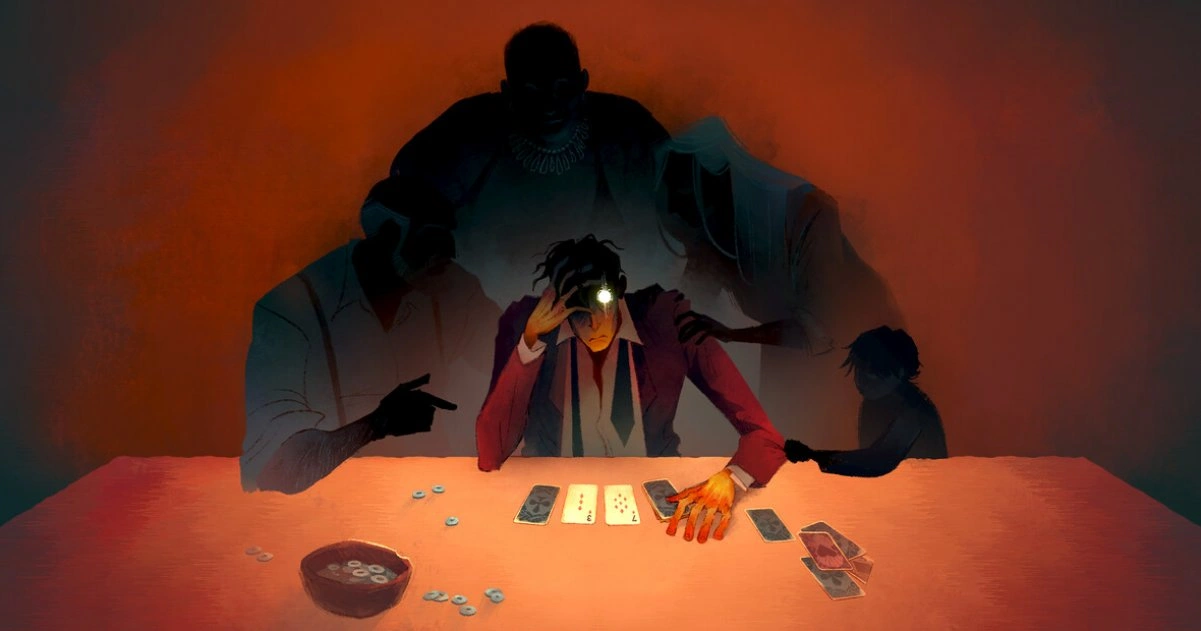

The afterlife in Black Jacket runs on desperate wagers. Developed by Mi’pu’mi Games and published by Skystone Games for PC and Xbox, with immediate Game Pass access, the game throws players straight onto the felt tables of purgatory.
You play as Kris, a confused soul with no memory, facing a massive bribe demanded by the underworld ferryman as the price of returning to life. Escape depends on winning gold coins from condemned opponents through a modified form of blackjack.
Reed, your main guide through this bleak passage, teaches the rules with a calm, eerie composure that makes the supernatural setting feel alarmingly routine. Each victory carries narrative weight. Winning hands restores pieces of Kris’s past, revealing personal ties between Kris and the souls across the table. Card play becomes a system for exposing regret, memory, and old connections through repeated mechanical pressure.
The Anatomy of Underworld Strategy
The game begins with the familiar outline of casino blackjack. Players build a hand as close to 21 as possible without going over, track standard face card values, treat aces with flexibility, and place coin bets after every draw. That familiar base quickly turns into a positional strategy puzzle.
Each participant uses an individual deck, and cards are dealt onto a personal board with five specific slots. Placement matters as much as arithmetic. The sleeve mechanic lets players pay coins to hold back a useful card for a later turn, creating a tight economy between present survival and future advantage.
The deeper strategy comes from awakened cards, supernatural tools that rewrite the normal number game. These cards can ignite active elements, consume nearby cards to absorb their value, or reveal future draws for precise planning.
The system divides these powers into distinct deck archetypes that define each run’s rhythm. Burn decks spread fires across the board and clear sections of play. Digestion decks eat your own cards to create high scoring bonuses. Break decks reverse numerical meaning, turning high-value cards into heavy negative values. Thorns decks attack the opponent’s base score, allowing wins with very low totals.
The royal face cards give the system its sharpest tactical identity. Their hidden interactions depend on relationship and position. A King placed beside a Queen activates a major defensive point boost. A Jack added to that arrangement creates betrayal: the Jack cuts the head from a neighboring card, splits the asset, and leaves a corrupted ghost effect with altered rules.
These royal interactions turn each round into a small narrative machine. The story of family, violence, and betrayal is played through card placement, and survival depends on reading the board as a mechanical space with emotional logic.
Progression Through Punishment
A run sends players across branching maps, with choices between card shops, fire sites that thin weak numbers from the deck, and passive artifacts that permanently alter match conditions. Artifacts shape your strategy through traits such as cheaper sleeve use or better slot efficiency.
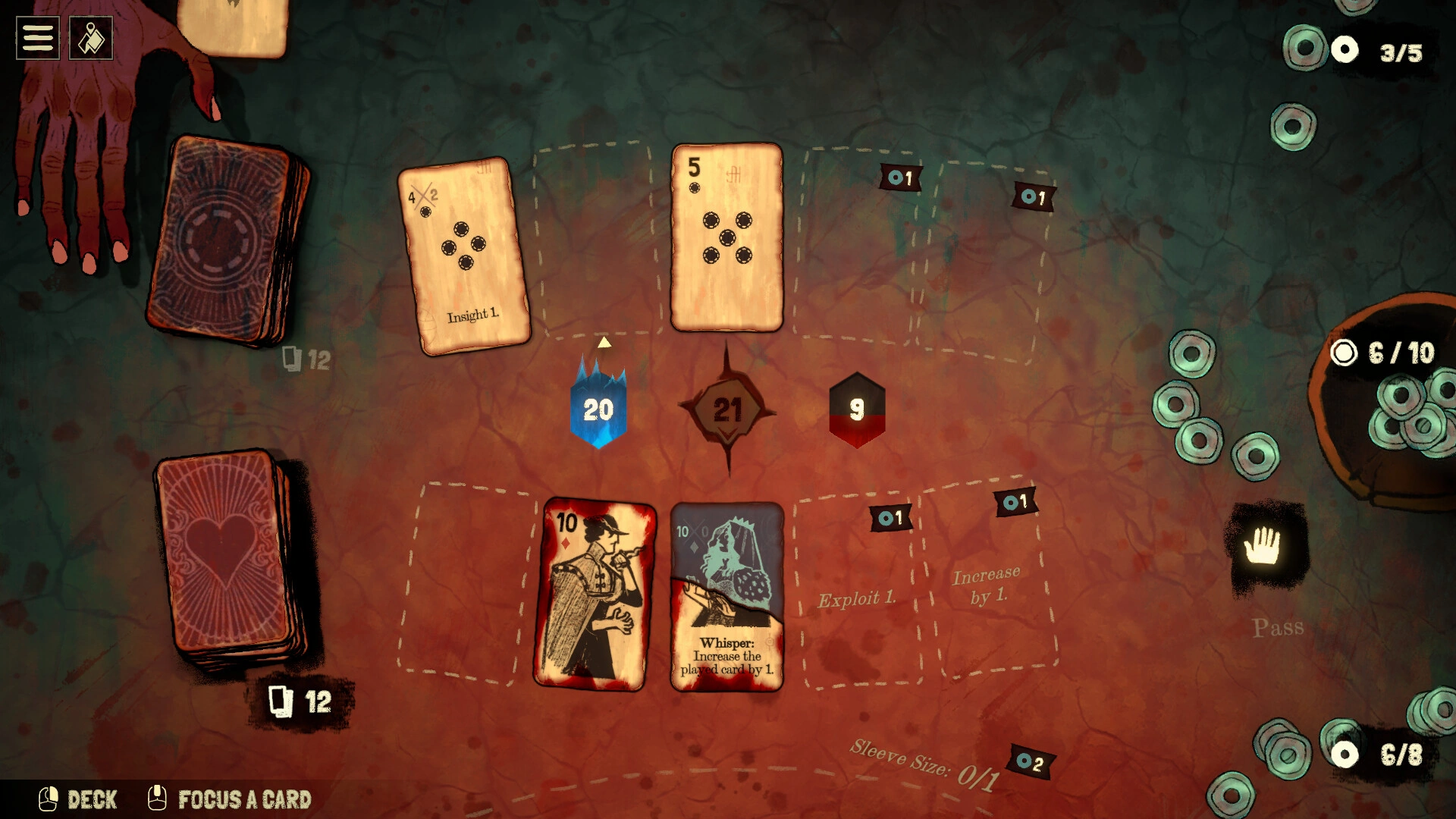
Character growth avoids standard role-playing experience points. Power comes from completing specific mechanical challenges during runs. These objectives unlock permanent rewards for later attempts, including a larger starting coin pool, increased sleeve capacity, and starter decks with specialized traits.
The loop moves between standard matches against desperate souls and major boss battles with shifting rule sets. Bosses break the table in distinct ways, such as tilting the physical orientation of the board or draining your funds through forced betting rules. Learning the full history of these major enemies requires defeating them multiple times across separate attempts. Lore arrives at the same pace as mastery, linking narrative discovery to repeated play and improved system knowledge.
The opening phase strains that design through severe onboarding problems. The game introduces complex systems with minimal explanation, leaving players to decode advanced card interactions with little guidance. Early runs can end in fast bankruptcy, since the mechanics demand clean execution before their logic becomes clear. Strong card combinations often sit unused, since their technical descriptions make their value hard to understand in practical play.
Random card distribution can also wreck a prepared plan, leaving players exposed after a run of poor draws. Some boss abilities feel punishing in early encounters before the counterplay becomes visible. The permanent reward structure eventually softens that frustration by letting players buy the same devastating skills for their own decks.
Early irritation turns into tactical agency once the system opens up. The game shifts from harsh randomness toward risk management, rewarding observation, adaptation, and pattern recognition. Short runs help this structure, since defeat usually delivers usable knowledge without consuming too much time.
Visual Clarity and Interface Friction
The visual style uses a dark, monochrome atmosphere that stays readable during complex turns. Shadowed backgrounds and sharp lighting give the game a distinct identity without obscuring card values. Dynamic animations give awakened cards strong physical feedback: flames spread, cards get consumed, and pieces shift across the table with clear impact.
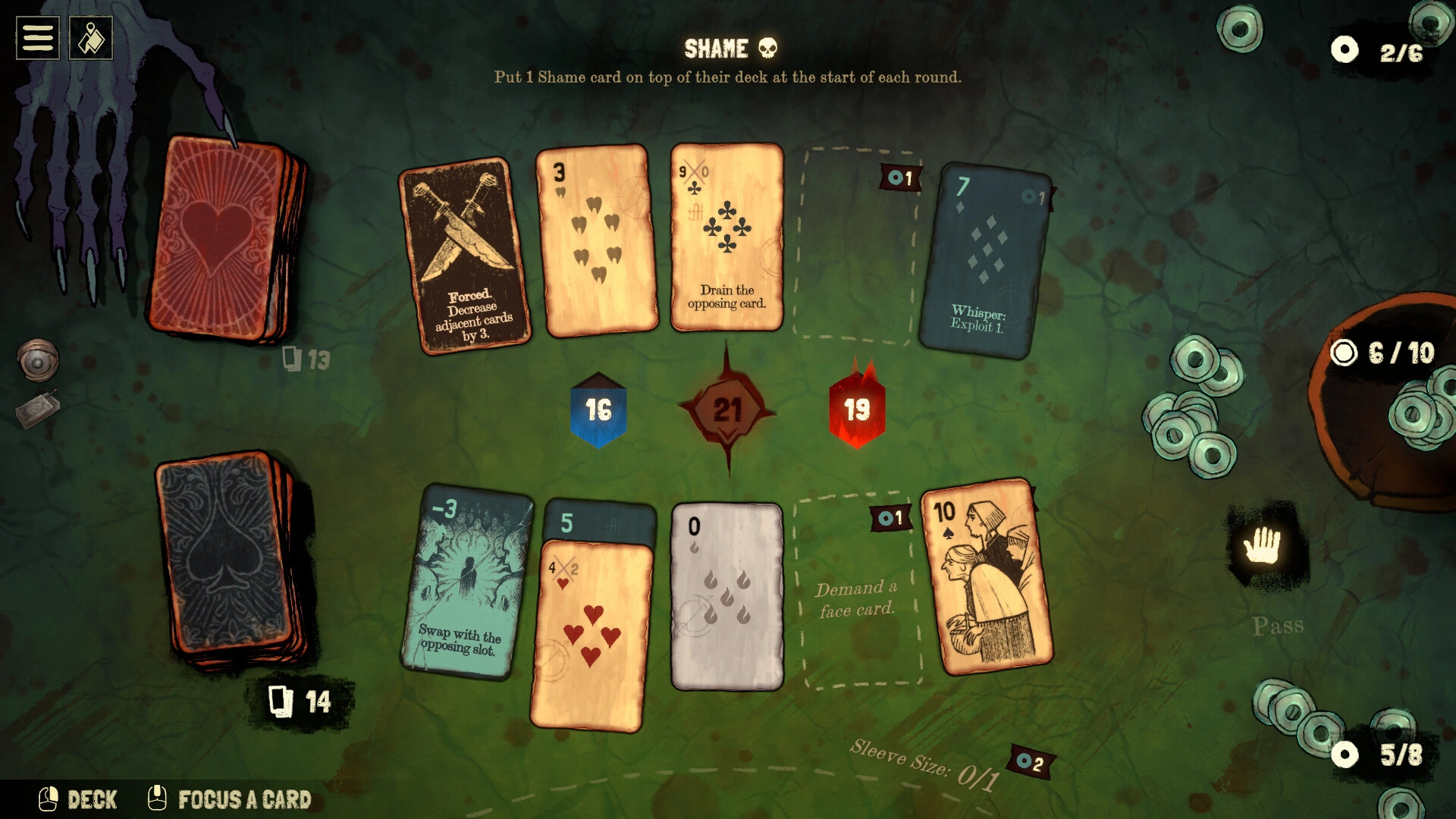
The sound design fits that bleak visual space through an atmospheric score that builds tension during important draws. Voice acting is a major strength, especially Reed’s calm and unsettling delivery, which deepens the purgatory setting without overplaying it.
The interface creates the most persistent friction. Text boxes explaining card properties are too large and often crowd the screen, blocking the five-card board and making important tactical reads harder than they need to be. Performance across hardware is stable, yet software bugs interrupt the flow.
Cards can freeze when moved from the sleeve into active play. A harsher bug creates a full black screen at the end of a run, forcing a complete software restart before progress can continue. These presentation issues weaken an otherwise smooth mechanical loop, asking players to show patience with flaws surrounding a strong strategic system.
The Review
Black Jacket
Black Jacket strips away the simple nature of casino gambling, replacing it with deep mechanical strategy and an unyielding underworld atmosphere. The brilliant marriage of card positioning, deceptive tactical sleeves, and narrative recovery outweighs the frustrating early tutorial shortcomings and interface clutter. It rewards mathematical planning and risk management, creating a highly satisfying loop of tactical cards.
PROS
- Deep tactical synergy between distinct deck types and card choices.
- Narrative expansion relies directly on your victory history.
- Excellent visual art design paired with great voice delivery.
CONS
- Poor initial tutorials leave game systems obscure.
- Oversized interface boxes block your view of the match.
- Severe black screen bug forces total application restarts.