























Doctor on the Edge places a polished city doctor in one of television’s most dependable pressure cookers: a small community where everyone knows everyone, resources are thin, and privacy has apparently been left on the mainland.
The Korean medical romantic comedy follows Do Ji-ui, a plastic surgeon serving as a public health doctor instead of standard military service. His assignment sends him to Pyeongdong-do, a remote island village where the clinic is modest, the equipment is dated, and the ferry ride there is already a personal crisis.
That setup gives the series an appealing social texture. The show is partly about romance, partly about medical urgency, and partly about what happens when public healthcare is treated as an obligation rather than a calling. Ji-ui arrives with technical skill and emotional damage, especially around ferries and water.
Yook Ha-ri, his chaotic first contact on the island, cuts through his anxiety with warmth, nerve, and comic timing. The result is a premiere that feels light on the surface, yet rooted in questions about access, duty, and the hidden cost of placing vulnerable communities at the edge of medical systems.
Medical Drama Meets Romcom Chaos
The premiere smartly introduces Ji-ui through a military training accident before sending him to Pyeongdong-do. When two soldiers fall during a wall-climbing drill, he reacts fast, treats their injuries, and proves that his polished surgical background is no empty credential.
The sequence matters because it establishes competence before the series begins poking fun at him. Once he reaches the ferry terminal, the confident doctor collapses into fear, medication, and a hallucinated rescue attempt that turns his first island crossing into a public spectacle.
That tonal swing is where Doctor on the Edge finds its rhythm. The medical drama emerges through outdated clinic tools, chronic illness among elderly patients, and the heart attack scare involving Mr. Park. The romcom side thrives in switched suitcases, dog chases, centipedes, awkward meals, and Ji-ui trying to survive island life with the dignity of a man who has clearly never had a bug fall on his face.
The show also taps into a streaming-era trend: genre stacking. Medical urgency, trauma mystery, workplace comedy, and romance are packed into one hour without feeling completely overloaded. The format reflects how global TV increasingly chases hybrid appeal, especially in K-dramas reaching international audiences through platforms hungry for stories that can travel across cultures. A scared doctor, a remote clinic, and a lively romantic lead need little translation.
Characters Built Around Wounds, Wit, and Social Friction
Do Ji-ui is most interesting as a contradiction. He is precise, talented, and socially polished, yet almost comically unsuited to the physical and emotional demands of island medicine. His perfectly packed luggage tells us plenty. So does his reaction to local food, insects, and the ferry. Lee Jae-wook gives Ji-ui a nervous edge that keeps the character from becoming a smug city-doctor cliché. There is sadness under the comedy, especially in moments where his panic seems tied to a death he has never processed.
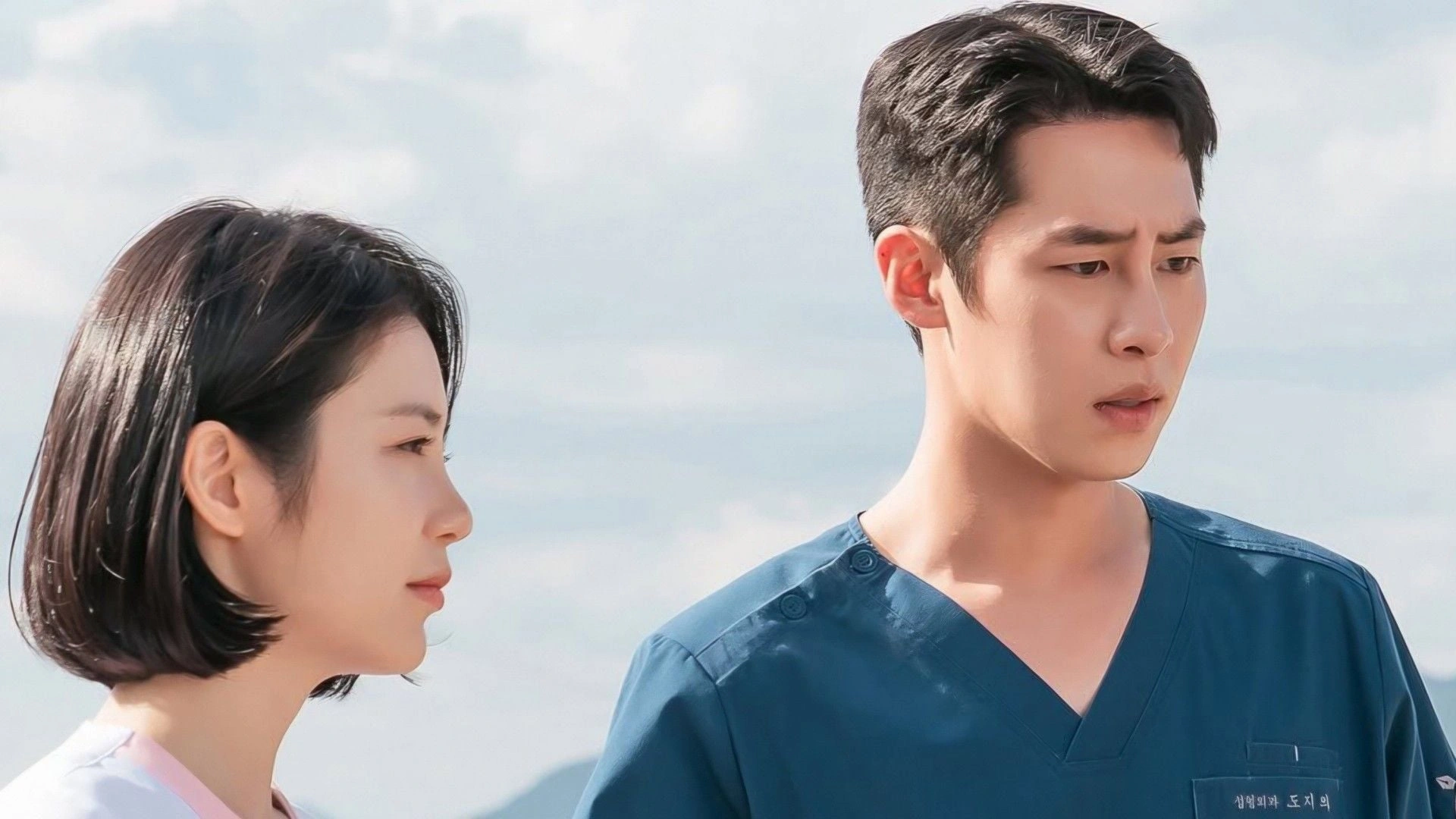
Yook Ha-ri brings the premiere its spark. Shin Ye-eun plays her with bright, slightly unruly confidence, making Ha-ri feel like a person shaped by the island rather than a decorative romantic lead dropped into Ji-ui’s redemption arc. She carries him after he passes out, handles the suitcase mix-up, corrects his version of the ferry incident, and later helps him through panic with headphones. Her link to her grandmother and her late parents gives her own presence a quiet ache.
The supporting cast turns the clinic into a small social organism. Hwang Shin-hye, the strict head nurse, carries the pressure of keeping an under-equipped health center functioning. Yong Ju-cheon offers warmth and local support, while Hyun Chi-yeon introduces professional snobbery and probable romantic rivalry. His dismissive attitude toward plastic surgeons hints at class and status tensions inside medicine itself. That is one of the show’s sharper details: even healers bring hierarchy with them.
Pyeongdong-do as Scenic Escape and Healthcare Warning Sign
The island setting gives Doctor on the Edge much of its identity. Pyeongdong-do is shot with enough coastal beauty to make the place inviting, yet the show never lets that beauty erase the practical hardship of living far from major hospitals.
The clinic’s outdated equipment and the dependence on ferries and helicopters turn the scenery into a structural problem. A heart attack on the island is not merely a medical event. It becomes a transport problem, a staffing problem, and a reminder that rural healthcare often survives through improvisation.
The direction handles Ji-ui’s trauma with effective sensory cues. Close-ups, flashbacks, and sound design make the ferry scenes feel physically uncomfortable. His fear is not treated as a quirky flaw alone. It is a wound with consequences. The comedy around him can be broad, sometimes very broad, but the actors sell it through embarrassment and timing rather than forced wackiness.
Some logistics do stretch credibility. The emergency transfer system seems wildly impractical, especially if every major case requires a helicopter and leaves the clinic short-staffed. The AI element, from what the premiere suggests, also feels like an extra gadget searching for a purpose. Still, the show’s strongest material lies in the human mess around the clinic: scared patients, overworked staff, unresolved grief, and a doctor learning that medicine outside the city demands humility along with skill.
Doctor on the Edge is a South Korean medical romance television series that premiered on June 1, 2026. The series follows an ambitious university hospital plastic surgeon who finds himself unexpectedly assigned to fulfill his mandatory public health service on a remote and isolated island. Stranded in a tight-knit community surrounded by the sea, he must navigate challenging medical emergencies alongside a warm but deeply secretive local nurse. Viewers can watch the ongoing series broadcast weekly on ENA and Genie TV in South Korea, or stream it internationally via Disney+ and Hulu.
Where to Watch Doctor on the Edge Online


Full Credits
Title: Doctor on the Edge
Distributor: ENA, Genie TV, KT Studio Genie, Disney+, Hulu
Release date: June 1, 2026
Rating: TV-14
Running time: 70 minutes per episode
Director: Lee Myoung-woo
Writers: Kim Ji-soo
Producers and Executive Producers: The Studio M, KT Studio Genie
Cast: Lee Jae-wook, Shin Ye-eun, Hong Min-gi, Lee Soo-kyung, Kim Yoon-woo, Kil Hae-yeon, Jung Ae-yeon, Lee Yoon-mi, Joo In-young
The Review
Doctor on the Edge
Doctor on the Edge makes a strong first impression by mixing island medical drama, romantic-comedy chaos, and unresolved trauma with surprising ease. Its rural clinic setting gives the series a social bite, while Lee Jae-wook and Shin Ye-eun bring enough contrast and warmth to carry the early episodes. Some medical logistics feel shaky, and the AI element has yet to prove its worth, but the characters, scenery, and emotional mystery make this a promising watch.
PROS
- Strong chemistry potential between the leads
- Beautiful island setting
- Effective mix of comedy, trauma, and medical stakes
- Lee Jae-wook gives Ji-ui emotional depth
- Shin Ye-eun brings charm and lively energy
- Rural healthcare angle adds social relevance
CONS
- Some emergency logistics feel implausible
- AI element feels unnecessary so far
- Love triangle setup may become frustrating
- Ha-ri needs deeper development beyond her lively introduction