

























![Kingdom Hearts Collection [I-III] Review](https://gazettely.com/wp-content/uploads/2026/10/Kingdom-Hearts-Collection-I-III-1-360x180.webp "Kingdom Hearts Collection [I-III] Review: KHII Holds Steady as Newer Entries Fluctuate 37")




Jinsei, meaning “Life,” is a fittingly vast title for Ryuya Suzuki’s first feature, a hand-drawn animated film that follows one unnamed figure across a century of personal and social fracture. Suzuki writes, directs, edits, animates, and scores the film himself, giving the work the feeling of a private vision forced into public view. Its rough edges are part of its emotional grammar.
The film traces the life of a Japanese pop idol from 1994 to 2095 across ten chapters, each named after a nickname, insult, or stage identity given to the protagonist. Voiced by Ace Cool, he is never granted the stability of a real name. That absence defines him. He becomes a child of trauma, a boy-band performer, a recluse, a celebrity, a symbolic figure, and finally something close to an oracle in a ruined future.
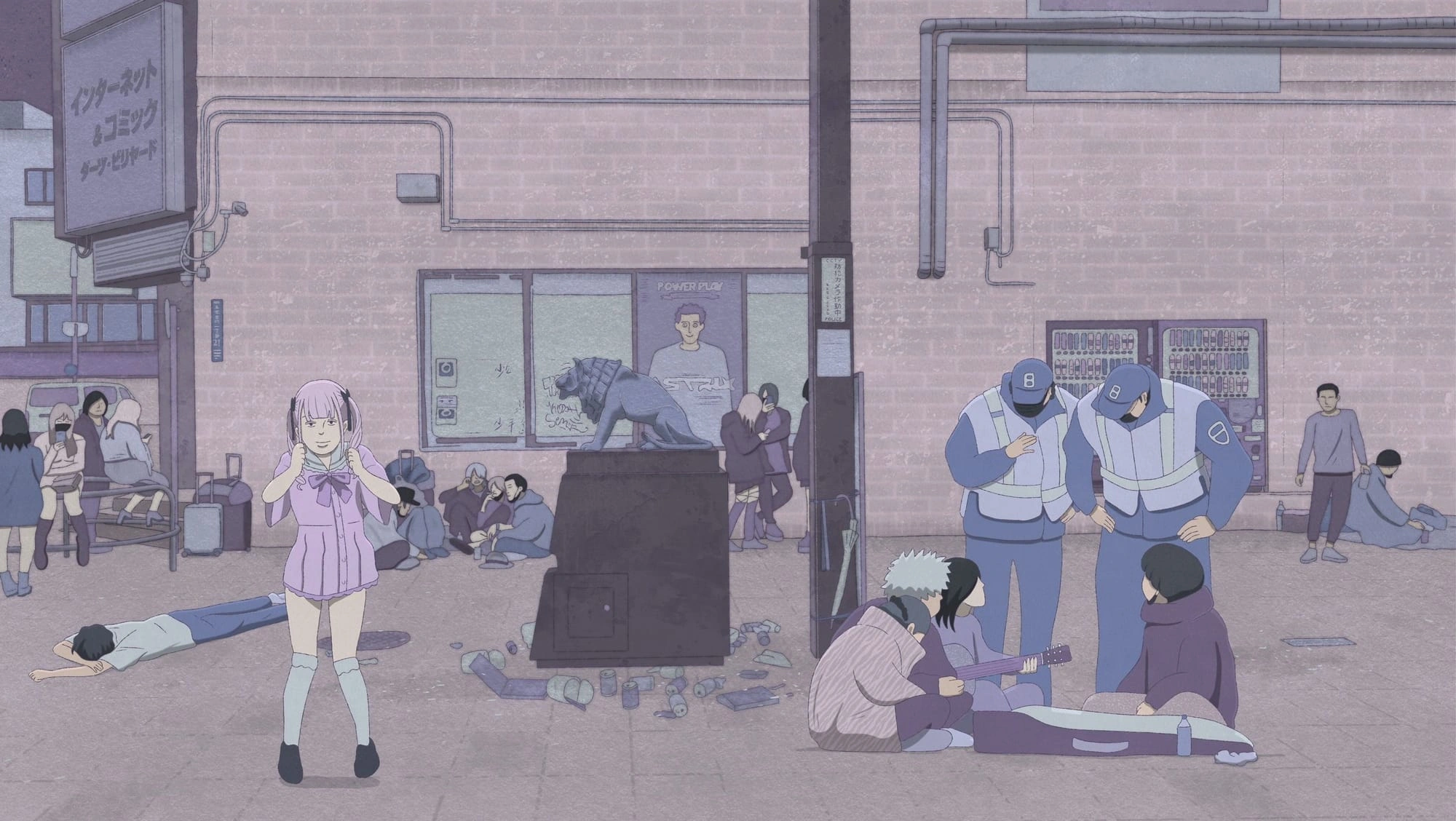
Suzuki’s visual choices announce the film’s inner temperature: a tiny boxed frame, slow-moving animation, grayscale textures, and later flashes of synthetic color. Fame glows, then curdles. The future expands, then empties. Jinsei treats identity as a costume others keep handing to a man who never learned how to stand inside himself.
The Boy With Too Many Names
The ten-chapter structure gives Jinsei its strange rhythm. Each title marks a new identity, yet the protagonist remains emotionally suspended, carrying the same childhood wound through every era. The early chapters sketch a life ruptured by loss: his mother dies, his father is left incapacitated, and the boy falls into muteness. School offers little refuge. Bullying sharpens his isolation until Kin, a fair-haired transfer student, introduces him to the glittering machinery of pop-idol culture.
Kin becomes the first person to give the protagonist a vision of escape. Their friendship has a tenderness that the film rarely states plainly, which makes it feel fragile, almost secret. Through Kin, the boy discovers the fantasy of performance: the screen idol, the perfect dance move, the promise that public adoration might repair private damage.
Then the industry arrives, with its boardrooms, handlers, and men who speak about children as marketable shapes. The protagonist joins ZENROKU, a boy band built less around music than around image management. He has presence, everyone tells him. He has an aura. The film quietly asks what such praise means for someone who barely seems present to himself.
Hiroshi, his stepfather, offers warmth without authority, a good man with limited tools. The record executives offer structure without care. Between these poles, the protagonist drifts. He rises, vanishes, returns, suffers, lashes out, and keeps changing roles while never gaining a secure center. The fragmented storytelling mirrors damaged memory: pieces remain, connective tissue disappears, and time begins to move faster than understanding can follow.
A Small Frame Holding a Century
Suzuki’s animation is sparse, but its austerity has force. The early passages rely on pale grays, dusty blues, and near-monochrome surfaces that make childhood feel emotionally oxygen-starved. The figures often appear flat, stiff, and isolated within symmetrical compositions. Faces stare from profile. Bodies move with deliberately limited fluidity. The result is less polish than pressure, as if every frame has been stripped down to the minimum needed to preserve feeling.
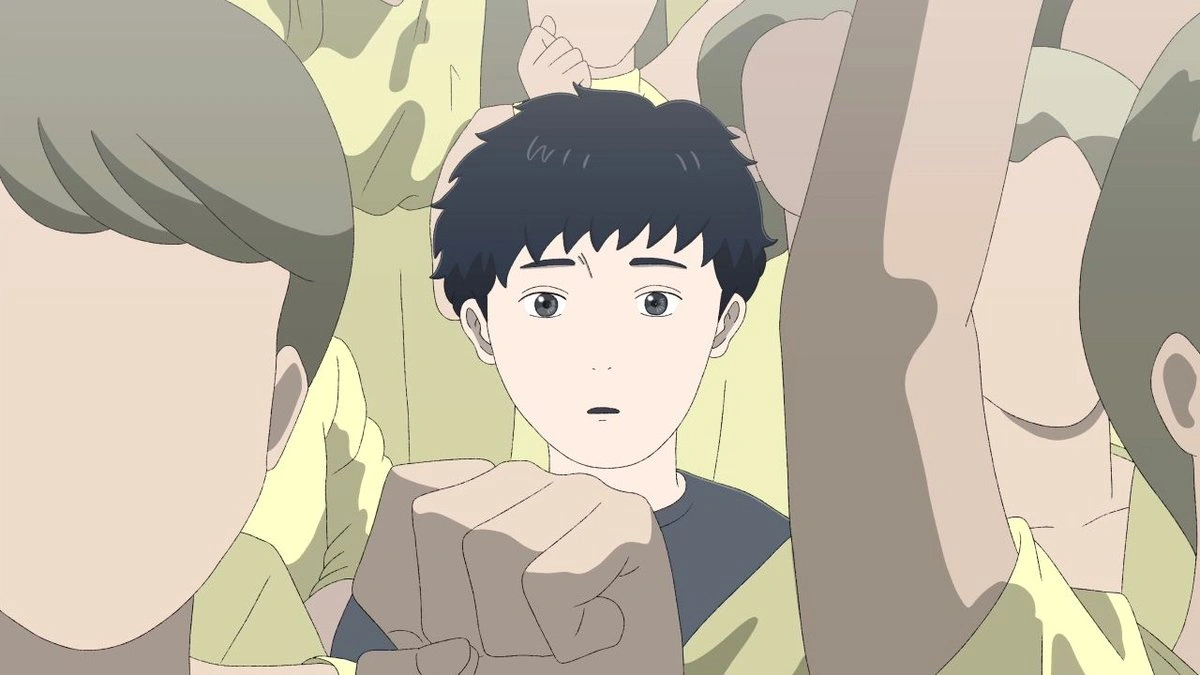
The boxed aspect ratio deepens this sense of confinement. The image sits like a memory seen through a keyhole. Rather than opening the world, the frame narrows it, forcing attention toward small gestures, blank stares, and the spaces where emotional information should be. The slow frame rate intensifies that gap. Movement seems delayed, faintly incomplete, haunted by missing frames.
As the protagonist enters the idol world, color begins to intrude: neon lights, artificial glamour, surfaces dressed up to sell joy. Suzuki treats that brightness with suspicion. It feels cosmetic, a commercial filter laid over grief. Later, in the dystopian and post-apocalyptic chapters, reds and purples stain the image with cosmic fatigue. The world grows stranger and larger, yet less knowable.
The sound design and score match that restraint. Suzuki’s music can feel mournful, skeletal, and oddly tender, especially when set against the protagonist’s silence. Pop performances carry a double charge: seduction and emptiness. Songs promise transcendence, while the machinery around them drains feeling into product. Silence becomes one of the film’s sharpest expressive tools, making the protagonist’s muteness feel less like absence than a language nobody has learned to hear.
Idol, Ruin, and the Shape of a Self
Jinsei uses pop stardom as a cultural mirror. The word “idol” matters because it suggests worship, projection, and sacrifice. The protagonist is rarely treated as an artist in any personal sense. He is a vessel for desire, national fantasy, corporate calculation, and later spiritual hunger. The public keeps inventing him, and he keeps accepting those inventions with a passivity that becomes tragic.
The film’s critique of entertainment culture is sharpest in its portrayal of the idol industry as a machine that converts vulnerability into appeal. Childhood pain becomes marketable mystique. Silence becomes charisma. Emptiness becomes a brand. Suzuki does not need to overstate the cruelty. The boardrooms, auditions, rehearsals, and managed smiles carry their own quiet violence.
Yet Jinsei reaches beyond celebrity satire. Its century-long timeline turns one man’s fractured selfhood into a map of social collapse. Wars erupt, robots enter human history, faith mutates, and apocalyptic imagery creeps into the frame. The protagonist survives through these eras like a witness who has been mistaken for a prophet. His life becomes mythic, yet the ache remains stubbornly human.
The recurring names function like masks, each one assigned by someone else. This is the film’s central wound: a person can be seen constantly and still remain unknown. Childhood trauma does not disappear through fame, prestige, or symbolic power. It simply changes rooms.
Suzuki’s fragmented structure can feel uneven, and some chapters carry greater emotional weight than others. Still, the film’s imperfections belong to its restless ambition. Jinsei feels handmade in the deepest sense: personal, severe, wounded, and searching. It asks how a life can be measured when identity is scattered across memory, performance, social expectation, and the approaching shadow of death. Its answer is elusive, but its images linger like half-remembered dreams.
Jinsei (alternatively known as Mumei no Jinsei) is an entirely hand-drawn Japanese anime drama that initially debuted in Japan last year before making its official North American theatrical premiere on June 5, 2026. Independently animated, written, and directed by newcomer Ryuya Suzuki over an intense eighteen-month period, the surrealist independent feature follows the beautiful yet sorrowful life of an unnamed protagonist who unexpectedly rises from a reluctant J-Pop idol to a futuristic deity. Along this winding personal odyssey, the narrative addresses heavy contemporary societal themes including human isolation, war, the modern entertainment landscape, and the struggles of aging populations. Following its North American acquisition by Greenwich Entertainment, moviegoers can experience this animated masterwork playing in selected arthouse and independent theaters across the United States.
Where to Watch Jinsei (2025) Online
Full Credits
Title: Jinsei
Distributor: Greenwich Entertainment
Release date: May 16, 2025 (Japan), June 5, 2026 (United States theatrical premiere)
Running time: 93 minutes
Director: Ryuya Suzuki
Writers: Ryuya Suzuki
Producers and Executive Producers: Kenji Iwaisawa
Cast: Cool Ace, Remi Chon, Eri Kamataki, Katsuya Magma, Ayumu Nakajima, Tsubaki Nekoze, Ryotaro Nishino, Miho Ohashi, Taketo Tanaka, Kanji Tsuda
Director of Photography (Cinematographer): Ryuya Suzuki
Editors: Ryuya Suzuki
Composer: Yuki Hara, Ryuya Suzuki, Taishu Tomita
The Review
Jinsei
Jinsei is a strange, wounded, visually spare animated epic that turns one unnamed man’s life into a meditation on fame, trauma, identity, and social decay. Its fragmented structure can feel uneven, with some chapters landing harder than others, yet Ryuya Suzuki’s singular vision gives the film a rare handmade intensity. The result is austere, eerie, and emotionally persistent, a century-spanning portrait of a self shaped by names, silence, and loss.
PROS
- Distinctive hand-drawn animation
- Powerful use of color and framing
- Ambitious century-spanning structure
- Strong themes of identity and fame
- Haunting score and sound design
CONS
- Uneven chapter pacing
- Protagonist can feel emotionally distant
- Later sections may feel abrupt
- Boy-band material repeats some ideas







