























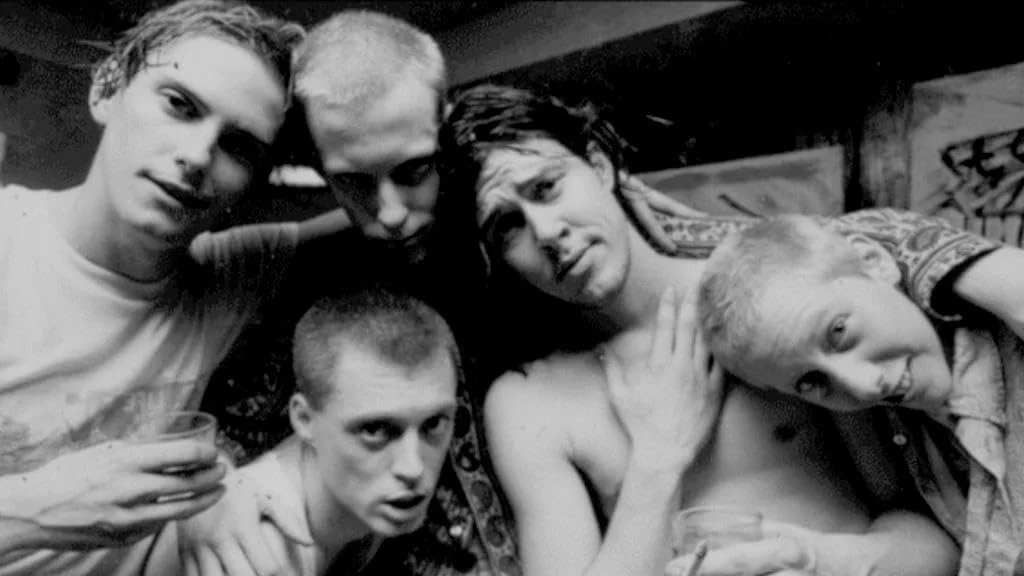

San Antonio gave Paul Leary and Gibson “Gibby” Haynes a respectable future, and they responded by building something that looked increasingly hostile to respectability. Tom Stern understands that contradiction immediately. Both men were studying business at Trinity University in the late 1970s, yet their shared interests kept drifting toward shirts, zines, visual art, and eventually music. Capitalism had prepared the paperwork. Art stole the employees.
Butthole Surfers: The Hole Truth and Nothing Butt traces that theft across 106 minutes, following the band from unstable club act to major-label anomaly. Stern’s strongest decision is to treat their history as a collision between performance and identity. Leary, reserved and dry, sits at one pole. Haynes, theatrical and volatile, occupies the other. Their friendship gives the film its structural spine because the band’s rise, damage, and eventual distance can be read through the tension between them.
The music developed the same way. Leary’s guitar and Haynes’ lyrics provided a foundation, then drummers King Coffey and Teresa Nervosa warped the rhythm by standing side by side and playing slightly out of sync. That tiny musical displacement matters. The songs seem to stagger forward instead of march cleanly. Disorder became composition.
Staging the Threat
The live footage explains why musicians still speak about Butthole Surfers with a mixture of admiration and mild disbelief. Stuffed animals are ripped apart so fans can scatter the filling through the venue. Cockroaches become confetti. Graphic experimental films flicker behind the musicians while the stage itself begins resembling some contaminated cabaret.
Richard Linklater once served as a projectionist during these shows, a detail that almost feels too neat. Stern uses it well because the projections were never decoration. They changed how the audience processed the musicians in front of them, turning a concert into simultaneous assault by sound and image.
The notorious Danceteria appearance pushes that idea furthest. Kathleen Lynch and Haynes simulate sex onstage while the performance surrounding them strips away any polite division between concert, body art, obscenity, and theater. Years later, the Lollapalooza show involving skeet shooting over the crowd applies the same philosophy on a larger scale. Ice-T recalls the spectacle because danger itself had become part of the composition.
That aesthetic carried social meaning too. Coffey and Nervosa were openly gay, the band played queer clubs, and these choices emerged from musicians shaped partly by conservative Texas. Coffey later discussing the pain of his marriage lacking legal recognition gives the old provocations a sharper edge. Some stage gestures were juvenile. Others were declarations made in rooms where declaration carried risk.
Chaos Gets Expensive
Stern charts the band’s unlikely professional ascent through episodes that sound invented. Their van breaks down near San Francisco’s Tool and Die Club, they insist on playing, Jello Biafra sees them and offers help. Years later come Capitol Records, John Paul Jones, ElectricLarryLand, and “Pepper,” the strange number-one single that turned an underground institution into something perilously close to a commercial product.

The documentary grows darker once success gives existing fractures room to expand. Haynes’ drug and alcohol use makes touring increasingly unstable, while Leary’s temper creates another point of ignition. Stern describes Haynes through people who remember warmth beside manipulation, affection beside chaos. The contradiction remains visible rather than being flattened into the familiar “tortured frontman” shorthand.
His proximity to two deaths deepens the unease. Haynes performed with Johnny Depp at the Viper Room the night River Phoenix died in 1993. He had also spent time in rehab with Kurt Cobain shortly before Cobain’s death. Stern acknowledges the psychological burden attached to those memories, yet the film moves onward before their shadows can fully settle.
The same compression affects the dispute with Touch and Go Records. Suing the label damaged the band’s standing with fans who saw Corey Rusk as a formative ally. The episode lands, then disappears into the chronology. At 106 minutes, history keeps elbowing psychology out of the frame.
The Afterimage
Stern avoids embalming the band inside the standard talking-head documentary. Interviews are interrupted by puppets, stop-motion, cut-out animation, archival photographs, performance footage, and a disclaimer promising strobing effects, nudity, puppet nudity, and regret. The formal playfulness is funny, yet it performs a serious function. A conventional visual grammar would falsify these subjects.
Flea, Dave Grohl, Eric André, John Hawkes, Richard Linklater, Dave Ween, and Ice-T help establish the band’s reach, though Stern keeps returning to the people who actually lived inside the machinery. Leary now appears settled in suburban domesticity, amused by parts of his past and distant from Haynes. Teresa Nervosa appears while suffering from severe lung disease, still remarkably upbeat before the closing credits reveal her death in 2023. Coffey speaks about marrying Craig Stewart, then losing him to dementia months after Nervosa’s death.
Haynes provides the strangest final turn. The former agent of stage chaos is now a husband and father. Stern asks about his earliest memory, and Haynes reaches back to something deeply distressing from childhood. Suddenly, years of provocation acquire another possible shape. The film does not diagnose him. It simply changes the light. That restraint suits a band whose mythology could easily swallow the human beings who created it.
Butthole Surfers: The Hole Truth and Nothing Butt premiered theatrically through Alamo Exclusives on August 28, 2026, following its initial festival run. The documentary explores the chaotic history and enduring cultural legacy of the influential American psych-punk band.
Full Credits
Title: Butthole Surfers: The Hole Truth and Nothing Butt
Distributor: Alamo Exclusives
Release date: August 28, 2026
Running time: 1 hour 46 minutes
Director: Tom Stern
Producers and Executive Producers: Noa Durban Scott Evans, Neil Fellah, Derrick Rossi, Tom Stern
Cast: Gibby Haynes, Paul Leary, Jeff Pinkus, Teresa Nervosa, King Coffey, Pat Doyle, Bill Carter
Director of Photography (Cinematographer): Alex Poppas, Jim Saah
Editors: Scott Evans, Nick Ferrell
The Review
Butthole Surfers: The Hole Truth and Nothing Butt
Tom Stern gives Butthole Surfers the documentary their history demands: unruly, funny, abrasive, and visually allergic to respectable rock biography. Puppetry, cut-out animation, archival performance footage, and grotesque stage imagery recreate the sensory disorder of the band without reducing it to spectacle. The weakness is structural. Haynes’ addiction, Leary’s estrangement, Teresa Nervosa’s illness, and King Coffey’s losses deserve longer shadows than 106 minutes permits. Still, the film understands something essential about its subjects: chaos was their aesthetic, then their livelihood, then occasionally their wound.
PROS
- Inventive mixed-media presentation
- Extraordinary archival performance footage
- Strong portrait of Haynes and Leary
- Candid treatment of personal tragedy
- Excellent sense of punk history
CONS
- Several band members remain underexplored
- Darker episodes need greater depth
- Packed chronology can feel rushed