










Djonny reaches a refugee camp after a car, a train, and a bicycle, and by then Hot Spot has already promised a detective story it has little interest in solving. Agnieszka Smoczyńska gives her investigator a ritual murder, an isolated suspect pool, a ticking deadline, and a mysterious woman who appears capable of entering other people’s minds. Robert Bolesto’s screenplay then spends much of the film loosening the bolts that hold those elements together.
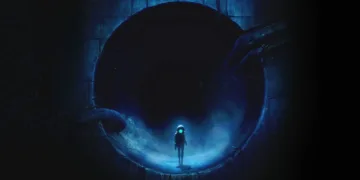
This is “nowhere in the future,” a climate-ravaged society where water and electricity have become privileges controlled by an artificial intelligence called The Head. Most survivors connect their minds to the system. The arrangement gives them telepathic communication, instant information, and basic resources. Staying connected requires swallowing a daily “jellybean,” while severe disruption can end with the user’s head exploding. The Head can also pipe public executions straight into the minds of its citizens. Convenience has developed a rather aggressive cancellation policy.
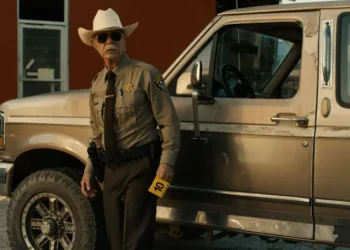
Djonny, played by Andrzej Konopka, works comfortably within this arrangement. He is a middle-aged detective with a bleach-blond perm, enormous earrings, a skin-tight black-and-white uniform, and the confidence of a man unaware that he resembles the last surviving member of a particularly doomed 1980s synth band. Europe’s “The Final Countdown” accompanies one of his early appearances, suggesting Smoczyńska may be setting up a comic hero. Konopka plays him completely straight.
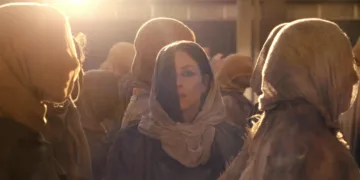
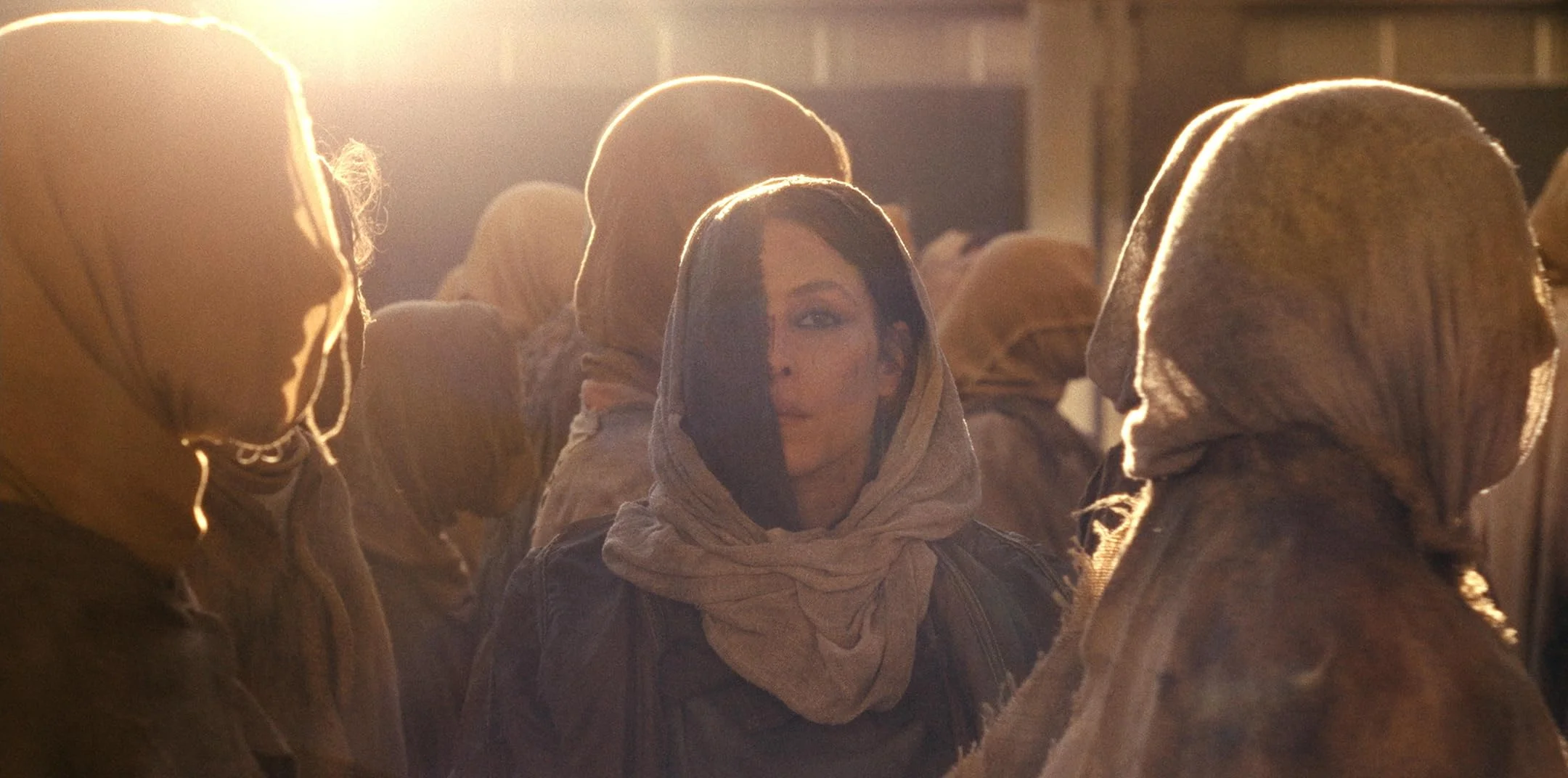
His assignment concerns a refugee murdered at a camp populated by people who reject The Head on religious and ideological grounds. They have only days before connection becomes compulsory. Djonny focuses quickly on Rana, played by Noomi Rapace, a hooded figure whose motionless stare separates her from the refugees singing and moving around her.
There is a clean movie hiding here. Djonny could investigate the killing, learn what Rana believes, discover what The Head fears about her, and gradually reconsider the system he serves. Hot Spot keeps introducing pieces of that movie, then wandering off before they lock together.
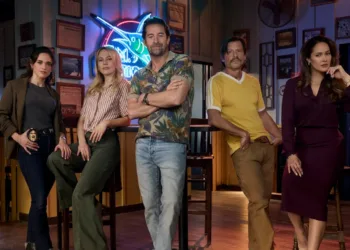
Rana appears capable of entering Djonny’s consciousness. Djonny’s wife Ayka, played by Reika Kirishima, can apparently use her singing voice to interfere with The Head. Djonny begins losing his grip on reality. At one point, his deterioration seems connected to transformation into a tiger. His partner Maria has elf-like ears that belong to no visibly established species or social group. The film offers these details with complete confidence. Explanation is another matter.
The Mystery Loses Its Spine
A murder mystery can survive withheld information. It cannot survive the feeling that information has ceased to matter. Bolesto keeps changing the dramatic question before the previous one gains enough weight. Who killed the refugee? What can Rana actually do? Why can Ayka interfere with The Head? What does Djonny’s transformation mean? How much control does the system exert over individual bodies? Each question could support a substantial section of the story. Here they accumulate faster than the film develops them.
The problem becomes especially visible around the midpoint. Djonny’s investigation should be tightening. Instead, his personal reality, the murder case, the refugees’ political situation, and the mechanics of The Head begin drifting into separate films.
One particularly abrupt stretch turns Djonny into a celebrated “witch hunter,” then shifts his attention to his son Zen, who has lost control of his movement and ended up on the edge of his school roof. The event should devastate Djonny because it brings the dangers of this system directly into his family. Yet the screenplay has provided so little clarity about bodily control, technological interference, and Rana’s reach that the scene lands first as another rule to decipher.
Ayka’s connection to Rana creates the same problem. She already has a useful dramatic function as the member of Djonny’s household who distrusts The Head. She disconnects herself, removes Zen from the network, and challenges the technological order her husband helps enforce. That conflict gives the marriage an understandable fault line.
Then Ayka begins resembling Rana, dressing like her and participating in a strange psychic doubling around Djonny. The images are striking. The storytelling underneath them becomes harder to locate.
Smoczyńska clearly prefers associative logic to procedural explanation, which worked far better in The Lure, where emotional desire could carry scenes through abrupt tonal shifts. Hot Spot gives itself a different problem. Detective stories train audiences to notice evidence. Science fiction trains them to study rules. This film invokes both traditions while refusing many of the agreements those genres make with their audiences. A dream can ignore cause and effect. A murder investigation keeps asking who did what.
The Head Has the Better Story
The frustrating part is that The Head itself contains a sharper film than the plot surrounding it. Its control works because it offers things people genuinely need. Citizens receive water, power, information, entertainment, and instant communication. The system does not rule solely through visible violence. It makes itself useful enough that leaving becomes materially dangerous.
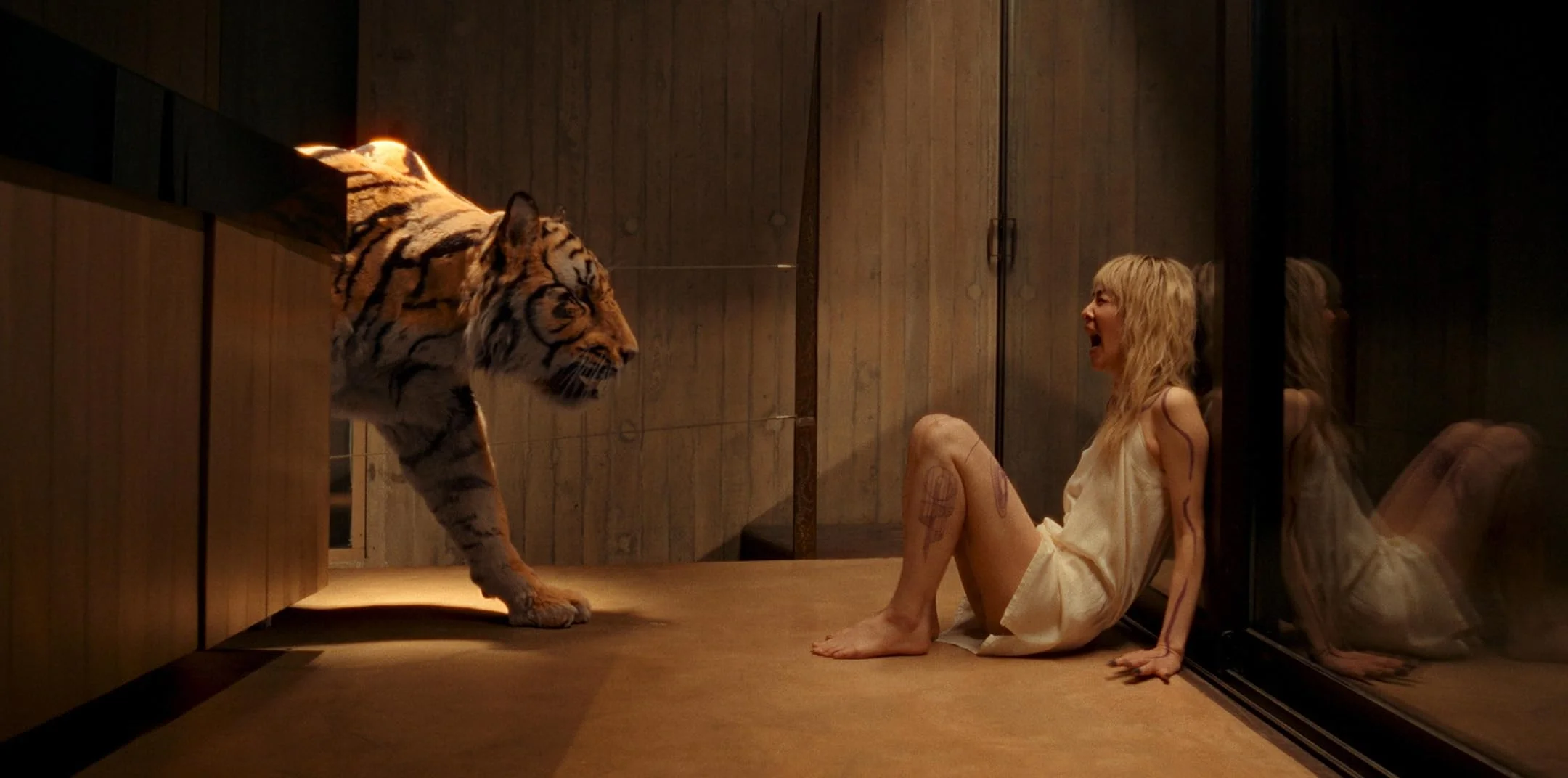
The daily jellybean is absurd, yet the absurdity has bite. A society has tied bodily survival to continued participation in a digital network. Miss the subscription and the consequences become biological. The idea is funny until someone’s skull becomes the terms-of-service agreement.
Smoczyńska gives us another disturbing detail when The Head broadcasts executions directly to connected citizens, including children. Here the film briefly makes its politics concrete. Surveillance is no longer somebody watching you. Control has colonized perception itself.
Djonny’s profession places him in a strong position within that system. His work targets people who refuse connection. His wife resists it. His son is caught between them. Rana represents a community willing to risk exclusion rather than surrender its autonomy. Those relationships could make the political structure personal.
The refugees are where the material becomes much shakier. Their robes, scarves, communal chanting, desert surroundings, religious refusal, and designation as outsiders pull from recognizable imagery associated with Muslim and Middle Eastern refugees. Yet Bolesto gives their culture little texture beyond resistance and mysticism. Rana becomes the clearest example. Rapace can hold the screen simply by staring from beneath her hood, but the screenplay treats that severity as characterization when it is really presentation. She remains an arresting figure waiting for a person to arrive.
The Future Looks Fantastic
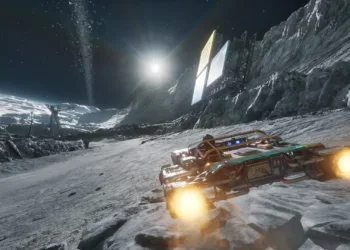
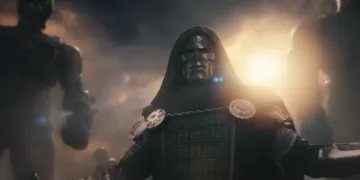
Smoczyńska is far more convincing when she stops asking the dialogue to explain anything. Jakub Kijowski photographs the landscape in bleached, dehydrated tones that make civilization seem physically exhausted. Brutalist structures sit against desert expanses, while ancient ruins and aging concrete survive beneath superficial futuristic additions. Anna Anosowicz’s production design makes this future look scavenged rather than invented. Humanity has built artificial telepathy without finding the budget to replace the old architecture.
Katarzyna Lewinska pushes the same idea into Djonny’s wardrobe. His early police outfit already seems salvaged from a lost decade. Later he moves through combinations involving a kilt, fishnets, leather, sneakers, and faux tiger fur. Individual pieces can be very funny. Their function inside Djonny’s psychological collapse remains elusive.
Konopka’s refusal to wink at any of it helps. When Djonny growls, pouts, or stalks through a scene dressed like civilization’s final thrift-store customer, the actor does not ask for a laugh. That deadpan commitment makes him visually memorable, while it also exposes how uncertain the film is about the emotional register surrounding him.
Ayka’s concert gives Smoczyńska the clearest opportunity to bring all these impulses into alignment. Red and blue light rip through the space. Bodies move under strobes. Ayka’s vocals become abrasive signals rather than conventional songs. Marcin Macuk and Zuzanna Wrońska push the electronic score into the foreground, while processed effects make the entire environment feel infected by The Head. For several minutes, explanation becomes unnecessary. The film’s broken social order makes sense through rhythm, bodies, artificial light, and noise. Then somebody starts talking again.
Communication Failure
Dialogue is a serious structural problem here because Hot Spot already asks its characters to carry unusually dense exposition. The multinational cast speaks English across a range of accents, fitting a future shaped by migration and collapsed borders. Smoczyńska also treats linguistic fragmentation as part of the film’s identity. The concept makes sense. The mix frequently works against it.
Ordinary conversations can be difficult to decipher, while telepathic communication adds processing and reverb to voices already responsible for explaining unfamiliar technology, political rules, personal histories, and supernatural possibilities. When a film withholds basic narrative information, every audible sentence becomes valuable. Hot Spot sometimes buries those sentences under its own sound design.
Kirishima fares best when Ayka does not have to explain herself. Her suspicion of The Head is legible when she disconnects Zen and when she performs onstage. Rapace achieves something similar through Rana’s stillness. Konopka supplies the physical deterioration that the script struggles to chart on the page. None of them can fully repair characters designed primarily as conduits for concepts.
That leaves Hot Spot in a peculiar place. Smoczyńska has made a film with a distinctive physical identity, several terrific audiovisual passages, and a dystopian system worth examining. Bolesto supplies so many narrative branches that the central investigation gradually disappears underneath them.
A murder case becomes a family crisis, then a cyber-religious conflict, then a body-horror episode, then a psychic identity puzzle. Somewhere inside all that machinery, Djonny is still supposed to be solving a crime. The Head connects everyone. The screenplay could have used the same service.
Hot Spot premiered in theaters on August 21, 2026, distributed by Focus Features in North America. Directed by Polish filmmaker Agnieszka Smoczyńska, the dystopian sci-fi thriller follows a weary private investigator looking into a murder in a refugee camp ruled by a sentient artificial intelligence, where he discovers a underground rebellion capable of threatening the digital ruler.
Where to Watch Hot Spot (2026) Online





Full Credits
Title: Hot Spot
Distributor: Focus Features, Madants, So Films
Release date: August 21, 2026
Rating: R
Running time: 1 hour 40 minutes
Director: Agnieszka Smoczyńska
Writers: Robert Bolesto
Producers and Executive Producers: Bogna Szewczyk-Skupień, Klaudia Śmieja-Rostworowska, Gregory Jankilevitsch, Marcin Czernik, Beata Rzeźniczek
Cast: Andrzej Konopka, Noomi Rapace, Reika Kirishima, George Aurimas Cris, Filippa Koutoupa, Ektor Liatsos, Filippa Kaye, Maria Maj
Director of Photography (Cinematographer): Jakub Kijowski
Editors: Beata Liszewska
Composer: Marcin Macuk, Zuzanna Wrońska
The Review
Hot Spot
Hot Spot has enough ideas for several dystopian thrillers and the structural discipline of none of them. Agnieszka Smoczyńska’s strongest passages arrive when Jakub Kijowski’s dehydrated imagery, Ayka’s techno-punk performance, and the electronic soundscape take control. The murder investigation fares worse, buried beneath unexplained psychic links, shifting rules, and Djonny’s increasingly surreal condition. Andrzej Konopka and Noomi Rapace commit to the strangeness, yet their characters rarely gain the clarity the spectacle denies them. Fascinating pieces keep accumulating. Assembly was apparently optional.
PROS
- Striking retro-futurist production design
- Aggressive electronic soundscape
- Memorable concert sequence
- Konopka’s committed deadpan performance
- Ambitious ideas about technological dependence
CONS
- Murder mystery lacks a stable structure
- World rules remain frustratingly vague
- Dialogue is frequently difficult to follow
- Rana receives little character development
- Surreal turns overwhelm narrative coherence