
























![Kingdom Hearts Collection [I-III] Review](https://gazettely.com/wp-content/uploads/2026/10/Kingdom-Hearts-Collection-I-III-1-360x180.webp "Kingdom Hearts Collection [I-III] Review: KHII Holds Steady as Newer Entries Fluctuate 37")



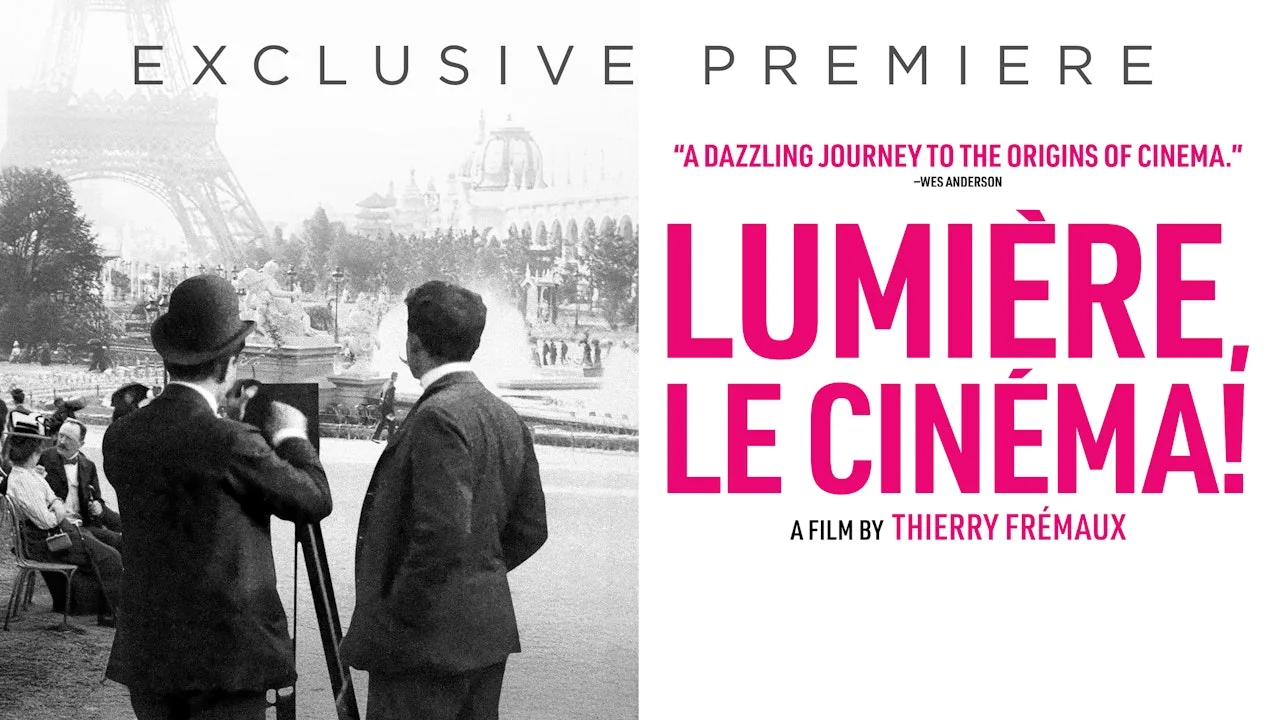

Imagine seeing a train move before you had learned that an image could move at all. The Arrival of a Train at La Ciotat has spent so long inside film history that its radical strangeness can be difficult to recover, yet Thierry Frémaux’s Lumière, Le Cinéma! manages, at moments, to give it back. The locomotive enters diagonally, growing within the frame, its mass acquiring an almost physical presence. Nothing happens that would trouble a modern camera. In 1896, everything was happening.
Frémaux returns to Auguste and Louis Lumière after his 2016 documentary Lumière!, assembling roughly 100 restored shorts from the brothers and their collaborators. Most last around 50 seconds. Together they form a record of cinema discovering its own senses, frame by frame, before anyone could know what those senses might become.
The famous train matters, but another railway image feels stranger. A camera rides near a locomotive as it enters a tunnel, the darkness closing around the view until the opening ahead becomes a natural iris. A perspective that now resembles millions of dashboard videos once represented a way of seeing unavailable to the human body. Cinema had learned that it could place an eye where a person could not stand.
Ordinary Lives, Fixed in Light
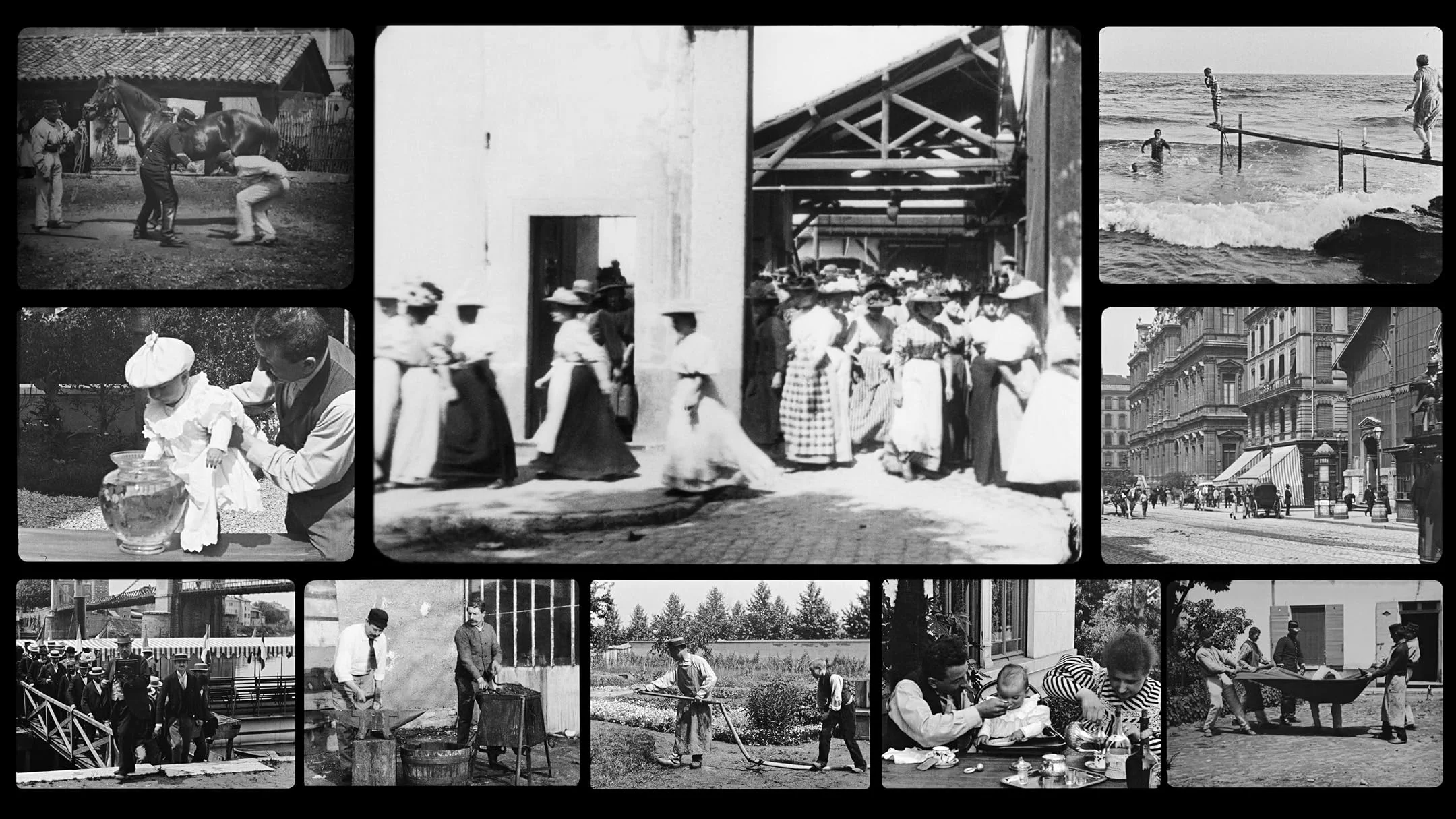
The Lumières repeatedly pointed their camera toward things that barely qualified as events: workers leaving a factory, pedestrians crossing streets, relatives climbing into a rowboat. Time has transformed those modest gestures into something almost unbearable.
Frémaux presents several versions of Workers Leaving the Lumière Factory, filmed from the same position with different groups passing through the gate. Comparing them weakens the comfortable myth of one spontaneous foundational image. People alter their behavior around the cinematograph. Some glance toward it. Others appear to perform for it or deliberately ignore it. Documentary and staging were already touching each other before either had acquired a vocabulary.
The same tension appears in the domestic footage. A family boarding a boat has no grand historical significance, yet the faces belong to people who lived entire lives beyond the borders of this tiny surviving fragment. Their afternoon persists while nearly everything surrounding it has disappeared.
Two Paris street scenes produce a similar disturbance. The Eiffel Tower dominates the background while pedestrians continue beneath it, small and occupied with whatever mattered that day. The camera does nothing flashy. Its placement is enough. Monumental steel and temporary human bodies share the same rectangle.
This is where the Lumière films become quietly existential. The cinematograph preserved movement, but movement immediately revealed disappearance. Every person crossing these frames is alive here and dead elsewhere. Their immortality lasts roughly 50 seconds at a time.
A Guide Who Sometimes Speaks Too Much
Frémaux understands these images intimately, and his narration is strongest when it teaches the eye where to look. He draws attention to smoke changing the texture of a frame, workers arranged across different planes, bodies entering and leaving compositions, and background details that reveal how carefully some supposedly simple actualities were constructed.
His affection can become suffocating. There are moments when the narration insists upon beauty or historical importance that the restoration has already made obvious. One begins to wish he would fall silent for another ten seconds and permit a face, train, street, or drifting cloud of smoke to carry the argument.
The structure also proves less adventurous than Frémaux’s earlier Lumière!. The first half moves through early cinema with something close to chronological order before loosening into a wider tour of the catalogue. Familiar films and repeated observations create stretches where discovery turns into accumulation.
Gabriel Fauré’s music helps soften that repetition. Rather than imposing modern drama upon the footage, the score gives the shorts a melancholy continuity, leaving enough space for the images to retain their odd silence. Across 104 minutes, the procession can still become tiring. Fifty seconds is brief. A hundred variations of fifty seconds ask for a different kind of patience.
The Distance Between Then and Now
The restorations collapse that distance in unexpected ways. Clothing, machinery, architecture, smoke, expressions, and tiny movements emerge with enough clarity that the nineteenth century occasionally stops looking antique. Poor prints teach us to mistake deterioration for age. Here, cleaned images allow these people to move without a century of scratches standing between their bodies and ours.
That clarity makes the smallest footage feel enormous. A street becomes evidence that these buildings stood this way. A worker turning toward the lens becomes evidence that somebody noticed the camera. A child near a boat becomes evidence that an afternoon happened and, against every ordinary law of memory, remains visible.
Frémaux playfully finds future genres scattered everywhere: travel films, slapstick, spectacle, documentary observation, home movies, staged violence, even an ancestral form of the animal clip. Such claims occasionally flirt with worship, yet the footage keeps supplying examples. Cinema seems to contain its future before it understands its present.
The mid-credits appearance of Francis Ford Coppola recreating the factory film with a hand-cranked camera makes that continuity literal. A filmmaker shaped by a century of cinematic language returns to the primitive mechanical gesture from which so much of that language grew: turn the crank, expose the film, watch someone walk through the frame. For a few seconds, the past moves again. It always does. That may be cinema’s oldest miracle, and its cruelest one.
Lumière, Le Cinéma! premiered in the United States on May 1, 2026, via Janus Films and is available for streaming on platforms like the Criterion Channel. This documentary presents another carefully curated selection of rare, newly restored archival shorts by Auguste and Louis Lumière, celebrating the foundational dawn of motion pictures.
Where to Watch Lumière, Le Cinéma! (2024) Online
Full Credits
Title: Lumière, Le Cinéma!
Distributor: Janus Films
Release date: May 1, 2026
Running time: 1 hour 44 minutes
Director: Thierry Frémaux
Writers: Thierry Frémaux
Producers and Executive Producers: Maelle Arnaud
Cast: Thierry Frémaux, Francis Ford Coppola, Chocolat, Tommy Footit
Director of Photography (Cinematographer): Auguste Lumière, Louis Lumière
Editors: Jonathan Cayssials, Thierry Frémaux, Simon Gemelli
The Review
Lumière, Le Cinéma! Review
Lumière, Le Cinéma! finds its deepest power in faces, streets, trains, smoke, and gestures preserved from a world that had barely learned how to see itself moving. Thierry Frémaux sometimes speaks with such devotion that the images seem burdened by explanation, and the procession of shorts can grow tiring. Yet the restored footage keeps breaking through, carrying the quiet shock of lives made visible across 130 years. Cinema here feels less like an invention than a form of memory learning to survive death.
PROS
- Extraordinary restored Lumière footage
- Remarkably expressive early compositions
- Powerful sense of historical immediacy
- Fauré’s music complements the images
- Everyday life becomes hauntingly permanent
CONS
- Frémaux can become overly reverential
- Repetition weakens the 104-minute structure
- Some commentary explains too much
- Less analytically fresh than Lumière!







